Muslim World: Iran’s Execution Binge

22/01/2011

In the early morning hours of Saturday, January 15 in the isolated and overcrowded Orumiyeh prison in western Iran [Iranian Kurdistan], the authorities hanged one of their opponents.

Hossein Khazri, an alleged activist with the Party for Free Life of Kurdistan (PJAK), was 29. He had been in custody since early 2009. His crime, of which he was convicted on July 11, 2009, was that of being an “enemy of God” in the eyes of the Islamic Republic.

Khazri’s specific activities against the deity worshiped by the rulers of Iran appear to have consisted of political agitation for democracy and federalism in the country of his birth.

In the course of his incarceration, in prisons administered by the Iranian Revolutionary guards Corps and the Intelligence Ministry, Khazri had been severely tortured, according to human rights organizations.

His hanging was the latest in a wave of executions of Kurdish activists and other opponents of the regime carried out in recent weeks. Fourteen other Kurdish activists are currently on death row, condemned for their political activities.

The International Campaign for Human Rights in Iran this week described the authorities as on an “execution binge,” orchestrated by the intelligence and security agencies.

The hanging of Khazri brings the number of people executed by Iran since the beginning of the year to 47.

A spokesman for ICHRI said that the “execution of Kurdish activists, without fair trials and following torture, increasingly appears as a systematic, politically motivated process.” The roundups and executions of Kurdish activists are part of an ongoing, brutal and little-reported war waged by the Revolutionary Guards against a separatist insurgency in the predominantly Kurdish areas of western Iran. Urumiya jail, which was built to house 150, is currently teeming with 300 inmates, as a result of recent crackdowns on independent political activity.

PJAK HAS been fighting the Iranian authorities since 2004. It defines its fight not in ethnic nationalist terms.

Rather, it claims to be fighting for “federalism and secular democracy” in Iran.

Based in the Qandil mountain range on the Iraqi border, the movement engages in periodic raids into Iran. Since February 2009, it has been designated a terrorist organization by the US. PJAK is an offshoot of the Turkish-Kurdish PKK, and belongs to the same umbrella organization.

It lacks the deep roots among the Kurds of Iran which the PKK possesses among the Turkish Kurds, however.

Unverified media reports have suggested that despite the terrorist designation, the group has received US support, as part of a larger effort to foment unrest and instability in Iran. There have also been rumors of Israeli contacts with the organization. These supposed Western links feature prominently in the propaganda of the Iranian authorities against PJAK.

But whatever the particular provenance of PJAK, it is clear that the people in whose name it wishes to speak, the Kurds of Iran, currently endure something much less than a free life. The movement’s potential for growth is thus considerable.

The repression of it by the regime is correspondingly harsh.

THE IRANIAN system is dominated by ethnic Persians, but the Islamic Republic does not define itself officially according to ethnic identity. Rather, it rules in the name of religion. As such, the regime constitutionally recognizes the Kurdish language. In practice, however, discrimination against Kurds and other minority ethnic and religious communities is widespread and of long standing.

Around 5 million Kurds live in Iran, concentrated in the provinces of West Azerbaijan, Ilam and Kurdistan. Separatist sentiment is particularly strong among Sunni Muslim Kurds,who constitute just over half the total. In the earliest days of the regime, Ayatollah Ruhollah Khomeini declared a jihad against Kurdish separatism, and 10,000 Kurds were killed as the Revolutionary Guards fought to establish regime control in these areas.

After the unrest following the rigged presidential elections of July 2009, the Islamist authorities’ repression in Kurdish areas of the country has once more sharply increased. Last May, the authorities began a crackdown as the anniversary of the elections approached. Four Kurdish activists, one a woman, were convicted of membership in PJAK and executed following severe torture.

None was given access to lawyers. PJAK denied any links with the four. All were convicted, like Hossein Khazri [Hussein Xizri], of the crime of war against God.

The incidents led to widespread demonstrations and further bloody suppression.

And this is where things remain. The period since the successful repression of the countrywide dissent that followed the elections of July 2009 has seen the consolidation of an Islamist counter reaction within the regime.

The power of the intelligence and security apparatuses has grown. This is reflecting itself in the brutal repression of dissent taking place in the Kurdish speaking areas along the border with Iraq. Khazri was the latest victim of this repression. He was almost certainly not the last.

Posted in Uncategorized | Tagged , , , , , , | Leave a comment

The Rise and Rise of Hizb ut-Tahrir

The Guardian- 09/10/2007

Sitting in the best bar in Jerusalem about four months ago (it’s called Sira, in case you’re interested), I entered into conversation with a tall, ginger-haired young man who turned out to be a member of the Swedish contingent in the Temporary International Presence in Hebron (TIPH). Our conversation ranged over the trials and tribulations of the life of a member of TIPH, the very large amounts of money he seemed to be making, and the merits of Jerusalem when compared with other cities in the region.

An offhand remark he made concerning the political balance of power in Hebron turned the conversation from mildly interesting to memorable. I asked him if Hamas was gaining ground in the city of Hebron. He replied wearily that the fastest-growing political force in the city was not Hamas, nor any of the other well-known Palestinian political movements. Rather, the most notable and noticeable development on the ground in Hebron was the sudden and rapid rise in support for the Islamist party Hizb ut-Tahrir.

Subsequent months have attested to the truth of my Swedish friend’s unexpected claim. Hizb ut-Tahrir (the “party of liberation”) is indeed growing in strength and visibility in the West Bank, especially in the areas of Jerusalem and Hebron. So what does the Hizb’s emergence as a political factor mean, and what implications may it have (if any) for the future direction of events between Israelis and Palestinians?Hizb ut-Tahrir was founded in Jordanian-ruled Jerusalem in 1952 by a sharia court judge, Taqiuddin al-Nabhani. The party inscribes on its banner the goal of the restoration of the caliphate – the Islamic government established after the death of Muhammad in 632, and abolished by Kemal Ataturk in 1924.

The party wants the imposition of sharia law – eventually worldwide – and is in favour of the destruction of Israel. However, it sees this as the job of the conventional forces of the restored Islamic caliphate. The party has thus not employed the methods of terror attacks against Israelis, as favored by other, more prominent Palestinian Islamist currents, such as Hamas and Islamic jihad.

Hizb ut-Tahrir has grown from its beginnings in Jordanian Jerusalem into an international force, with branches in 45 countries in the world. It has achieved particular notoriety in central and southeast Asian countries, in particular in Uzbekistan and Indonesia. It has also come to prominence in western European countries – particularly in Britain, where a branch was established in 1986. A number of the best-known British participants in Islamist terrorism attended meetings of the group or one of its offshoots at certain stages of their trajectories. These include Omar Khan Sharif, who tried to bomb the Mikes Place bar in Tel Aviv in 2003, and the “shoe bomber”, Richard Reid.

In the Arabic-speaking world, Hizb ut-Tahrir was long regarded as an obscure, eccentric current. Some analysts saw its failure to place the Palestinian issue at the centre of its concerns as contributing to its marginality. This is now changing. In the West Bank in the last months, Hizb ut-Tahrir has held a series of successful events, which mark its entry onto the stage as a significant player in Palestinian politics. In early August, the party organised a number of mass rallies in the West Bank, including a gathering of 10,000 people in the town of Al-Bireh, and similar-sized rallies in Hebron and Ramallah. These took place under the slogan “The caliphate is the rising force”, and coincided with similar gatherings held by branches around the world. The rallies followed a year of frenetic activity and growing prominence for the movement in the West Bank, which saw activists, for example, protesting against the establishment of a new mission school in Hebron in May, 2007 and organising demonstrations in protest at the Danish cartoons of Mohammed in October, 2006.

What does the rise of Hizb ut-Tahrir among Palestinians imply? First, it indicates that the assumption over the last two decades that Palestinian politics was essentially a two-horse race between nationalist Fatah and Muslim Brotherhood/Hamas may be beginning to fray at the seams.

More profoundly, the emergence of the movement raises a question over the optimistic scenario recently raised in some quarters, according to which once Islamist movements such as Hamas are tested in office and fail, previous, predominantly secular patterns of politics will re-emerge.

It may well be that a deep, and profoundly significant “Islamisation” of the politics of the Arab world is taking place, the implications of which are only beginning to be glimpsed. Looking around the region, the wall-to-wall dominance of Islamist groups in opposition politics appears to attest to such a process. Hizb ut-Tahrir itself may well end up being only one of many symptoms of this broader trend, all trying to ride the wave. Such a shift, if it takes place, would have severe implications for hopes of a consensual peace between Israelis and Palestinians, and for wider regional stability. A Fatah official I spoke with recently told me that in his view Abu Mazen was “the last Palestinian,” whose failure would mean the emergence to prominence of a new brand of chaotic, rejectionist politics among the Palestinians.

So had my Swedish friend – enjoying his weekend off in a west Jerusalem bar – revealed a dot on the horizon, indicating the approach of something new? It’s too soon to tell, of course. But interested parties among both Israelis and Palestinians will no doubt be keeping a close eye on the activities of Hizb ut-Tahrir in the West Bank in the period to come.

Posted in Uncategorized | Tagged , , , , | Leave a comment

More United, Less Passionate

The Guardian- 25/03/2006

Three days now remain until the elections in Israel. The election campaign has been the most sedate in living memory. One may walk the main streets of the three main cities, and hardly be disturbed by activists, posters, leaflets. I remember my first visits to Israel, and the election campaigns of 1984 and 1988. As a London Jewish teenager, I was thrilled by the impassioned debates, the raucous crowds gathered round two rival activists locked in verbal combat, each using a fine range of theatrical rhetorical skills to the utmost. The rival activists at Zion Square and outside the Hamashbir department store in Jerusalem. Endless disputation. Historical analogies, Bar-Kochba, the events of the 20th century, the destruction of the Temple, all freely invoked and brandished. This, I thought, was what a democratic Jewish state ought to look like.

This has all changed now. It is a change of great significance, open to interpretation in a variety of ways. First the facts. Israeli society is a fragmented, sectoral, disenchanted sort of place compared with the fervor of yesteryear. Yet it is also more united than ever before – on the basic issues that have dominated discussion for the last 40 years. This sounds like a contradiction, but isn’t. Allow me to explain. Since the mid-70s, Israeli politics has been dominated by the Labour-Likud divide, with the two big parties, and their argument over policy on the Arab-Israeli dispute defining the political life of the country.

These two parties wore the colours of old, pre-state Zionist factions. On occasion, lip service would be paid to arcane ideological loyalties. Likud derived its support from the country’s poorer Jews, originating in North Africa and Asia and fiercely committed to a nationalist, traditionalist outlook. The party, until recent years, was neither more nor less committed to free market economics than Labour. Labour, meanwhile, was the party of the liberal Israeli middle classes. The split between the parties, as between the pre-state Labour and Revisionist movements from which they emerged, was over high national issues, the one more inclined to suspect the Arabs and cleave to ancestral territories, the other more inclined to compromise.

The structural Labour-Likud divide continued to dominate Israeli politics throughout the ’90s and beyond. But in that period, it became essentially bled of meaning. The experiences of the Intifada, Oslo, the breakdown of Oslo and the subsequent five year conflict with the Palestinians mixed up the old definitions, damaging the basic edicts of the faiths of hawk and dove alike. For many hawks, the Palestinian uprisings called into question the easy assumption that Israel could simply rule over the West Bank and Gaza indefinitely. The growing Palestinian populations of that area made these new concerns ever more urgent. For the doves of Labour, meanwhile, the collapse of the Oslo process, and the rejection by the Palestinian side of the Clinton proposals of December 2000 called into question their easy assumption that sufficient Israeli forthcomingness could quickly wrap up the issue under dispute. The result has been the slow emergence of a new consensus at the center of Israeli politics, which sees no Palestinian partner with whom to deal, and at the same time considers that maintenance of the status quo is not to Israel’s advantage. The Gaza Disengagement, and the likelihood of further withdrawals on the West Bank is the policy fruit of this new alignment. The split in the Likud, and the emergence of the Kadima Party to its astonishing, dominant position on the map is the political result.

So we have a new party that stands for no-partner and unilateralism. This party looks set to win the elections (36 seats, according to current polls) But there is more to it than that. The old parties – Labour and Likud – were based on historic movements, which at their height commanded a fierce partisan loyalty from their supporters. To be a ‘Likudnik,’ or an ‘Alignment (Labour) man’ in Israel was to take on a whole historic narrative and set of loyalties. These old tribal ideological blocs have departed the stage. Many people will turn out to vote for Kadima on March 28th. But the loyalty to Kadima is based on a resigned acceptance of unpleasant facts, combined with a very pervasive feeling of cynicism toward the political class in general. Ehud Olmert and his colleagues are accepted as being perhaps the best team for the job. But the idea that they carry with them the aura of moral authority that a Ben-Gurion, a Begin, or even a Shamir or a Rabin in their time could claim would be met in today’s Israel with a snort of derision. Turnout in the election is expected to be low.

How might one interpret this turn of events in Israeli politics? Well, there is the apocalyptic view held by various left and right-wing Israeli ideologues, along with Hizballah Chairman Nasrallah, Khaled Maashal of Hamas (and for all I know also their European sympathizers) according to which this sense of disillusion signals the advancing decrepitude of Israel, presaging its imminent collapse. I do not share this reading. It seems to me that the growing unwillingness of Israelis to look for identity and moral belonging in politics – the shallowing of political allegiance, the skepticism toward political leaders and so on – places our society in a parallel process to that of other western democracies. In the Israeli case, it is a sort of maturing – not in the idealized coming-of-age sense of that word, but more in the sense of a tempering of hopes, fervor and dreams, an awareness of the smaller amounts that can be achieved, and a consequent narrowing of the place of political involvement, debate and discussion in everyday life.

It has its dangers – an increasingly disengaged public might lead to a despairing acceptance of mediocrity and worse in the political class. But it also represents the possible emergence of a measured, sober pragmatism into a system which has been largely characterized for the last decades by a distinct lack of that ingredient, along with an urgent need for it. I miss the impassioned crowds at Zion Square – nowadays, one assumes that the few kids quietly offering leaflets for Kadima in city centers are being paid to do so. But then I also miss my adolescence, and I nevertheless have no desire to return to it.

Posted in Uncategorized | Tagged , , , , , | Leave a comment

Along with the Boycott, Some Good News

Haaretz- 09/06/2006

The decision by NATFHE, the British college lecturers union, to initiate a blacklist with respect to their Israeli colleagues has been met with shock in Israel. It has rapidly become clear that the instigators of the boycott belong to that school of thought in Europe that regards the very existence of the Jewish state as an affront and an injustice. The re-emergence of the boycott initiative in the U.K. was followed closely by a decision by the Canadian Union of Public Employees (CUPE) in Ontario to declare its own boycott of the Jewish state. Again, the motion that was passed included provisions – such as support for the right of return of 1948 refugees and their descendants to within Israel’s borders – which are a coded demand for Israel’s demise.

These two victories for the boycotters might be seen as evidence that Israel is losing the ideas war in significant parts of the Western world, with the demand for Israel’s demise moving steadily closer to the political mainstream. Closer observation of political trends, however, indicates a more complex picture. Those who seek Israel’s destruction are indeed closer to the mainstream than ever before, but those who argue for a wholehearted identification with Israel are also increasing in numbers and influence in the political mainstream. The latest developments are a factor in a more general, growing polarization.

Let’s take a look at what’s being said, and by whom. Taking the British example, it is worth examining for a moment the background to the boycott vote in the NATFHE lecturers union. The same NATFHE conference that supported the blacklist resolution also sent a vote of congratulations to the Respect party for its recent performance in Britain’s local elections. Respect is a small and strange alliance of British Trotskyites and Islamists that has emerged in recent years. The blacklist vote, it appears, was the brainchild of activists of this organization.

What may be learned from this is that the desire for the delegitimization of Israel is not a free-floating, generally-held notion in British political debate. Rather, it is embedded in a more general set of ideas currently on the rise, but far from dominant in Britain and other Western European countries.

This set of ideas includes a generalized loathing of the U.S., fervent opposition to the Iraq War and a belief that radical Islam is analogous to anti-colonial liberation movements in being an inevitable, understandable response to oppression. One may encounter this belief system in its pure form in organizations such as Respect. It is visible in a more diluted version in the editorial pages of a number of Britain’s quality daily newspapers, and among backbench MPs of the Labour and Liberal Democratic parties.

Outright rejection of Israel’s right to exist as a Jewish state is one of the articles of faith of this belief system in its undiluted form. In the milder version, a view of Israel as analogous to now-defunct outposts of settlement left behind by receding European colonialism – such as Rhodesia and apartheid South Africa – is the preferred stance. Many of the ideas and prejudices held in these circles about Israel have been absorbed undigested from the norms of political debate in the Arabic-speaking world, via the alliance with Islamism.

On the opposite side, as the debate grows in harshness, one may discern an increasing willingness to openly identify Israel as a valued ally. This is a cross-party phenomenon, though it is mainly to be found on the center-right in European politics.

To continue with the British example, the new leadership of the U.K.’s Conservative Party combine an outspoken Atlanticism with an overt commitment to confronting the threat of radical Islam. In a speech given last year, William Hague, who will be the U.K.’s foreign secretary should the Conservatives win the next elections in Britain, told his audience that “the parallels with the rise of Nazism go further … If only, some argue, we withdrew from Iraq, or Israel made massive concessions, then we would assuage jihadist anger. That argument … is as limited as the belief in the 1930s that, by allowing Germany to re militarize the Rhineland or take over the Sudetenland, we would satisfy Nazi ambitions.” In less strident words, senior Labour figures have expressed a similar linkage.

Of course, speeches given by politicians seeking office should be treated with caution. But the underlying idea here is a striking one. It holds that in the central foreign policy challenge of this generation, Israel is a natural, valued friend, its victory the victory of the wider Western world.

In order to understand the passions raised in Europe by the Israel-Palestinian conflict, it is thus crucial to grasp that our dispute is no longer merely another item on the long list of foreign issues that occasionally trouble European political discussion. Rather, it has become to all intents and purposes part of the domestic debate. In the shrill, discordant attempt to single out the Jewish state as a uniquely nefarious presence in world affairs, whose rightful fate is dissolution – one sees into the heart of that alliance of far left and radical Islam that seeks appeasement and accommodation in the face of the Islamist challenge. And in the responses to the demonization of Israel may be glimpsed those forces coalescing to confront this challenge.

Posted in Uncategorized | Tagged , , , , , , | Leave a comment

Iranian Quickstep: 1 Step Forward, 2 Steps Back

15/02/2010

Latest Ahmadinejad statement suggests that Teheran still believes it can find a few partners for the dance it has been performing since 2003.

Iranian President Mahmoud Ahmadinejad this week told Iranian state television that “we have no problem sending our enriched uranium abroad.”

In so doing, Ahmadinejad appeared to agree to the long-standing plan for the export of the greater part of Iran’s enriched uranium stocks.

Recent experience with the diplomatic methods of the Islamic Republic of Iran suggests that this statement is the latest instance of Teheran’s favored approach to diplomacy. The Iranian tendency is to seek to offset confrontation at the 11th hour by appearing to show flexibility. Once crisis is averted, the regime relies on differences over the details to make sure that nothing actually happens. It is the diplomacy of one step forward, two steps back. Thus is further time bought for the Iranian nuclear program.

The hitherto seemingly inexhaustible international patience at Iranian maneuvering, meanwhile, has recently been showing signs of at last wearing thin. British Prime Minister Gordon Brown is the latest convert to the cause of renewed sanctions. Brown said on Tuesday that “What we now, I think, have to do is accept that if Iran will not make some indication that it will take action – we have got to proceed with sanctions.”

It remains to be seen if the latest Iranian move will revive the spirits of the advocates of “engagement.” Ahmadinejad’s statement relates to the IAEA proposal that Iran should ship its low-enriched uranium abroad, where it would be converted into fuel rods for an Iranian research reactor producing medical isotopes.

The purpose of the IAEA proposal was to call Iran’s bluff. Iran has long claimed that its nuclear program is for purely peaceful purposes. Very well, then, said the IAEA – let other countries take charge of converting Iranian low-grade uranium into material fit only for domestic use. Of course, this proposal depends on the assumption that the Iranians have been entirely honest in revealing all their supplies of enriched uranium. If they have not, and if a substantial amount remains outside of the purview of international observers, then the exercise becomes meaningless. Still, let us assume in this regard that the Islamic Republic of Iran’s well-known tendency toward honesty and transparency has prevailed, and that as such the proposal to export a large percentage of Iran’s known supplies of low enriched uranium is not entirely devoid of content.

In considering the seriousness or otherwise of Ahmadinejad’s statement, it is worth looking back to October last year, when the export proposal was first tabled. The apparent Iranian flexibility at that time came two weeks after the revelation of a secret uranium enrichment plant in the town of Qom on September 21. At the time, there was international excitement as Iranian representatives in Geneva agreed “in principle” with the proposal for the export of uranium. It was agreed that the details would be worked out at a subsequent meeting in Vienna.

That was on October 2. At the meeting in Vienna on October 19, the proposal was further clarified. A draft proposal was formulated. At the end of that month, Iran began to retreat from its apparent acceptance of the proposal. On November 18, Iranian Foreign Minister Manouchehr Mottaki unambiguously rejected it in the following terms: “Definitely, Iran will not send its 3.5 percent-enriched fuel out.”

The tentative December “deadline” came and went. On January 20, Iran confirmed that it rejected the export proposal as formulated in Vienna.

In other words, a skeptic might conclude, the international anger resulting from the Qom revelation made a bit of momentary cooperation from Iran advisable. Once the moment had passed, normal service could be resumed. The Iranian parliament and Guardian Council a week ago approved an Ahmadinejad endorsed bill to cut food and energy subsidies. The move, while significantly reducing government spending, stands to sharply increase prices and possibly lead to rising inflation. Political unrest is ongoing in Iran, and the regime is reported to be unnerved by the failure of its initial attempts at repression to douse the flame.

At such a moment, the last thing the regime needs is renewed sanctions. It is therefore an opportune moment for the reappearance of the reasonable Teheran of last October – to kick the ball down the road again for another few months.

Will the “international community” play ball? There are currently indications of a hardening US stance. A bill to target Iranian fuel imports is working its way through Congress. New sanctions may be discussed at the Security Council later this month. In the absence of renewed UNSC sanctions, the administration may set about trying to build a “coalition of the willing” for further moves against Iran.

But it is deeply questionable if any of this will prove sufficient to stop the Iranian nuclear drive.

In the meantime, the latest statement by the Iranian president suggests that Teheran still believes it can find a few partners for the dance it has been performing since 2003: one step forward, two steps back – all the way to a nuclear Iran.

Posted in Uncategorized | Tagged , , , , , | Leave a comment

Fire from the Mountain

23/10/2010

In the badlands between the borders of Iraq, Turkey and Iran, a small band of Kurdish separatists continue to wage their war.

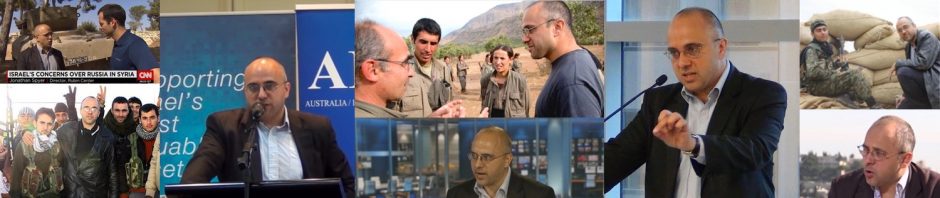
Our PKK contact and driver arrived at the appointed time outside the hotel in Erbil. We had been told he would identify himself using an agreed term. We hadn’t quite been ready for the fact that this single word would be the sole communication possible between us. The diminutive, scrawny youth who turned up at six that morning knew neither English nor Arabic.

Only Kurdish. That was how we began our journey from the Iraqi Kurdish capital toward the Qandil mountains, in the remote border area between Iraq, Turkey and Iran.

It is in these mountains that the guerrillas of the Parti Karkeren Kurdistan (PKK) live and wage their 26-year-old war against Turkey.

They offer ideal terrain for guerrilla fighters. Accessible only through a network of narrow, near impenetrable passes, the mountains serve as a launching ground for the PKK and the allied Iranian Kurdish PEJAK into their respective areas of operation.

The writ of the Iraqi Kurdish regional government has little purchase in the Qandil area. The PKK is the de facto ruling authority.

Our contact from the Kurdish regional government in Erbil cheerfully wished us luck on the eve of our departure – and told us not to bother calling him if we got into trouble. There was, he said with a broad smile, “absolutely nothing he could do” in such a situation.

The PKK is waging a struggle in these mountains for autonomy and recognition for the Turkish Kurds. The Qandil area has become a little known but crucial window into the complex strategic arrangements that dominate today’s Middle East.

FOUNDED IN 1978, the PKK began its armed campaign against the Turkish authorities in 1984. The Turkish military responded with ferocity. In the 1984-99 period, around 30,000 people lost their lives in the conflict. The Turks destroyed more than 3,000 Kurdish villages. The capture of PKK leader Abdullah Ocalan in 1999 led to a sharp downturn in the movement’s fortunes.

Turkish governments failed to address Kurdish grievances following the capture of Ocalan. So from its base in Qandil, the PKK slowly rebuilt itself.

The movement, which ended a 12-month cease-fire in June, subsequently carried out a number of successful operations before renewing its cease-fire in August. The most daring of these was a mine blast along the Kirkuk-Ceyhan oil pipeline on July 21. The blast claimed two lives, temporarily halted the flow of oil along the strategic pipeline and served notice of the PKK’s undimmed abilities to strike at its Turkish enemy.

As a result of the renewed campaign, Turkish aerial attacks on the mountains took place. Iranian mortar fire is also a common occurrence. The fighters of the PKK live in temporary structures, constantly alert and seeking to avoid the regular attentions of Turkish drone aircraft.

Finding our way to the PKK in the mountains had not been easy. It involved a long series of communications with supporters of the movement in Europe. Finally, the word had come and we had made our way to Erbil.

But relations between the Erbil-based Kurdish regional government and the PKK are complex. Hence the semi-clandestine arrangements for our trip to the mountains.

The KRG has created the most stable and peaceful part of Iraq. The Kurdish regional capital has the feel of a boom town, with new malls, hotels and office blocks springing up all over the city.

The cautious, pragmatic Iraqi Kurdish leadership has little in common with the ideologues of the PKK. At the same time, the Erbil leadership is unwilling to undertake the kind of drastic measures that would be necessary to remove the movement from its mountain fastness in Qandil.

As a result, the government uneasily tolerates both the presence of the PKK, and the Turkish and Iranian bombings which this presence brings about.

Checkpoints manned by the Peshmerga forces of the KRG dotted the highway leading into the mountains. The Peshmerga is one of the most professional and efficient military forces in Iraq. But the soldiers clearly had little interest in blocking the way to foreign journalists very obviously on the way to meet with the guerrillas of the PKK. Our passports were perfunctorily glanced at, and we were waved on.

The mountains, as they loomed suddenly before us, were majestic, harsh and beautiful.

The way to the heights where the PKK is to be found involves the traversing of near impassable gorges on the narrowest of dirt roads. In places, the paths simply disappear,washed away by mountain streams, and the vehicle must cross directly through the rushing water. The precise points at which Iraq, Turkey and Iran intersect are also not exactly clear. The second intelligible word our driver spoke to us was not reassuring. “Iran,” he suddenly said at one stage in the ascent, pointing toward a narrow fence to our immediate left.

The leader We avoided Iran, and managed to stay on the tracks. Finally, we arrived at a house of a PKK sympathizer, where we met our movement contacts for the first time in the flesh. From there, we were driven to a remote house, passing a roadblock manned by PKK fighters, and to a small building, where again we were told to wait. Minutes passed.

Finally, Murat Karayalan, acting leader of the PKK, entered, accompanied by an entourage of armed fighters.

Karayilan, 67, gray-haired and mustached, is the acknowledged senior figure in the PKK. The pleasantries completed, he quickly turned the conversation to the issue of the AKP government in Turkey. The PKK leader wanted to talk about what he called the “strategic alliance” between the Islamist AKP and Iran. Karayilan first noted a recent visit by Iranian First Vice President Mohammad Reza Rahimi to Turkey, in which in a statement with Prime Minister Recip Tayyip Erdogan, he announced the launching of a joint strategy to develop economic relations.

Such a strategy, Karayilan suggested, would serve to help Iran bypass the economic embargo against it. It would also serve as a basis for joint action against the twin Kurdish guerrilla organizations present in the Qandil mountains – the PKK and PEJAK, its counterpart among the Iranian Kurds.

“The AKP is currently trying to draw the surrounding countries into hostilities against us,” Karayilan said, “and through the ideology of Islam they want to control and dominate the whole Islamic world, in an attempt to use this power against peaceful coexistence between nations – this is Erdogan’s game.”

He also accused Erdogan of “double dealing” in his regional and international alliances. “Turkey has relations with the USA, and also with Iran,” he said, “and both are used against the Kurds. In Qandil, US-made drones fly over the zone. They collect intelligence and bring it back to Turkey. Turkey then comes and bombs the area. But Turkey also passes the information on to Iran, which also bombards us.”

The AKP, Karayilan maintained, has a plan to crush the PKK “in Sri Lankan style,” and was in the process of attempting to firm up regional and international alliances – most importantly with Iran and Syria – to put this plan into effect.

Karayilan’s manner was calm and friendly throughout the interview, more in the manner of a politician in late middle age than a paramilitary leader, despite his military uniform. (The PKK remains on both the US and the EU list of terror organizations.) He became more animated, however, when he alleged the deaths and jailing of Kurdish children under the Erdogan government.

He accused the Turkish prime minister of “lying” in his supposed support for the Palestinians and empathy with their suffering.

“On the one hand,” said Karayilan, “he says this shouldn’t happen. On the other, he is doing it himself.”

He also related to the issue of Israel. He stressed the empathy felt by Kurds for the Jews, given their joint experience, as he put it, of “tragedies and genocides.” He expressed his “respect” for the people of Israel, while also criticizing the government for its defense relationship with Turkey.

Karayilan reiterated the recent allegations that the Turks have used chemical weapons against the movement’s fighters. He mentioned an incident he had dealt with personally in the Sirnak province in southeast Turkey. He said that 20 PKK fighters died as a result of Turkish use of chemical weapons.

He said that he had personally sent materials found at the site to a laboratory in Germany for testing, where it was confirmed that chemical weapons had been used.

But Karayilan also stressed what he called the “defensive” nature of the PKK’s strategy and its desire for dialogue with Turkey. The impression given was not that of a militant leader hungry for conflict. Rather, the PKK is aware of its isolation, and appears to want to walk a careful line between militancy and political action to advance the cause of the Kurds in Turkey.

The fighters The morning after the interview, we were taken to observe a demonstration of tactics by young PKK fighters at a secluded spot high in the mountains. The fighters, a mixed group of young men and women, demonstrated a tactical response to an ambush. They were all very young, none of them much over 20. Nearly all of them from the villages of southeast Turkey.

They had signed up with the PKK for the duration, no longer able to reenter Turkey, living all year round in the mountains, constantly in motion to avoid the probing Turkish drones. No way to leave, our interpreter, who had lived for 14 years in Australia, told us, once you have signed up.

“They give their lives for the cause.”

The PKK fighters looked young and fresh-faced, but there is every reason to believe that they would put up a fierce and capable resistance to any Turkish attempt to move in force against them. They are familiar with the terrain, well skilled in guerrilla tactics, and fiercely devoted to the organization and its overall leader, the jailed Abdullah Ocalan. Karayilan also indicated that should such an attack take place, the organization would undertake to spread the area of combat by initiating attacks in western Turkey, outside of the main area of Kurdish population.

Still, there are reasons to believe that such an outcome may not be immediately imminent.

The PKK elected to unilaterally continue its cease-fire for a further month after September 20. The organization may well be hoping to benefit from the widespread disillusionment felt by the Kurds of Turkey with Erdogan’s perceived failure to deliver on early promises. Such a path requires patience and political organization, not militancy alone.

The road ahead The PKK has abandoned its dreams of a large Kurdish state and today says it seeks only autonomy and language rights for Kurds in Turkey. It has no interest in provoking the Turkish government to a point where a large scale incursion into the Qandil mountains would become inevitable.

From the Turkish point of view, too, such an incursion would ultimately solve little.

The military could certainly kill a large number of PKK fighters, but the “Sri Lankan” style solution that Karayilan claimed Erdogan seeks may be precluded by political considerations both domestic and international.

And for as long as the basic issue of the Turkish Kurds and their status remains unresolved, the PKK would be likely to organize and rise again.

So for the moment, at least, the stark Qandil mountains are likely to continue to play host to the isolated but formidable insurgent movement that currently dominates them. The PKK’s cease-fires may continue to come and go. The growing Turkish-Iranian alliance will do its best to make life as unpleasant as possible for the movement’s militants in their mobile bases on the peaks. The Kurdish regional government will go on developing further south, and looking nervously at its uninvited Kurdish compatriots in the mountains.

There was mortar fire in the distance as we drove down from the mountains, heading back to Erbil. Maybe it was the Iranian gunners, who fire regularly up at the Qandil area, in the general direction of the PJAK militants waging their own war against the Revolutionary Guards. Maybe it was a PKK training exercise.

One thing seemed certain as our driver negotiated the narrow descents and we made it to the highway back to Erbil – that there was no end in sight. The beautiful, blighted border zone of Qandil will be ringing to the sound of gunfire, the shouts of insurgents and the periodic thunder of Turkish aircraft and Iranian cannons, largely out of earshot of a largely indifferent world, for a long time to come.
Posted in Uncategorized | Tagged , , , , , , , , | Leave a comment

The Weatherman and the Wind

05/04/2010

Bob Dylan wrote that “you don’t need a weatherman to know which way the wind blows.” With great respect to Dylan, however, if you are truly looking to ascertain the direction of the winds in a particular place and time, it doesn’t do any harm to listen to what the most experienced local weatherman is saying and to watch what he’s doing.

The small and dispersed Druse sect has over time developed the most sensitive instruments in these parts for knowing in which direction the winds of political power are blowing. This ability derives from necessity.

The Druse strategy for survival has been to spot which trend, leader, country or movement is on the way up, and to ally with it in good time. This explains, for example, the long alliance between the Druse of the Galilee and the Zionist Jews.

It also explains one of the most curious political turnabouts in the last half decade: namely, the transformation of Lebanese Druse leader Walid Jumblatt from a stalwart of the pro-democracy, pro-Western March 14 movement into a supplicant of Damascus.

Jumblatt, hereditary Druse warlord and leader of the Progressive Socialist Party in Lebanon, met in Damascus this week with Bashar Assad, hereditary Syrian president. Assad is the son of the man who murdered Jumblatt’s father Kamal, a towering figure in modern Lebanese politics.

The meeting was the first between the two since 2004, when the agitation to end the Syrian occupation of Lebanon began. Jumblatt had apparently been trying for the meeting for some time, with Assad enjoying keeping him dangling, as a local vizier might with a courtier – or a cat with a mouse.

The Syrian news agency SANA reported that the two discussed the “historic and brotherly ties” between Syria and Lebanon, and the importance of enhancing them. Jumblatt, according to SANA, had particular praise for Assad’s efforts to safeguard Lebanon’s “security and stability.” The two also agreed regarding the importance of the role played by the “resistance” (i.e. Hizbullah) in confronting the “schemes” of Israel.

Jumblatt’s company on the trip to Damascus was of note. According to the An-Nahar newspaper, he was escorted not by officials of his own party, but rather by Hizbullah leader Hassan Nasrallah and Hizbullah officials Wafiq Safa and Hussein Khalil. The Shi’ite Islamist group played the key role in mediating between Jumblatt and Assad.

ALL THIS represents an interesting journey for Jumblatt – both in the geographical and in the wider sense. It was he, after all, who previously referred to the Syrian president variously as a “snake,” a “tyrant,” “the one who killed my father” and a “monkey.” With regard to Hizbullah, Jumblatt, in January 2008, called the movement “savage people, not an opposition… declaring war whenever they want, and kidnapping soldiers whenever they want.” He accused Syria of responsibility for a wave of murders of pro-Western political figures following the withdrawal of Syrian forces from Lebanon in 2005.

Regarding Hizbullah’s desire for veto power in the coalition, Jumblatt said bluntly that “they can take it by force, over our dead bodies, but I will not give up veto power for the sake of Hizbullah, their allies and the Syrian regime.”

Nor did the matter stop at words alone. In the fighting in May 2008, which brought Lebanon to the brink of civil war, it was Jumblatt’s Druse fighters who put up the most impressive resistance to Hizbullah. In the Druse heartland of the Chouf mountains, up to 40 Hizbullah fighters were killed during the clashes.

So what has happened? What has transformed the formerly defiant Jumblatt into the humble, awkwardly apologizing figure emerging from the meeting in Damascus?

The answer is not complex. The Druse weatherman has taken a glance at the sensitive and vital weather vane maintained by his community, and has noticed that it is currently pointing toward Damascus and Teheran.

JUMBLATT TURNED away from Syria and toward the West in 2004, shortly after the US invasion of Iraq. For a moment, at that time, Iran and Syria were cowed. Their subject peoples shifted their hopes and their allegiances accordingly. But that moment looks rather remote now. Through a combination of cunning and murderous ruthlessness,Damascus and Teheran have rebuilt their power in Lebanon, in Iraq, among the Palestinians and beyond.

The change started at the top. The current administration in Washington has made clear from the outset that it seeks accommodation with its regional enemies, rather than confrontation with them. This has made its regional enemies happy and dismayed its friends.

Saudi gestures of rapprochement toward Syria last year showed that Riyadh had concluded there was no advantage to be gained from a policy of attempting to block Syrian ambitions. The Saudi-backed March 14 movement, which failed to develop its own “hard power” in Lebanon to match that of Hizbullah, was in effect left helpless – despite its election “victory” in June 2009.

As a result, the Druse chieftain Jumblatt took a long and sober look at his situation. His first concern, of course, is far from the slogans about regional democracy, or Arab nationalism, which he has uttered in the past as part of his alignment with this or that power interest. Jumblatt’s concern is protecting the Druse, and keeping them on their lands. As the May 2008 fighting demonstrated, the Druse in the Chouf face an enemy backed to the hilt by Iran and Syria, while they themselves now have neither reliable ally nor armorer. Without supply lines, with local partners unwilling to fight or incapable of it and with the “international community” indifferent, Jumblatt has made his calculation – and gone to Damascus.

That the most sensitive instrument for the reading of regional trends is currently indicating that Iran and Syria are the people with whom it is worth being friends should be of concern to anyone who cares about the future of the Middle East. It is perhaps the strongest indication yet of where the current Western policy of punishing allies and rewarding enemies is likely to lead.

Posted in Uncategorized | Tagged , , , , , , , , | Leave a comment

The Culture of Tyranny

13/02/2008

The ancient city of Damascus received another mark of recognition last week. Following in the wake of Liverpool – which was recognized as the European Capital of Culture, and Stavanger in Norway, which was named the non-EU European Capital of Culture, UNESCO last week designated Damascus as the Arab Capital of Culture for 2008.

In a speech celebrating this decision, Syrian President Bashar Assad chose to highlight a very specific element of his capital city’s culture — namely, Damascus’s self-appointed role as the center of Arab ‘resistance.’ “Damascus is the capital of resistance culture by symbolizing Arab culture” he declared, and went on to define ‘resistance culture’ as “the culture of freedom and defending freedom.”

A closer look at what exactly President Assad means by ‘resistance culture’ might lead one to ask whether the type of activity designated by the term really deserves the acclaim and recognition of an august international body such as UNESCO.

UNESCO’s Cultural Capitals Program was launched in the Arab world in1998. It aims to promote the cultural aspects of development and increased international cooperation.

The new Arab Capital of Culture has a unique approach to “international cooperation.” Damascus serves as the headquarters of a long list of designated terrorist organizations, including Hamas, Palestinian Islamic Jihad, the Popular Front for the Liberation of Palestine, the Popular Front for the Liberation of Palestine-General Command (PFLP-GC), and an alphabet soup of smaller organizations similarly committed to the practice of violence against civilians. This particular approach to encouraging international cooperation brought the Assad regime to international recognition even prior to its latest accolade from UNESCO. Syria has successfully defended its position at the top of the USA’s list of “countries supporting terrorism” since 1979.

Since the mid-1990s, Damascus has served as the operational headquarters of Hamas and Islamic Jihad, and as a nexus for the transfer of external funds to operatives of these organizations in the Gaza Strip and West Bank. Seized documents revealed a series of direct financial transactions from Syria to the two terrorist organizations. Syria, who was quick to recognize the Hamas Government in Gaza (despite the objection of the Palestinian Prime minister) also announced a public donation campaign to support it.

According to the State Department, Syria gives the Lebanese militia Hizballah “substantial amounts of financial, training, weapons, explosives, political, diplomatic, and organizational aid”. Iranian arms bound for Hizballah regularly pass through Syria which effectively occupied and controlled neighboring Lebanon between 1990 and 2005, and which is currently engaged in attempting to regain control in Beirut.

Hizballah’s July 2006 missile strikes on Israeli cities – another expression, presumably, of the “culture of resistance,” prompted allegations that Syria and Iran were using the group to deflect international attention from other issues, such as Iran’s contentious nuclear program.

Syria is also active in Iraq. David Satterfield, coordinator for Iraq at the State Department, recently noted that the US had received ‘no Syrian cooperation’ in attempting to stem the flow of foreign fighters into Iraq. Rather, he continued, “Syria still allows foreign fighters and suicide bombers to pass across its territories into Iraq.” A recent US media report estimated that 90% of foreign fighters entering Iraq to take part in insurgent activity come via Syria.

In Lebanon, Damascus is thought to be behind the wave of killings of anti-Syrian political figures which began with the assassination of former Prime Minister Rafiq al-Hariri in 2005. Syria is doing its utmost to prevent the emergence of a new president and a stable government in Lebanon. French Foreign Minister Bernard Kouchner last week told Arab reporters in Paris that “Syria wants to appoint the prime minister in Lebanon, the ministers, the distribution of ministries and the governmental plan of action through its allies in Beirut.”

The new Capital of Culture and Resistance also, according to U.S. defense and intelligence reports, maintains an active chemical weapons program. Other reports suggest that Syria was clandestinely working on a nuclear program when these efforts were halted by a successful Israeli attack in September, 2007.

Thus, the ‘culture of resistance’ means acts of terror against civilians, the deliberate subversion of the governments of neighboring countries, the assassination of political opponents and the apparent attempt to stockpile weapons of mass destruction. One wonders if this is what UNESCO — which describes its own goal as ‘to build peace in the minds of men’ had in mind. The title of ‘Arab capital of culture’ is currently held by the capital of one of the most brutal and lawless regimes in the world. Arab culture – which has given so much of lasting beauty and value to humanity – surely deserves a better representative.

Posted in Uncategorized | Tagged , , , , , , , , | Leave a comment

The 17th Knesset Elections, 2006

MERIA News Special Issue, Volume 10, Issue 3-10/04/2006

The 17th Knesset elections took place following a series of political events dramatic even by Israeli standards. The Gaza Disengagement Plan brought a new strategic concept of unilateralism to the forefront of Israeli policy thinking.
The political fallout from the introduction of this new policy was the eruption of a bitter dispute within the ruling Likud Party, which had dominated the politics of Israel for a generation, since 1977. The dramatic decision of PM Ariel Sharon to split this party–which he had helped create–made the holding of new parliamentary elections inevitable.
For a time, the results of the March 28, 2006, elections looked like they would be a foregone conclusion, as the new Kadima Party created by Sharon scored commandingly high ratings in opinion polls. The opinion polls in December 2005, consistently predicted a Kadima return of about 40 Knesset seats. Such a mandate would give a firm political base for the further pursuance of Sharon’s chosen strategy. The Prime Minister’s own sudden departure from the political stage, however, in early January, 2006, once more reintroduced an element of unpredictability into the campaign. In the last weeks leading up to the election, the new Kadima Party began to shed significant amounts of support, according to polls. By March 28th, while Kadima was still reckoned the likely victor, the margins of the expected victory had become a matter of central interest.

The predictions of falling support for Kadima proved accurate, and the new party, while victorious, scored far lower than its leaders had hoped, though still sufficient to form a government. This article will focus briefly on each of the party lists in the election, observing their campaign performance and the implications of the outcome.

Kadima

By far the most significant result of the 17th Knesset elections was, of course, the victory of Kadima – a party which came into existence less than half a year before its assuming power. Observers of Israeli politics had long been aware of the apparent potential for a party of the center, given the distribution of public opinion in Israel. Opinion surveys have consistently confirmed that a sizeable majority of Jewish Israelis favor some form of territorial concessions to the Palestinians but do not accept the assumption that there is a credible Palestinian partner, the idea underlying the 1993 Oslo agreement and those which followed during the 1990s’ peace process.

A party able to present a credible centrist message was thus likely to prove a formidable political force. Efforts in the past to create such a party, however, had proved abortive. Going back as far as the late 1970s, such attempts had fallen on the rocks of entrenched party loyalties in Israel. The Democratic Movement for Change in the 1970s, the Third Way in the early 1990s, the Center Party in the 1990s – all had proved unable to break the two-party-dominant pattern of Israeli politics. Kadima now appears to have achieved this, ushering in a new political map in Israel.

The party’s victory, however, was, as noted above, in far smaller dimensions than had been expected. Kadima’s 29 seats do not enable the party to dictate terms to its coalition partners. Kadima is committed to a strategy of further unilateral concessions as outlined in Ehud Olmert’s Convergence Plan. Given the results, Kadima will have difficulty mustering a majority of Jewish Knesset members to support the Convergence Plan. Kadima, taken together with Labour and the Pensioners’ Party, and assuming support from Meretz from outside of the coalition – amounts to exactly 60 seats. Thus, in order to pass legislation for a further unilateral withdrawal in the Knesset, Ehud Olmert will need the support of at least one of the Ultra-Orthodox parties. This will complicate the coalition negotiations, and may have serious implications for the possibility of a unilateral disengagement on the West Bank.

Labour

While Labour’s 19 seats represents a slight decline in the party’s level of Knesset representation, the results have been seen as a vindication of the new direction taken by the party in the period following the victory of former Histadrut (trade union) leader Amir Peretz over Shimon Peres in elections for the party’s leadership. Labour’s campaign certainly represented a new departure for the party. Throughout the campaign, Labour remained consistent in its stressing of socio-economic issues and avoidance of detailed reference to its diplomatic plans and record.

There were two reasons for this strategy. First, the party’s past “dovish” positions were largely viewed as discredited. Second, the party–formerly viewed in Israel as the representative of Israel’s social, economic and security elites–sought to ‘re-brand’ itself as a campaigning social-democratic party. Peretz proved a vigorous and energetic leader. The reception he received in Israel’s periphery and development towns – traditional strongholds of the Likud and Shas–was encouraging for Labour.

Labour strategists believe that their campaign successfully identified a growing interest among the public in seeing increased emphasis on social and internal issues in the political discussion, based partly on the fact that Kadima did represent a basic consensus regarding regional and security policies. As such, while this time around the results constituted only a bare holding of ground by Labour, there is a general sense in the party that Labour is on the right road to constituting a key force in a transformed Israeli political map.

Likud

For Likud, the 17th Knesset elections resulted in a very severe defeat, and the termination of this party’s role as the dominant force in Israeli politics. This was a role which Likud had held in essence since its first election victory in 1977. In the period 1977-2006, Likud had been a presence in government for all but seven years (1992-6, and 1996-9). For the entirety of its period in government, with the arguable exception of the 1984-6 period, Likud had constituted the dominant element in the coalition. As such, for this previously mighty political party to see its support eroded to a level of 12 Knesset seats constitutes a bitter blow.

The Likud’s campaign, in direct contrast to Labour’s, sought to concentrate almost exclusively on diplomatic and security matters, as well as striking all the party’s traditional themes. Following the victory of the Islamist Hamas movement in the Palestinian Legislative Council elections on January 25th, 2006, at the beginning of the Israeli election campaign, Likud made the Hamas issue a central part of its campaign. The slogan adopted by the party was: “Likud: strong against Hamas.” The Likud campaign attempted to portray Kadima’s Convergence plan as a dangerous policy of concessions which would allow Israel’s enemies, including Iran, to move into the vacuum left by further unilateral withdrawals. The campaign also included a singling out of Olmert, and a comparison of his record with that of Benjamin Netanyahu, the Likud leader.
The Likud campaign nevertheless proved unsuccessful. Netanyahu’s problems were two-fold. In the first place, his own recent term as finance minister, while judged successful in overall economic terms, had led to hardship and resentment among precisely those sections of the population among whom Likud relied for its core support. Netanyahu tried to address this issue in the course of the campaign by explaining what he portrayed as the desperate situation of the economy prior to his arrival at the finance ministry. But his explanations appear to have failed to convince. This also carried the political advantage of his making direct attacks on his predecessor in that job, Silvan Shalom, who also happens to be his main rival for the Likud leadership.

The large number of Israelis who approved of Netanyahu’s economic measures, meanwhile, appear to have been unconvinced by his hard-line views on the diplomatic process. The center-right credentials of Kadima’s leaders may have rendered them less vulnerable to attacks from the right on the charge of being naive on matters of security. The downfall of the once-dominant Likud is one of the central outcomes of the elections of 2006.

Yisrael Beiteinu

One of the surprise success stories of the elections was the historically rightist Yisrael Beiteinu list, headed by former transport minister and prime minister’s office director-general Avigdor Lieberman. Lieberman, an immigrant from Kishinev in Moldova, relied heavily on the support of voters hailing from the former Soviet Union.

Yisrael Beiteinu’s program, however, did not focus mainly on the parochial concerns of the immigrants. Instead, Lieberman’s party showcased its original, deeply controversial plan for the solution of the Israeli-Palestinian conflict. Lieberman professes opposition to the unilateralism of Kadima. At the same time, his party’s plan envisages the creation of a Palestinian state. Lieberman recommends, however, a series of border adjustments which would place Arab towns currently in Israel within the borders of the future Palestinian state. Such a notion represents a major departure from the traditional thinking of the Israeli right.

Pensioners Party

The second surprise success story of the 17th Knesset elections was the totally unpredicted achievement of 7 Knesset seats by the Pensioners’ list, led by former senior security official Rafi Eitan. The Pensioners’ success may be seen as evidence of a shift toward a greater presence of social and economic issues on the Israeli electoral stage. Pensioners in Israel have been hard-hit in the process of economic reform. There is high public support for the restoration of at least some aspects of the benefits denied them by the recent overhaul of the welfare system in Israel. In this respect, the success of Rafi Eitan’s list may be classified alongside the respectable showing of Amir Peretz’s Labour Party. The Pensioners’ also benefited from a certain element of a protest vote from younger Israelis. This latter element is also of significance – coming together with the low number of eligible voters participating in the election (just under 63%), and the general, much-noted indifference toward the campaigns of the various parties.

Shas

The achievement of 12 seats by the Sephardi, Ultra-Orthodox Shas list represents a significant success for party leader Eli Yishai. Long in the shadow of his charismatic predecessor, Aryeh Deri, Yishai may now claim to have won an impressive endorsement from the voting public, which will give Shas the bargaining power it needs in order to acquire resources for the social and economic structures which are the basis for its support.

Shas is a unique presence in Israeli politics, combining as it does religious ultra-Orthodoxy with a clear ethnic message to poor, Sephardi voters. The party’s voting base is considered both more secular, and more hawkish than the party leadership. As a non-Zionist force, Shas does not rule out the possibility of territorial concessions. The party’s focus is not on external issues and matters of land, but rather on the maintenance of the educational and social structures it has created for the maintenance of religious observance among its public. As such, Shas is a possible contender for participation in a Kadima-led government. Shas is known to be particularly concerned to re-enter government at the present time, because of its need for patronage for its educational and social structures. The party does not operate on a democratic basis, however, and the final decision on joining the coalition will be taken by Rabbi Ovadiah Yosef, the movements’ founder and overall leader.

NRP/National Union

The achievement of 9 seats will be a disappointing result for the leaders of the newly merged National Religious party and National Union lists. The 2006 elections were the first occasion when the two parties had run together on a single list. The joining of NRP with NU represented the coming together of the traditional sectional party of Israel’s religious Zionist population (NRP), with lists associated with the hard right of the political spectrum (NU).

Historically, the NRP has represented the communal interests of “modern Orthodox” (dati) Israelis who combined nationalism and membership in that group. Its main purpose was to serve its constituency, though increasingly the party became close to a single-issue party supporting the settlers in the West Bank and Gaza Strip. The NU has been an explicitly right-wing nationalist party which criticized Likud as too willing to make concessions.

Since there is a large overlap between these two parties’ supporters, the unification made a certain amount of electoral sense. However, in the 16th Knesset, the National Union (which then included Avigdor Lieberman) had 7 seats, while the NRP had 6. So the 9 seats achieved by the new party represents less than had been hoped for, while still leaving the NRP/NU a significant presence in a somewhat fragmented Knesset containing a large number of medium-sized lists.
United Torah Judaism

With 6 seats, representing Israel’s Ashkenazi Ultra-Orthodox communities, the UTJ faction has predictably roughly maintained its previous level of support (the faction had 5 seats in the 16th Knesset.) The non-Zionist UTJ is in politics mainly to safeguard the educational and social interests of the population it represents, and is likely to support any government formed, without taking up ministerial posts, in return for guarantees to maintain allocations in this regard.

Meretz

With 5 seats, compared to 6 in the previous Knesset, the left-wing, secular Meretz list may be included among the losing parties in the 2006 elections. Campaigning on a combined diplomatic and socio-economic program, the party suffered, according to a number of activists, from a set of problems which in a way mirrored those experienced by the Likud on the opposite end of the political spectrum. Party leader Yossi Beilin is associated in the eyes of the public to whom Meretz’s social and economic policies might be thought to appeal with a diplomatic stance of being too trusting in the Palestinians and too eager to make concessions or take dangerous risks. On a broader level, Beilin is seen–rightly or wrongly–as a representative of Israel’s social elites. The Geneva and Oslo Accords which the party favors, meanwhile, are discredited in the eyes of a large number of centrist Israeli voters, who consider that they are based on the illusion of a credible peace partner, where none actually exists.

United Arab List-Arab Renewal

This combined list, which includes former PLO Advisor Dr. Ahmed Tibi, as well as Taleb a-Sana’a of Israel’s Beduin minority, and a number of prominent Islamist activists, has now emerged as the largest of the lists representing Israel’s Arab citizens. This is the most traditional-oriented of the three lists representing Arab Israelis, and supports, among other things, greater powers of jurisdiction for Islamic courts.

The list was formed by the merger of Ahmed Tibi’s Arab Renewal movement with the United Arab List – which is dominated by the southern faction of the Islamic Movement in Israel. Led by Ibrahim Sarsur, the list is particularly popular among Israel’s Beduin population. The fact that it has now eclipsed the two more secular-oriented Arab Israeli lists is a significant development in the elections which has been unjustly ignored in coverage of the results.

Hadash (3)

Hadash is the list of Israel’s communist party, campaigning on a combined program of support for a negotiated solution to the Israeli-Palestinian conflict, and a social democratic economic platform. For historic reasons, the communist party was for a time the central focus of electoral support for Israel’s Arab citizens. Today, its fortunes are declining, though it is likely to remain as a marginal force on the political map.

National Democratic Assembly (3)

The National Democratic Assembly, led by Dr. Azmi Bishara, is a more Arab nationalist-oriented list, which stresses the need to end Israel’s status as a Jewish state. Bishara has attracted controversy in recent years, due to his outspoken support for Arab nationalist causes, and his direct challenges to the basic symbolism and identity of the State of Israel.
A high level of apathy and indifference were to be found among Arab voters in the 17th Knesset elections, with a large number dissatisfied at the performance of their representatives, and not convinced that their representatives are able significantly to influence the political process.

RESULTS OF THE MARCH 28, 2006 ISRAEL PARLIAMENTARY ELECTIONS –
IN PARENTHESES, NUMBER OF SEATS HELD BY PARTY IN THE 16TH KNESSET
The Results

Kadima: 29 (–)
Labour: 19 (19)
Likud: 12 (38)
Shas: 12 (11)
Yisrael Beiteinu: 11 (–)
NRP/National Union: 9 (7)
Pensioners: 7 (–)
United Torah Judaism: 6 (5)
Meretz: 5 (6)
United Arab List-Arab Renewal: 4 (2)
National Democratic Assembly: 3 (3)
Hadash: 3 (3)

Summary
The 17th Knesset elections have given political expression to an emerging centrist consensus in Israel on the key issues that have defined the Israeli political divide for a generation. There is a sense in which it is felt that the old dreams of both the Israeli left and right – the ‘New Middle East’ and the ‘Whole Land of Israel,’ – have not stood the test of reality. As such, a cautious approach to external affairs – not ruling out concessions but not expecting a final status accord in the immediate future – has emerged. The existence of this new consensus makes possible the entry into the discussion of key domestic issues which could not previously make themselves heard above the impassioned debate for and against territorial compromise. Hence the notably greater importance and weight afforded internal issues this time around when compared to previous election campaigns.

The relatively low turnout in the elections, and the much remarked upon growing sense of apathy and disillusionment with the political class – which also gave rise to protest votes such as for the Pensioners’ Party, were also particularly notable aspects of these elections. Finally, the growing estrangement of Arab Israeli voters from the political process, and the growth in power of the Islamist-influenced United Arab List must be a matter for concern and attention.

Posted in Uncategorized | Tagged , , , , , , , , , , , , , , | Leave a comment

Gulf Regimes: The real game – Saudi Arabia

Jerusalem Post- 11/03/2011

From a strategic point of view, the Iran-led regional axis has until now emerged as a net earner from the “Arab Spring” of 2011. In Egypt and Tunisia, two stable, pro-Western Arab regimes have fallen, giving way to ambiguous and potentially chaotic situations in those countries.

Among the countries of the “resistance axis,” meanwhile, protests have been brutally suppressed or stillborn, at least for the moment.

Attention is now turning to the vital Persian Gulf area. Bahrain is in the midst of an uprising by the country’s majority Shi’ite population. But the main question is whether instability will spread to Saudi Arabia – the key US ally in the area, and in many ways the linchpin of US regional strategy.

Here, Tehran stands to play a more active role than that of lucky bystander. The Gulf area is the central focus of Iranian ambition. It wishes to fulfill a long-standing strategic ambition of emerging as the dominant power in this area. The breakdown of order in Saudi Arabia would offer it a major opportunity to advance this cause.

Iran lacks conventional military ability and real economic power. It is adept, however, at turning political chaos into gain. The regime has developed tools and practices for political warfare which have so far delivered it domination of Lebanon, a competing franchise in Palestinian nationalism and key influence in Iraq.

If the Gulf regimes fail to effectively navigate the current unrest, Iran is fair set to begin to apply these practices in this area. The potential implications are enormous. The rulers of Saudi Arabia and the Gulf states are aware of the risk, and are energetically trying to keep these areas closed to Iranian political-military subversion.

Bahrain is the test case. Here, the Iranians are best placed to make gains. The population of this tiny kingdom is 70 percent Shi’ite. The ruling Sunni al-Khalifa family has failed to address the socioeconomic needs and demands of this section of the population. The kingdom is currently roiled by a Shi’ite uprising. A formerly London-based cleric with Iranian connections, Hassan Mushaima, recently returned to take part.

Bahrain is small but vital. It is the base of the US Fifth Fleet, which ensures the security of the Gulf states in the face of a conventional military threat. Still, the real game is in Saudi Arabia.

Iranian potential depends largely on the volume of the Shi’ite population in a given country. In Saudi Arabia, Shi’ites constitute only 10%-15% of the population, around 2 million people. Scope for subversion there is limited, but potent.

They are found largely in the areas of al- Hasa and Qatif, in the oil-rich eastern province of the kingdom. Saudi Shi’ites are distrusted by the monarchy, and have long been subject to a repressive, restrictive regime and to economic marginalization.

The Wahhabi rulers of the kingdom despise Shi’ism, which they regard as heretical.

Like Egypt before the fall of Hosni Mubarak, Saudi Arabia is facing an inevitable succession crisis. King Abdullah is 88 years old. Despite the vast oil wealth of the kingdom, there are significant social problems among Saudi citizens, both Shi’ite and Sunni. These include high youth unemployment and a shortage of available housing. So the potential for crisis, and for external exploitation of it, is considerable.

The solution the kingdom has traditionally found is a combination of repression and throwing money at problems. The recent announcement of $37 billion in benefits for Saudis, combined with the pronouncements of senior clerics forbidding participation in demonstrations, suggests that a similar approach will be tried to hold off the current regional unrest.

Will it work? The current indication, as oppositionists plan a “day of rage,” is that it may well, in the sense that the monarchy is unlikely to fall any time soon. The implications of such an eventually would be of such seismic proportions – above all to the global oil industry – that it may be assumed that the Western backers of the Saudis, if need be, will countenance all measures necessary to prevent this – unless a truly disastrous naivete prevails in the West, of course.

Whether or not the upcoming day of rage proves a damp squib, the Shi’ites of Saudi Arabia cannot by themselves pose a threat to the monarchy. They are too minor a section of the population. And the main focus of anger is likely to be this community. But this does not render them without use from Iran’s point of view.

It may be assumed that the Kuds Force of the Iranian Revolutionary Guard Corps is well-entrenched among the Shi’ites of Saudi Arabia. If they can cause disruption in the oil-rich eastern province, they will attain a major new card in building their status as the key power broker in the Gulf. And if Saudi Arabia suffers from disruption beyond the boundaries of the Shi’ite community, Iran will also benefit from the simple zero sum equation that its enemy’s loss is its gain.

Thus, as the initial euphoria of the Arab uprisings begins to fade, the familiar contours of the regional standoff begin to return to visibility and assert their relevance.

Rival forces are attempting to make use of the sudden eruption of popular unrest for their own preexisting purposes. The game for Iran is promoting internal dissent in Saudi Arabia and the Gulf. The objective for the West must include promoting the same against the brutally repressive Iranian regime. The Iranians have so far proved adept at suppressing their own protesters. The Al-Sauds are now determined to prove no less able practitioners of the art of staying alive and in power.

Posted in Uncategorized | Tagged , , , , , | Leave a comment