Taken – a novel by Michael Totten. Book Review.

Taken’ is the first novel by Michael Totten. Totten, an American blogger and foreign correspondent, is the author of ‘the Road to Fatima Gate’ and two other works of reportage.  In the Middle East, he has reported from Lebanon, Iraq and Israel.


Totten has pioneered an approach to the work of the foreign correspondent’s trade appropriate to the digital age.  Travelling light, unencumbered by formal affiliation to bureau or newspaper, he has managed in his reportage to achieve an empathy for and insight into both Middle Easterners and westerners in the Middle East which has made him into one of the most interesting voices working on the region. 


This is his first foray into fiction.  It is a success.  The novel deals with the kidnapping of a writer called ‘Michael Totten’ from his home in the US Pacific North-west.  He is abducted at night by a band of four who turn out to be Islamists. At least one of the gang appears to be American-born, or raised.  The fictive Totten is then presented by his captors with a strange opportunity.  They intend to hold him until the USA releases a number of incarcerated terror suspects.  But in the meantime, he will be permitted to make entries to his blog, in order to raise publicity for the terrorists’ case. 

There follows some wry blogger’s humor in which the fictional Totten ponders his situation.   He is furious about his capture, but cannot fail to note that the blogger’s dream of vastly increased traffic is now before him. 


Totten tries various tricks without success and finally reaches a desperate and unexpected decision as a means to gain freedom. To find out what happens next and further in, it will be necessary to read the novel.  This is recommended.  


‘Taken’ works on a number of levels.  From one point of view, it is a thriller. The author drives the plot with a determined hand. He shows a talent for describing scenes of action and intensity which has already been apparent from his reporting on Iraq and Lebanon. 


But the book is also a novel of ideas, and a character study.  In terms of the former, Totten uses the framework of the novel to discuss the nature of journalism and war correspondence, as the kidnapped ‘Michael Totten’ ponders his fate from his incarceration. 


He notes the nature of the war correspondent as a ‘tourist on the dark side’, observing that he has always been happy with a ‘certain amount of darkness in my life’, as long as its not ‘my own personal darkness.’  This, slipped into a scene in a thriller, is as insightful and honest a phrase on the typical foreign correspondent as any to be found. 


Through the depiction of the kidnappers, the book also asks questions about the appeal of radical Islam for some western-raised Muslims, and the gap between the west and the Middle East. 


The characters of three of the captors are finely drawn.  In particular, that of Ahmed, the leader of the group, is closely observed.  It is a portrait more subtle, and in a qualified and measured way sympathetic, than would generally be found in books dealing with the grim subject matter here. 


This reviewer is generally skeptical regarding the postmodern tactic available to novelists of inserting themselves into their own novels.  However, here the device works well. This is because of Totten’s slightly tongue in cheek approach to it.


Thus at one point, the (fictive) Michael Totten casts doubt on his own fictional status. He declares that while a particular course of action might have worked all very well in a work of fiction, he had to remember that ‘I wasn’t a character in a novel,’ and so this could not be assumed to also apply to his situation.  Such acrobatics are slightly dizzying, but the (writer) Totten manages to pull it off. 


 I had two small quibbles with the novel.  Ahmed, the main protagonist among the kidnappers, describes himself as having ‘converted’ to Islam.  But it appears that his family were non-practicing Muslims indifferent to their faith.  The child of such people would not need to ‘convert’ to Islam.  I would have liked this issue to have been explained in more detail.


The other, smaller quibble was that at a certain point Totten hears his kidnappers arguing in an adjoining room and understands what was being said.  This reviewer’s language antennae twitched at that point.  I asked myself ‘why would they be conversing among themselves in English?’


But these are very minor points. On the most fundamental level, the question that needs to be asked about a work of fiction is; does the writer succeed in creating an imaginative world in which the reader is able to immerse himself for the duration of the story? Is the fictional world presented with sufficient depth and power to make this mysterious process possible?  Here, the answer is yes. 


Posted in Uncategorized | Tagged , , | Leave a comment

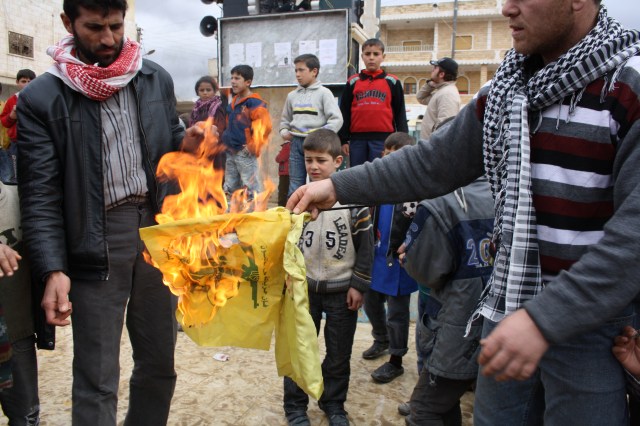
Burning of Hizballah flag in northern Syria

Burning of Hizballah flag in northern Syria

Opposition activists set fire to a flag of the Lebanese Shia Islamist organization, Binnish, northern Syria, February, 2012.

Posted in Uncategorized | Leave a comment

The Failure of Western Policy on Syria

Tower Magazine, May, 2013

The Syrian civil war has now entered its third year with no end in sight. Over 70,000 people have died. 1.5 million refugees have fled Syria, with another two million displaced within the country’s borders. According to the UN, around four million Syrians are in need of aid. Despite gains and losses on both sides, the rebels and the regime of President Bashar al-Assad appear locked in a very bloody stalemate.

At the same time, the reaction of the United States and the Western powers has been extremely troubling. Unlike the regime’s Russian and Iranian allies, which are dedicated to Assad’s survival and willing to take action to ensure his victory, the West’s policy toward Syria has been confused, indecisive, and often self-defeating. While sympathetic to the rebels, the West has not expressed clear support for their cause or provided them with the military aid necessary for victory. Now, even in the face of increasingly strong evidence that the regime has used chemical weapons, the West seems unable to stop equivocating and take decisive action.

This is not merely problematic. It is also dangerous. The Syrian civil war is only a part of an emerging regional conflict that pits Sunni Muslim nations like Turkey and Saudi Arabia against Shia powers like Iran and its Lebanese proxy Hezbollah. While the Sunni powers certainly have their problems, the Shia bloc is avowedly anti-Western and dedicated to a radical Islamist ideology. The West’s inability to form a coherent policy on Syria makes it look weak and—most importantly—vulnerable to defeat in the eyes of its regional enemies. Like it or not, the West has chosen sides in the Syrian conflict, and if it cannot or will not take the measures necessary to ensure the victory of its allies, it could face potential disaster in the future.


***


I have witnessed the unfolding tragedy in Syria on three separate occasions over the past year. Each time, I entered the country “illegally,” twice from Turkey in the company of Arab rebels and once from Iraq with Kurdish fighters. The human cost of the war is indeed terrifying. Syria has been transformed into a charnel house, into death’s dominion. It is vital that this not be forgotten amid talk of policy and options—on which this article will focus. The lives of millions of Syrians have been made unlivable and the lives of thousand prematurely terminated by this war.

The military situation continues to ebb and flow. The rebellion now controls a majority of the country’s overall territory, but the regime is not in free fall. Since mid-2012, forces loyal to president Assad have adopted a strategy of abandoning areas that are not essential to the regime’s survival in order to better defend those that are. The result has been the emergence of distinct areas controlled by either the regime or the rebels, with the fighting taking place along the seam lines that separate them. In addition, a de facto Kurdish autonomous zone, allied with the rebels, has emerged in the northeast.

The regime has pursued a ruthless strategy of preventing the development of coherent administration and the possibility of normal life in rebel-held areas. To achieve this, the regime subjects these territories to aerial bombing, shelling, ballistic missile fire, and now, it appears, chemical weapons. This strategy has brought immense suffering to the civilian population in rebel controlled areas.

Nonetheless, Assad’s decision to reduce his area of control only to those zones essential to his survival appears to have preserved the regime. Despite predictions of its imminent demise, his government does not look to be on the verge of collapse. Indeed, after suffering setbacks in the early part of 2012, it has achieved significant reversals of rebel gains in recent weeks. Most notably, regime forces have secured the Qusayr area and the vital Damascus-Homs highway. They are currently engaged in the expulsion of much of the Sunni population in the area. Many informed analysts believe that this ethnic cleansing, or “purging” as Assad calls it, is part of a larger plan to establish a pro-regime enclave in the western coastal area.

Such an enclave would allow for the protection of population groups loyal to the regime. In particular, this would include the 12 percent Alawi minority. Assad and his family are Alawi, and the community constitutes both the regime’s power base and a demographic majority in the western coastal area. It is also likely that Christians and Druze, fearing the victory of Sunni Islamist rebels, would seek refuge in an Assad-ruled enclave.

There is no immediate likelihood that Assad will go on a general offensive to re-conquer lost ground, and it is probably beyond the capability of his forces to do so. The rebels, however, remain disunited, and do not appear to be in any position to bring about Assad’s defeat in the near future.

In recent weeks, the regime has also made significant gains in the war of perception regarding the nature of the conflict, which will play an important role in the international response to it. For most of the last two years, both elite and popular opinion in the West has seen the war as that of an insurgency struggling to destroy a brutal dictatorship. In spite of rebel excesses and the presence of extremist Sunni Islamist forces on the rebel side, this perception has largely held. But recent media coverage and statements from western officials indicate that this has started to change. Indeed, several anonymous officials have been quoted suggesting that a rapid victory for the rebels would not be in the interests of the Syrians or the West.

From the beginning, the Assad regime has sought to portray the rebellion against it as a campaign by Islamist “terrorists” seeking to destroy a secular regime that has protected minority communities in Syria. The regime line has been reflected in recent statements by Assad officials. In a New York Times article, Syrian prime minister Wael Nader al-Halqi described Syria and the West as “partners in fighting terrorism,” while Information Minister Omran al-Zoubi described the conflict as “a war for civilization, identity and culture. Syria, if you want, is the last real secular state in the Arab world.”

Reporting from the ground on the growing strength of extreme Islamist elements on the rebel side has lent a degree of credibility to this position. The bombing of the Boston Marathon also gave it a significant boost by refocusing international attention on the threat of Sunni Islamist terrorism. This represents a significant advance for the regime in the battle for the “narrative” of the conflict.

What all this adds up to is that contrary to media reports of rebel advances, the stalemate in the Syrian civil war has not been broken. The two sides each control part of the country. Their competing narratives are swiftly becoming equal in the eyes of the world. Neither is close to dislodging the other. The West is capable of breaking this stalemate, but has thus far failed to do so.


***


So what is the west doing about this situation? And do western countries bear any responsibility for the current state of affairs in Syria?

The policy of the Western powers and particularly the United States on Syria has developed in a confused way, with many stops and starts. Prior to the outbreak of the uprising, the Obama administration saw president Assad as a reformer and sought to engage him. This impression took a long time to fade. Washington did not call on Assad to step down until August 2011 and the US embassy in Damascus continued operations until February 6, 2012. As the situation in Syria transformed from an unarmed uprising to outright civil war in the latter half of 2011, Washington seemed determined above all to avoid entanglement. Instead, the task of supporting the Syrian opposition was farmed out to Washington’s regional allies: Turkey, Qatar, and Saudi Arabia were to play the key roles.

Turkey gave the opposition a safe haven and permitted its military wing—the Free Syrian Army—to establish itself on Turkey’s southern border with Syria. The first attempt to form an umbrella organization for the Syrian opposition began on Turkish soil under Turkish government tutelage. The formation of the Syrian National Council was announced in Istanbul on August 23, 2011. Meanwhile, Qatar and Saudi Arabia provided the financing for arms purchases. Starting in late 2011, Saudi and Qatari middlemen were in southern Turkey, making contacts and developing relations with the myriad of small armed groups that the rebellion was producing. Both Riyadh and Doha identified those they regarded as deserving recipients and began to equip their clients.

The results were predictable and significant. Turkey is ruled by a president and a party in sympathy with the Sunni Islamism of the Muslim Brotherhood. As a result, the political leadership of the Syrian National Council became dominated by the Syrian Muslim Brotherhood and their allies. Qatar and Saudi Arabia showed a preference for Islamist groups of both Muslim Brotherhood and Salafi ideologies. In addition, Doha and Riyadh had an early falling out over the correct strategy for arming the rebels. Qatar followed its usual pattern of supporting organizations linked to the Muslim Brotherhood. The Saudis fear and distrust the Muslim Brotherhood, which they see as a potential threat to the Gulf monarchies. As a result, they favored Salafi groups.

The result, which was readily apparent by late 2012, was utter confusion. Instead of a coherent, centralized supply line to the Syrian rebels, a clandestine free market emerged in which rival groups sought to market themselves to the Saudi and Qatari representatives active in southern Turkey.

The lack of unity in supplying the rebels was exacerbated by the Syrian opposition’s own failure to unite. The Syrian National Council went through a rapid turnover of leaders and failed to acquire influence among the armed elements inside the country. It soon began to be seen as irrelevant by the US and the West. In an attempt to solve the problem, the SNC was revamped in November 2012, with the establishment of the National Coalition for Syrian Revolutionary and Opposition Forces. It can be argued, however, that the coalition has run into the same problems as its predecessor—namely, accusations of excessive influence from the Muslim Brotherhood and failure to unite the disparate rebel forces.

This only began to change earlier this year. During the first two years of the Syrian civil war, the role played by the US and other Western countries was by choice minimal. It was not until late February 2013 that the US pledged to directly aid the Syrian rebels. Though the West had provided substantial financial aid to the SNC prior to this—in the hope of building up its ability to provide governance and aid in rebel-controlled areas—the US now began to supply “non-lethal” aid to the rebels themselves. US Secretary of State John Kerry stated that this aid would consist of medical and food supplies. In addition, the European Union announced a change in its policy of embargoing military aid to the rebels. Henceforth, EU countries would be permitted to provide “armored vehicles, non-lethal military equipment, and technical aid” to the rebels.

It quickly became apparent, however, that a Western-led operation of considerable scope was working behind the scenes to create order and unity in the rebel camp, as well as ensuring that rebels with whom the West sympathized received adequate weaponry—even if the arms were not directly purchased by the West. This partly covert operation had a variety of elements to it. Most importantly, it involved a major increase in the quality and quantity of weapons made available to the rebels. Qatar and Saudi Arabia still provided the funding, but there was an increasingly direct role for Western countries—in particular, the US, Britain, and France—in overseeing the weapons transfers. This followed a covert effort—presumably by western intelligence services and special forces—to identify “deserving” rebel groups on the ground.

The weaponry entered Syria from Jordan and Turkey, but there appeared to be a preference for Syria’s southern border with Jordan. This was part of a more general strategy. The main rebel gains up to that point in the war had taken place in the north of the country, but this area is also dominated by Sunni Islamist and anti-Western elements. So the decision to channel improved weapons supplies mainly to southern Syria appeared to form part of a strategy in which the more problematic groups in the north were to be bypassed in favor of less ideological rebels in the south. This strategy was presumably based on the hope that the southern rebels would be able to launch a swift assault on Damascus, effectively making them masters of Syria.

This strategy was overly optimistic and did not work out as planned. The rebels in the south did make significant gains in the first months of 2013 and, for a moment, looked like paving the way to a push on Damascus. But the regime did not collapse and the rebels’ advance rapidly ground to a halt.

In addition, researchers tracing the movement of weaponry in Syria found that, predictably, efforts to keep the new weapons from reaching jihadist rebels in the west and north have been unsuccessful. The fact was that many of the most active and determined rebel groups adhered to jihadist ideologies and weaponry tends to find its way to the people most prepared to use it. These include some of the most extreme rebel groups.

The West’s change in policy also failed because of another crucial factor: The West hoped to aid “secular” rebel forces, but it was apparent to close observers that by the time the West finally chose to act, such forces simply did not exist.

By early 2013, the rebels had solidified into a number of alliances, organized along broadly ideological lines. Three of them had risen to dominate the rebellion. The most extreme is the Jabhat al-Nusra group, which openly declares itself the representative of al-Qaeda in Syria. It is among the most active rebel units and is thought to number around 6,000 fighters. In addition, there is the Syrian Islamic Front, which brings together a number of Salafi Islamist groups, the largest of which is the Ahrar al-Sham organization, thought to be supported by Saudi Arabia and Kuwait. This bloc probably numbers around 15,000 fighters. By far the largest rebel alliance is the Syrian Islamic Liberation Front, which brings together fighters from several of the most powerful non-Salafi groups in Syria. It has somewhere between 35-40,000 fighters.

These are the main groups among the rebels. There is no alternative secular rebel alliance on the ground.

Western policymakers’ vacillating and half-hearted approach to the conflict must take a significant amount of responsibility for this unwanted outcome. US and Western policy on Syria has been largely influenced by its reluctance to become embroiled in a new Middle East war and its determination to avoid direct intervention. This has led to a deeply divided insurgency in which Sunni Islamists, sponsored by the competing regional forces that have performed the “heavy lifting” of supporting the rebels, are now dominant.

It remains to be seen whether the latest revelations regarding the regime’s use of chemical weapons will shift US policy toward a more active stance, but the signs are not good. The latest statements from the Obama administration indicate a further qualification of its “red line” on the issue. It is now the “systematic” use of such weapons that constitutes the “game changer,” rather than their use in and of itself.

It seems, then, that the US and the West in general are likely to continue their previous approach to the conflict. This is unfortunate, because their desire to avoid direct involvement and outsource their support for the rebels, such as it is, has produced two main results: The domination of the uprising by Sunni Islamists and the survival of the Assad regime.


***


Western indecisiveness is particularly problematic because it is in sharp contrast to the approach adopted by Assad’s allies—Russia and Iran chief among them. Assad has benefitted immensely from having a small but extremely effective group of allies with a clear and simple agenda: To keep him and his regime in power. Unlike the West, these allies have maintained a consistent and determined stance throughout the conflict.

Russian support in particular has been invaluable to the regime. Russia’s veto at the UN Security Council has prevented any effective UN action against Assad. In addition to diplomatic cover, Russian arms supplies have enabled Assad to continue the conflict militarily.

Russia has sound strategic reasons for supporting Assad. A recent article in the Guardian notes that the naval base at Tartous allows the Russian Navy to operate in the Mediterranean, as well as granting easy access to the Red Sea via the Suez Canal and the Atlantic Ocean via the Straits of Gibraltar. It is also clear that President Vladimir Putin sees relations with the West as a zero-sum game. If Moscow is able to make the West look hapless and weak by defending its own client to the hilt, this is a positive development from Putin’s point of view. As a result, Russian support for the regime remains and likely will remain firm and unwavering.

Next to Russia, Iran is Assad’s most important alley. From the beginning, it has provided equipment, money, arms, and manpower to the dictator. As early as April 14, 2011, US officials confirmed that Iran was aiding in the repression of what was then a mostly non-violent uprising. A classified United Nations report from early 2012, eventually leaked to the media, stated that Iran was by then covertly shipping arms to Syria in violation of international sanctions. Iran has also provided support through its paramilitary Quds Force, a special unit of the Iranian Revolutionary Guard Corps.

Teheran has also enlisted other allies from the regional bloc it leads. The Iraqi government of Nuri al-Maliki, for example, has made its territory available for weapons transfers and acted as a go-between for funneling financial support to Assad. It has done so together with Iran’s Lebanese proxy militia Hezbollah, which has provided access to Beirut’s financial and banking system, as well as occasionally acting as agents for the sale of sanctioned Syrian oil.

Iran’s use of Hezbollah has also been a major source of military support for the regime. Hezbollah men have been observed fighting in Damascus and the Qusayr area, both of which are essential to the regime’s survival, and seem to have been invaluable in helping Assad develop new and more useful military capabilities. In particular, the evidence suggests that—with the aid of Hezbollah and Iran—Assad has created a new, sectarian paramilitary force. Developed from the Alawi irregular fighters of the “Shabiha” group, it is known as the National Defense Force and is staffed mainly by Alawis and other minorities. Its emergence testifies to the regime’s new ability to adapt to changing circumstances—in contrast to the rigid, Soviet-influenced system that preceded the uprising.

All this determined activity by Iran, its allies, and Russia has been far more effective than the vacillating policy of the West. Indeed, it is the key element to the dictator’s survival. The regime’s allies have from the outset been determined and implacable. They have pursued a clear goal using creative, ruthless, and flexible methods. The supporters of the rebellion have been disorganized, hesitant, and uncoordinated. The rebels have made gains in spite of this because of their own determination and the support, overt or covert, of a large portion of the population. But the regime has managed to survive and shows no signs of imminent collapse. The main reason for this is that Assad’s allies know what they want and are determined to get it, which is not rue of their rivals.


***


Where have the rebels’ failures, the hesitant support of their allies, and the resolution displayed by Assad and his supporters led us? It has resulted in a situation in which the Syrian conflict has become a full-fledged sectarian civil war with grave regional implications. It pits a non-Sunni regime backed by the leading Shia power in the region—Iran—against a Sunni rebellion backed by the most dominant Sunni powers—Turkey, Qatar and Saudi Arabia.

This means that the Syrian civil war is no longer a regional conflict. It has potentially serious repercussions for the entire Middle East. It is now the hottest point in an emerging Sunni-Shia conflict that is sweeping the region. Indeed, it has already spread both east and west. In Lebanon, the Shia group Hezbollah is fully and actively committed to the cause of the regime. Sunni forces in Lebanon are supporting the rebellion. In Iraq, the Shia-dominated government supports Assad while Sunnis in the restive Anbar and Nineveh provinces are collaborating with Syrian rebels across the border. On an ideological level, the Syrian civil war serves as an inspiration to Sunni forces seeking to challenge Shia control of Iraq.

Even in areas not directly affected by the Syrian situation, the Sunni-Shia rivalry is heating up. In Bahrain, Yemen, and eastern Saudi Arabia, Sunni and Shia Arabs are in conflict. Iran is backing the Shia forces in all these cases, while some combination of Saudi Arabia, Qatar, and Turkey is backing the Sunnis.

This emerging Sunni-Shia conflict is, in many ways, the result of US policy in the Middle East over the last half-decade. By ending its support for US-allied regimes in Tunisia and Egypt, the US enabled Sunni Islamist governments to rise to power in these countries. This perceived withdrawal from involvement in the region has led the Saudis to enthusiastically support Sunni forces across the Middle East. In the past, Riyadh assumed that the US would do the work of opposing threatening forces in the region. Now, the Saudis realized, they would have to do it themselves. Sunni unrest also provided an opening for Qatar to pursue its regional ambitions, which are mostly aligned with the Muslim Brotherhood—including in Syria. Similarly, US inaction on the Syrian rebellion has allowed the civil war to become defined by this larger Sunni-Shia conflict. In particular, the preferences of the West’s proxies—Turkey, Qatar, and Saudi Arabia—has led to the undisputed domination of the rebellion by Sunni Islamist forces of various hues.

This is not only a political and ideological problem; it is also a practical one. Put simply, the West’s Sunni proxies cannot produce positive results. The insurgency they have created is not strong enough to defeat the Assad regime and its determined backers. And the forces that have flourished among the rebels because of those proxies are dominated by those committed to the establishment of a militant Sunni Syria that would likely be disastrous for Syria’s non-Sunni population.

All of this puts the US in an extremely difficult position. Because it has offered clear verbal support to the rebel side, Washington now looks weak and ineffectual in the eyes of both allies and enemies in the region. This impression has only been strengthened by the apparent ineffectuality of the Americans’ “red lines” on chemical weapons. The Syrian experience shows that the US and the West in general cannot rely on local Sunni clients to preserve Western interests in the face of an openly anti-Western Shia bloc led by Iran and its global allies. Instead, US disengagement from the region is producing a regional Sunni-Shia confrontation.


***


It is, of course, reasonable to ask whether the emergence of a Sunni-Shia confrontation is in itself a cause for concern. It obviously has severe consequences for the Arab world, but does it matter to the West?. If the Middle East becomes an arena for sectarian competition, struggle, and war, is this a serious threat? Or can it be largely ignored, much as the Western world ignores the massive violence and political dysfunction prevalent in sub-Saharan Africa?

To answer this question, one must understand that a region dominated by sectarian conflict abhors a vacuum. If the rebels’ allies will not act to control and define the conflict, Assad’s allies will happily do so instead. And thus far they have done so quite successfully. If the regime survives, even in only those parts of Syria deemed essential by Russia and Iran, this will represent a highly visible victory for an alliance of declared enemies of the West. A victory won against an alliance of western clients, albeit with deeply problematic elements.

Following the collapse of pro-US regimes in Egypt and Tunisia, an Assad victory would be seen by political elites across the Middle East as an object lesson. The lesson will be that allying with the US is an error. The US will not back you in your moment of need, while opposing it and allying with its enemies carries little cost. The US and its regional allies, it will be believed, can be successfully challenged as long as you have determined allies of your own prepared to back you to the hilt. And such determined allies can be easily found in Iran and Russia.

Should evidence of American weakness become so readily apparent, it would have several practical effects: First, Iran will be encouraged to defy the West over its nuclear program, secure in the knowledge that US and Western threats can be faced down. In the longer term, an Iranian victory in Syria and a general sense that the US and its allies are a spent and declining force could revive the idea of Iran and its allies as a “resistance bloc” that can effectively defeat a collapsing West. In turn, this could result in a regional shift in favor of Iran, with such states as Qatar and possibly even Muslim Brotherhood-oriented regimes such as Egypt and Gaza tilting in favor of the Islamic republic. That this is a potential catastrophe for the West should be obvious.

Unfortunately, it is true that the Sunni rebels in Syria do not represent a chance for better government and economic development. But this is something the West must accept. The war in Syria represents a point at which the advance of forces overtly hostile to the West is either stopped by determined resistance or wins a resounding victory that will set the stage for further advancement—and, as a result, more chaos, violence, and war. It must be acknowledged that the forces prepared to align with the West are deeply problematic. But this is one of those moments when the question is one of alignment, not ideological sympathy.

Until now, the US and the West have failed completely to meet this challenge. They have neither opposed their enemies nor supported their allies effectively. As of now, the Assad regime is standing firm and even regaining lost ground. Its survival, which means its victory, would be a disaster for the West. It is crucial, then, for the West to take those measures necessary to prevent it and to end the carnage in Syria in the shortest possible time. This is a strategic imperative of the utmost urgency for the United States and its allies in the Middle East.
 

Posted in Uncategorized | Tagged , , , | 1 Comment

Erdogan’s Kurdish Gambit

Jerusalem Post, 17/5

On May 8th, fighters of the Kurdish PKK militia began to withdraw from their positions in Turkey, bound for their mountain strongholds in Kurdish-ruled northern Iraq. The decision by the PKK to withdraw is the result of orders issued by jailed movement leader Abdullah Ocalan. The re-energizing of the Turkish-Kurdish ‘peace process’ is one of the most important of the phenomena generated by the seismic shifts currently under way in the Middle East. But the foundations of this process are far more shaky than the guerrillas’ redeployment from Turkey would suggest.

The newly minted Turkish-Kurdish peace process resembles the veteran Israeli-Palestinian version in a number of ways. Perhaps most importantly, the process has been launched without any clear picture of how it is supposed to conclude. There is no evidence of any ‘historic compromise’ between the sides on the core issues which caused the conflict in the first place.

For the Kurdish side, the struggle is no longer about separate statehood. Rather, their demands now center on the right to use Kurdish language in education, equal status of Kurds in the Turkish constitution, greater autonomy for local authorities in Kurdish majority areas, and the release of thousands of Kurdish political prisoners held in Turkish jails.

Turkish Prime Minister Recep Tayepp Erdogan has committed himself on none of these issues. For him, the existence of the process appears more important than its result. Erdogan’s Kurdish gambit is intended to form part of his broader campaign to transform the Turkish polity.

Starting in September 2008, representatives of the Turkish state and of the PKK engaged in intermittent face to face talks in the Norwegian capital, Oslo. From August 2009, the Turkish side were led by Hakan Fidan, a close associate of Erdogan who now heads the MIT, the Turkish National Intelligence Association. Parallel talks between MIT representatives and PKK leader Ocalan also took place at Imrali, the island jail where Ocalan has been incarcerated for the last fourteen years.

From the outset, Kurds suspected that the Turkish intention of the talks was to induce the PKK to end its insurgency, for the sake of the process, while offering no concrete path for solving the conflict. As a result, recent years have been marked by long ceasefires and periodic bursts of conflict as the Kurds sought to remind the Turks that the quiet should not be taken for granted, for as long as the core issues remained unresolved.

So what was the breakthrough which has led to the current appearance of progress? From late 2012, the Turkish government began a new round of talks with Ocalan alone, on Imrali, denying the PKK the possibility of presenting a coherent stance as a movement. This process has led to the orders by Ocalan for the withdrawal of PKK fighters and the appearance of progress. But what exactly the government has or has not proposed on Imrali remains shrouded in mystery. Nothing in writing has emerged from the Imrali talks, on any of the core issues of the conflict.

While Ocalan retains an iconic status within the PKK and parts of the broader Kurdish world, it is not difficult to discern caution and some confusion among movement cadres regarding their leaders’ latest orders.

In an interview this week with renowned Turkish journalist Hasan Cemal, prominent PKK commander Bahoz Erdal stressed that the current PKK decision for a ceasefire does not imply surrender, nor remove the possibility of a return to armed action if the Kurdish issue remains unresolved. “They asked for a cease fire – we declared. They asked for withdrawal, we are doing this now. If tomorrow they ask that this is not enough, you should lay down your arms – they can’t force us to do this. This means surrender for us which we (the PKK) have never accepted, even in the most difficult times,” Erdal told Cemal.

The point, Erdal said, was not a ceasefire for its own sake, but to remove the reasons why Kurds took up the guerrilla struggle in the first place.

The veteran PKK fighter also noted that the Turkish army has begun to construct a new infrastructure along the border, intended to hinder the ability of Kurdish fighters to return into Turkey should the conflict continue. This observation is part of a broader concern in the PKK that Erdogan’s intention may be to neutralize and distance the movement and render it irrelevant, rather than to reach a true rapprochement with it.

Erdal is a very prominent commander, well respected among the Kurds, and his statements will be carefully studied by all sides.

Murat Karayilan, the de facto leader of the PKK in Qandil, said that the withdrawal from Turkey would ‘stop immediately if there is any attack, operation or bombing of our guerrilla forces, and our forces will use their right to reciprocate.’

Karayilan also made clear in a rare press conference at the end of April that PKK disarmament would take place only after the Turkish government carried out constitutional amendments in line with the movement’s demands relating to Kurdish rights.

Serious questions therefore remain as to whether the peace process will in the end bear fruit.

From Erdogan’s point of view, however, the move towards the Kurds makes obvious political sense. The Turkish prime minister’s current central goal is to ensure the passing of a constitution which would radically re-shape the nature of the Turkish republic. Most importantly, the new constitution will replace the current parliamentary system with a presidential one. This will then pave the way for Erdogan himself to stand in presidential elections in 2014, and rule with vastly increased executive powers.

Many in Turkey fear that at this point, Erdogan will complete the process of a Putin-style hollowing out of Turkish democracy which they discern is already under way – in the emasculation of the free media, the jailing of senior officers on trumped up charges and the incarceration and harassment of journalists.

To bring the constitution to a referendum, Erdogan needs a 330 seat majority in the 550 member parliament in order to bring the constitution to a referendum. He currently controls 325 seats.

One of the ways in which Erdogan could ensure his majority would be by securing the support of the Kurdish BDP (Peace and Democracy Party.) Many observers adiscern the central goal in Erdogan’s current peace process as being to secure BDP and Kurdish support for the new constitution.

This brings with it the possibility that once the new constitution is in place and Erdogan securely ensconced as president, he could abandon the perhaps impossible task of reconciling Turkish and Kurdish desires, leaving a neutered PKK, and reverting to the previous policies of repression.

Should the peace process falter, however, Erdogan will need to take account of a strikingly improved Kurdish strategic position. Perhaps most importantly of all, a franchise of the PKK now controls north-east Syria. Kurdish fighters resisted a Turkish backed attempt by Syrian rebels to begin a re-conquest of this area in January. There is also a flourishing de facto sovereign area in the Iraqi Kurdish region (which is not, of course, aligned with the PKK).

So Erdogan has launched an audacious gamble, initiated with the help of the ever-eager diplomats of Norway. PKK leader Ocalan, meanwhile, has reportedly said that if the process fails, 70,000 fighters await his orders. Whether Erdogan’s move will result in a lasting rapprochement between Turks and Kurds – or flounder into renewed conflict – remains very much to be seen.

Posted in Uncategorized | Tagged , , , | 1 Comment

The Israeli Debate over Syria

Tablet Magazine, 14/5: The civil war in Syria has led to a keen debate among the professional echelon tasked with advising policymakers in Israel. This debate has been reflected in a more subdued public conversation and occasionally in spectacular events—like the bombing of Syrian military sites around Damascus. So, what are the dividing lines in this Israeli debate? Does Israel back any side in the war in Syria? And what would be an optimal outcome from the Israeli point of view?

The history of the Israeli-Syrian diplomatic process is long and winding, and it is defined by failure. Direct talks in the 1990s failed to produce an agreement. Subsequent attempts to revive direct negotiations between Damascus and Jerusalem proved elusive. Turkey-sponsored indirect talks broke down after Israel’s Operation Cast Lead action in the Gaza Strip in 2008-2009. Yet discreet channels of communication were nevertheless maintained between Israel and the Syrian regime, often through private individuals close to the Israeli government.

Prior to the outbreak of the civil war in Syria, an influential group of Israelis in the policymaking establishment favored a revival of efforts to make peace with Syria. These included former head of Military Intelligence Uri Saguy, and former Foreign Ministry Director-General Alon Liel. Advocates of this position considered that the Assad regime represented the most brittle and reluctant element in the Iran-led “resistance bloc.” They also thought that because Assad himself was not an Islamist—nor even a Muslim in the generally accepted sense of that term—his commitment to the “resistance bloc” was purely pragmatic in nature. If he could be tempted by territorial inducements to change sides and align with the West, this would represent a major blow to Iran and an achievement for Israel—one that would justify far-reaching territorial concessions on the Golan Heights.

But Assad has refused to comply with this scenario. Instead, he chose to double down on his support for the “resistance bloc” after the 2006 war between Israel and Hezbollah.

Now, should he be so inclined, Assad can congratulate himself on his foresight. Since the outset of the rebellion, Iran has offered vital aid to the Syrian dictator. Direct Iranian aid for the Assad regime has come in the form of financial assistance, provision of vital equipment and arms, and also the presence on the ground of Revolutionary Guard advisers who are expert in guerrilla warfare and have helped to organize, train, and direct the militias that provide an essential prop for the beleaguered Syrian dictator and his regime.

Iran has also mobilized its regional clients and proxies, like the pro-Iranian Maliki government in Iraq, and the Hezbollah organization, which dominates Lebanon, to provide further assistance, including boots on the ground. Maliki has permitted his territory to be used to transport Iranian weapons into Syria, despite American pressure for him to stop. Hezbollah, meanwhile, has been engaged in the border area between Syria and Lebanon since the early days of the civil war. Today, the organization has committed around 5,000 fighters on Syrian soil. Hezbollah men are also present in Damascus, where their task officially is to defend the Sayida Zeinab shrine, a place of veneration for Shia Muslims, from the Sunni rebels. In short, Assad’s preference for sticking with his Iranian allies appears to have saved his rule.

It has also clarified the Israeli attitude toward him. The Israeli raids on Syrian targets in May cast light on the extent to which the Assad regime today is seen by Israel as a component part of Iran’s projection of power into the Levant area. While Israeli spokesmen have been keen to stress that Israel has no desire to intervene in the Syrian civil war and wants only to stop weapons shipments to Hezbollah, it is quite likely that the beleaguered position of the Assad regime was also factored into the consideration of Israeli planners in devising the air action over Damascus.

The statements by Syrian and Hezbollah officials following the latest strikes appear to justify the Israeli calculation. These statements combined bellicose rhetoric with concrete threats of a far more modest nature. Yet the Israeli professional echelon remains divided in its overall assessment of the war in Syria. In the public debate, both former Military Intelligence head Amos Yadlin and former Mossad head Meir Dagan have suggested that the preferred outcome of the war for Israel would be the defeat of Assad and the resultant heavy blow to the Iranians that it would deal.

Dagan said recently that Israel should “do whatever it can to make sure that Syrian President Bashar Assad is removed from power” and expressed skepticism regarding concerns of a powerful and hostile new Sunni Islamist regime emerging from the ashes of Assad’s Syria. He suggested that Western-aligned Gulf countries would ensure that a Sunni-dominated Syria did not veer toward radicalism. Yadlin fell short of advocating Israeli action to help Assad’s fall but also said that the prospect of Sunni radicalism in Syria would not represent a major challenge for Israel and that Assad’s departure would be a major blow to Iran and its allies.

All of this said, however, talks with serving Israeli officials engaged on Syria suggest the existence of a separate school of thought that is deeply concerned at the potential threat of emergent Salafi Islamism in Syria in whatever vacuum is left in the wake of Assad’s downfall. Israel is observing closely the growing strength of the al-Qaida-linked Jabhat al-Nusra organization, which is now thought to have upward of 6,000 fighters under its banner and has made statements suggesting that it plans to attack both Israeli and U.S. targets, once its war with Assad has been concluded.

While rival analyses clearly exist in the Israeli discussion regarding the likely direction of events in Syria, these do not reveal broad differences regarding recommended Israeli actions in the immediate future. In the here and now, Israel is pursuing a policy designed to minimize the threats represented by both sides.

Against the Iran-led bloc, Israel is taking determined action to prevent a Syrian government policy of moving high-grade weapons systems into Lebanon. It is very possible that the May strikes were not the last of their kind. But in any case, these strikes formed only an unusually visible episode in an ongoing, usually clandestine, war being undertaken by Israel to reduce the threat posed by Iran and its various assets in the region.

Jerusalem has also quietly engaged in the significant strengthening of security measures on the northeastern border facing Syria. As the adjacent Dera’a province falls ever deeper into the hands of Islamist rebels, Israel has constructed a new, state of the art border fence and has increased the forces deployed on the Golan Heights.

There are indications of a certain level of cooperation on the ground between Israel and elements among the rebels in the border area separating Syria from Israel. The IDF has established a field hospital in the area of Tel Hazekah, an observation post on the heights. According to media reports, Syrian rebels wounded in the fighting in the south have been brought to the hospital for first aid. A small number of badly wounded fighters have been transferred to Israeli hospitals for further treatment.

The operation of the field hospital, whose existence Israel has not officially confirmed, suggests a level of communication between the IDF and the rebels. The existence of a certain level of liaison between the IDF and these rebels should be seen in the broader context of a semi-clandestine, U.S.-led effort, which has been under way in recent months to train trusted Syrian rebel fighters in northern Jordan and then to introduce these fighters into the combat zones of southern Syria. The intention behind this effort appears to be two-fold: to protect the borders of Jordan from attacks from radical Sunni rebels; and to provide a balance to the Sunni Islamist rebels who dominate northern Syria.

With the civil war showing no signs of ending any time soon, and the country separating into separate and hostile enclaves, it appears that a quiet strategy of ensuring a strong presence of non-Salafi, Western-supported fighters in the area of the Jordanian and Israeli borders is under way. It is likely that the low-level communication and the treatment of wounded Syrian rebels by Israel is part of this. There are currently no signs of Israel being drawn further into a more overt implementation of this strategy, and it is likely that neither Israel nor the rebels in question would want this.

Ultimately, Israeli policy on Syria derives from the familiar combination of limited political/diplomatic possibilities and military superiority. The deep-rooted rejection of the legitimacy of Israel’s existence is common to both sides of the Syrian civil war and is ubiquitous in the Arabic-speaking world and among the Iranian leadership. This rejection shapes and limits Israel’s options as an actor on the regional stage. Even with the leading Sunni states opposed to Iran, interaction and cooperation are necessarily covert and limited—and the growth of Sunni political Islam as a result of the “Arab spring” has only exacerbated this reality.

In such circumstances, Israeli options are reduced to the basic need to ensure the security of its citizens and deter enemies. It appears that Moshe Dayan’s famous dictum that “Israel has no foreign policy, only a defense policy” continues to hold, at least in Israel’s immediate neighborhood.

Posted in Uncategorized | Tagged , , , | Leave a comment

Is Assad Winning?

Jerusalem Post, 3/5

The imminent demise of the Assad regime has been announced on numerous occasions over the last two years of civil war in Syria. But the regime has held on. Despite some advances by rebels in the south of the country in the early months of 2013, Assad shows no signs of cracking.

Indeed, in the last few weeks, the momentum of the fighting has somewhat shifted. Regime forces have clawed back areas of recent rebel advance. The government side, evidently under Iranian tutelage, has showed an impressive and unexpected ability to adapt itself to the changing demands of the war.

As long ago as the summer of 2012,the government side demonstrated that it was able to adjust creatively, if ruthlessly, to events. When it became apparent that determined attempts by the regime army to crush the revolt in the northern Syrian countryside were proving fruitless, Assad’s forces carried out a strategic withdrawal.

In effect, the regime ceded large swathes of northern and eastern Syria to the Arab rebels and to Kurdish separatists. Assad held on to the cities of the north, the western coastal area, the Damascus area, and the highways between all these.

The dictator and his Iranian patrons then settled down to a process of attrition – with the twin goals of preserving their own area of rule, and rendering ungovernable the area under rebel control. This latter goal was attempted through the use of air power, artillery and latterly ballistic missiles against civilian targets. It has been successful in so far as the rebels have proved notably unable to avoid their area of control turning into a chaotic zone consisting of the rival fiefdoms of various local commanders and alliances.

These were the contours of the bloody stalemate into which Syria settled for the latter half of 2012.

In the first months of 2013, the rebels made a concerted effort to break this stalemate. Aided by deliveries of new and improved weapons systems paid for by the Saudis and brought in via Jordan, rebels in the south made significant gains. The town of Dael on the road to Damascus form the southern border fell at the end of March. Much of rural Dera’a province, the cradle of the revolt, fell to rebel forces.

Further north, the town of Raqqa fell to Islamist rebels in early March. This was the first provincial capital to fall.

At this point, it looked like the battle for Damascus was about to begin. But in the course of April, the regime has hit back.

Damascus remains a fearsome prospect for any rebel force wishing to enter it. The regime has assembled a huge array of artillery and missile systems on Mount Qassioun, a strategically vital area of high ground over the city.

The regime has also entrenched its most loyal and able fighters, including the Republican Guards and the 4th Armored Division, and elements of the Lebanese Hizballah and the Alawi paramilitaries trained by Iran, in the city.

Regime forces last week recaptured Otaiba, a town east of Damascus which formed a vital link for rebels seeking to bring weaponry and ammunition from the Jordanian border to the eastern suburbs of Damascus.

Hizballah fighters operating on behalf of the regime in the western part of the country and backed by regime air power have driven the rebels back in the Qusayr area in central Homs province. In so doing, they have ensured that the vital Damascus-Homs highway remains open (though with heavy loss, according to reports.) As of now, the rebel Farouq Brigade has prevented Hizballah’s entry into Qusayr City. The fighting remains intense.

But the regime’s rallying has taken place not only on the battlefields. Assad has from the outset possessed a clear narrative of the conflict, according to which his regime is facing attack from an alliance of jihadi ‘terrorists.’

The irony of this version of events is rich, given that the dictatorship in the not at all distant past made ample use of Sunni jihadi clients, employing them to destabilize neighboring Iraq (where Bashar’s regime allowed a steady stream of foreign jihadis to use Damascus airport as an entry point to the region on their way to take part in the Sunni insurgency against the US) and Lebanon (where the regime sponsored the Fatah al-Islam group as a tool to destabilize the country in 2007.) Nevertheless, no one has ever suspected the Assads of having an excessive sense of shame.

The bombings at the Boston marathon have re-focused western attention on the threat of Sunni jihadi terrorism. The west’s preference for staying out of direct support for the rebellion left a vacuum which has been largely filled by Islamist fighters and trans-national jihadi groups.

So the regime’s predictions now constitute a kind of self-fulfilling prophecy. It is an account of events that has some resonance beyond circles naturally sympathetic to Assad. The result is that morale among supporters of the regime has improved markedly in recent weeks.

The Assad regime has benefitted on every level from the support of a determined international coalition which has stood behind the dictator since the outset of the rebellion. Russia, Iran, its proxy Hizballah and the Maliki government in Iraq are all playing a vital role. The latest indications are that the US and the west still prefer to stay out, despite the obvious crossing of notional ‘red lines’ regarding the use of chemical weapons. So it is likely that the Assad regime will be around for some time to come.

This regime may be a study in vileness from a moral point of view, but Assad and his allies over the last two years have shown what can be achieved when a clear strategic goal is wedded to a willingness to use the most ruthless and murderous of means. Only a comparable level of cohesion and commitment from the rebellion and its backers is likely to prove sufficient to finally terminate Assad’s rule. This shows no signs of emerging. So Assad isn’t winning, despite the new bullishness of his supporters. But right now, he isn’t losing either.

Posted in Uncategorized | Tagged , , , , | 2 Comments

Muslim Brotherhood Presides over Growing Chaos in Egypt

Jerusalem Post, 12/2:
Recent days have seen a further sharp deterioration in Egypt. Against a background of economic crisis, Salafi Islamist groups are increasingly assertive. The Salafis are engaged in the violent harassment of Egyptian Copts and secular oppositionists, and in ongoing attempts to pressurize the Muslim Brotherhood government of Mohammed Mursi to accede to their policy demands through public agitation and disorder.

The government, meanwhile, finds itself caught in an inescapable dilemma over economic and social policy. Foreign currency reserves are running dangerously low at $13.4 billion – 60% below their December 2010 level. Egypt is currently seeking a loan of $4.8 billion from the International Monetary Fund. But the conditions likely to accompany the granting of these funds will exacerbate the social discontent in Egypt, to the benefit of the government’s opponents.

In the latest escalation of anti-Christian harassment, two people died this week after an Islamist mob attacked Copts leaving a funeral in Cairo. The funeral itself was for four Copts shot dead in the town of Khosous near the Egyptian capital last week.

The unrest following the funeral began when Egyptian Muslims threw petrol bombs at mourners chanting anti-government slogans. The Copts later accused the authorities of failing to protect their community. They noted that police fired tear gas into the compound of St Mark’s Cathedral in Cairo, where mourners had sought shelter from the violence.

Coptic Patriarch Tadrawos II later issued a public statement condemning the government’s failure to protect the Copts and describing Egyptian society as ‘collapsing.’

The increasingly vociferous Salafis, meanwhile, are forcing the government’s hand in other areas. On Sunday, Tourism Minister Hisham Zezoua announced the cancellation of recently renewed tourist flights from Iran. No reason for the decision was given. But the Mursi government’s u-turn came after Salafi demonstrators attacked the home of a senior Iranian diplomat resident in Cairo.

The demonstrators chanted anti-Shia slogans, and attempted to place a Syrian rebel flag on the gate of the diplomat’s residence. Riot police narrowly prevented a storming of the building.

The Egyptian government’s apparent helplessness in the face of Salafi provocations, and its instinct to appease them, represents only one side of Mursi’s woes.

The secular and leftist opposition is also increasingly active, and is similarly turning toward civil disobedience as its preferred means of protest. The National Salvation Front, a coalition of secular parties, is demanding the formation of a new ‘neutral and credible’ government to oversee parliamentary elections set to take place later this year.

The April 6 youth movement, a remnant of the youth of Tahrir Square who so excited the world’s media in 2011, remain active at ground level. The movement supported Mursi’s election, but has now turned against him. 44 people were injured in ‘day of rage’ protests organized by the movement in the Cairo area this week.

Supporters of April 6 contend that Mursi is not the real leader of the country. Rather, they assert that the real decisions are in the hands of Mohamed al-Badie, the ‘Supreme Guide’ of the Muslim Brotherhood movement.

Against the backdrop of ongoing unrest, an IMF team is in Egypt, to negotiate the terms of a loan of $4.8 billion to Egypt. The negotiations are deadlocked.

The IMF wants the government to enact budget cuts, including on energy subsidies, in order to secure the loan. The government, facing growing unrest, rising prices and fuel shortages, fears that to do so would be to add fuel to the flames already threatening it.

Qatar, which has already given $5 billion to Egypt, this week announced a further grant of $3 billion. Qatar, as the key regional backer of the Muslim Brotherhood, evidently feels a responsibility toward the beleaguered Mursi government. But even Qatari generosity will only go so far, and cannot offer a long term solution.

The Muslim Brotherhood in Egypt appears caught in an inescapable dilemma. Conforming to international financial requirements will require cuts that will exacerbate already growing unrest. Refusal to do so will preserve the current situation of economic dysfunction – which will also fuel the growing disorder.

Where is all this heading? A recent article in the Atlantic by Eric Trager quoted activists of the April 6 youth movement privately admitting that they are hoping for a return to military rule. The activists said that a short period of rule by the army would be preferable to the current growing anarchy.

Of course, Egypt’s last short period of military rule began in 1952, and ended in 2011.

Another possibility is that the Muslim Brotherhood themselves may seek in the months ahead to use the security organs of the state to crack down harder on the growing resistance to their rule. They waited after all, more than 80 years for their moment in power. They will not willingly concede to its early termination.

At the present time, there are no indications that the military are contemplating a return to power. Presumably, the generals are for the moment happy to allow the Muslim Brotherhood to take responsibility for their own failures. This may change in the period ahead, if the situation deteriorates further.

But the fact that it is regarded as a possibility, and even a desirable one, by elements among the very forces that spearheaded the revolution against Hosni Mubarak, is perhaps the single most telling indication of the current state of affairs in Egypt.

Posted in Uncategorized | Tagged , , | 1 Comment

Iran’s Silent War in the Gulf

Jerusalem Post, 5/4: A series of trials currently under way in the neighboring Gulf states of Saudi Arabia and Bahrain offer a glimpse into the ongoing, silent war being waged by Iran against its regional rivals.

Bahrain is of particular interest to Teheran. The tiny island emirate is home to a Shia majority – ruled over by the Sunni Khalifa monarchy. Iranian officials often describe Bahrain as rightfully constituting the ‘14th province’ of Iran. A Shia insurgency was crushed in March, 2011, following the entry of Saudi, Kuwaiti and UAE forces. Tensions remain high.

Saudi Arabia, meanwhile, is one of the main regional rivals of Iran. The two, both major oil-producing states, are separated by sectarian loyalties, strategy toward the west, and straightforward geo-political competition for dominance in the energy-rich Gulf region.

The latest revelations suggest that the long standing use by the Iranian regime of subversion and irregular warfare as tools of policy in the Gulf as elsewhere is proceeding apace.

In Bahrain, recent revelations have centered on two separate cases. In the first, a Bahraini citizen convicted in July 2011 of transferring “military information and identifying sensitive sites in Bahrain” to Iranian diplomats in Kuwait had his ten year sentence confirmed this week.

According to a statement from the court, the man, who has not been named, sought to photograph ‘military and economic installations’ in Bahrain, as well as the homes of individuals employed at the US Juffair naval base on the island. The Juffair base is the main site in the Gulf offering onshore services for the US Navy’s 5th fleet. The ‘diplomats’ in question were identified as members of the Iranian Revolutionary Guards Corps. IRGC members have a long history of posing as Iranian diplomats and consular staff.

In the second, more recent case, the Bahraini authorities in late February arrested eight Bahraini citizens who were accused of membership in a cell established by the Revolutionary Guards to plan and carry out attacks on Bahrain’s international airport, interior ministry and other public facilities, and to assassinate Bahraini officials.

The Bahrainis identified an IRGC official, code-named ‘Abu Naser’ as the head of this group. They claimed to have captured a host of evidence, including electronic equipment, incriminating the arrested men. The authorities also maintained that the members of the cell attended IRGC training camps in Iran and Hizballah-run centers in Iraq.

In Saudi Arabia, meanwhile, the authorities in March arrested 16 Saudi citizens, an Iranian and a Lebanese, similarly on suspicion of membership in a cell established by Iranian intelligence elements, and tasked with gathering information and providing documents concerned with ‘installations and vital areas’ in the kingdom. The Saudi citizens all hail from the country’s 2 million strong Shia minority.

The Iranians, predictably, have denied all the accusations. Iran and its regional mouthpieces accuse the Gulf states of seeking to justify their repression of Shia communities.

Thus, the opposition al-Wifaq party in Bahrain denounced the latest arrests. In Saudi Arabia, meanwhile, 37 Shia clerics issued a statement accusing the Saudi authorities of escalating sectarian tension as a way of diverting public attention from other issues.

It is indisputable that both the Shia majority in Bahrain and the Saudi Shia minority face real repression and discrimination. The existence of real and justified grievances does not, however, cancel out the evidence of Iranian subversive activity.

And it is also clear that the evidence emerging regarding the activities of the IRGC in both countries follows a pattern familiar both from past experience and from Iranian activities elsewhere in the region and beyond it.

The use made by Iran of local Shia communities, and the subsequent engagement of those communities in political violence on its behalf is no longer in dispute. Past precedent suggests that Iran seeks not only to recruit participants for paramilitary activity. Rather, Teheran also wishes to build political influence and power through the sponsorship of Shia Islamist movements.

Their efforts in Bahrain are not of recent vintage. As far back as 1981, the proxy Islamic Front for the Liberation of Bahrain launched a failed coup attempt, with the support and probably under the direction of Iran and the IRGC.

The Iranians have spent many patient years building up assets and clients within the Bahraini opposition.

Hasan Mushaima, the Shia Islamist leader of the Haq movement, was openly pro-Iranian and known to have strong links with the Iranian regime. Mushaima was jailed for life after the 2011 unrest. His son, along with five others, was convicted (in absentia) 2012 for involvement in an earlier Teheran sponsored terror cell.

Both the mainstream Wifaq opposition movement and the more radical Coalition for a Republic have pro-Iranian elements within them. The latter includes the Bahraini Islamic Freedom Movement. The leader of this openly pro-Iranian body, Saeed Shihaby, was discovered in 2011 to be working in London in premises owned by the government of Iran.

The latest revelations of Iranian subversion in the Gulf come against a background of frenetic activity by Teheran elsewhere.

Just this week, Lebanese-Swedish Hizballah member Hossam Taleb Yaccoub was convicted of gathering information on Israeli holidaymakers in Cyprus prior to the bombing at Burgas.

A build up of Hizballah and IRGC personnel in Damascus, according to a report in Al-Arabiya, is now under way, in a determined attempt to hold back recent rebel advances.

An Iranian ship carrying weapons for Shia rebels in north Yemen was seized last month.

Teheran is seeking to guard and expand the perimeters of the client and proxy structure it has built, at a time when a rival Sunni Islamism is having its moment.

Iran’s silent war in the Gulf forms an important front in this larger campaign.

Posted in Uncategorized | Tagged , , , , | 2 Comments

In Syria, Western Illusions Lead to Ill-Advised Action

PJ Media, 23/3: The signs are now unmistakable: both openly and behind the scenes, a major Western effort to bring the Syrian civil war to a close with the defeat of the Assad regime is now underway. This is being undertaken with intentions of ending the stalemate in the war, and of preventing the dominance within the rebel camp of extreme, jihadi elements.

The effort is taking a variety of forms.

Reports indicate the training of rebels on Jordanian soil by British, French, and U.S. special forces. These fighters are being trained in the use of anti-aircraft and anti-armor weaponry – the regime’s current domination of the skies and its ability to deploy heavy armor remain key advantages in its hands; the West, in recent weeks, has been acting to neutralize these advantages.

Simultaneously, reliable sources confirm the presence of Western special forces operators on the ground in Syria, presumably with the task of assessing the orientation and abilities of armed rebel units.

The U.S. has been pressuring the Syrian opposition to create a unified political and military leadership, a task which has proved elusive throughout the two-year-old rebellion. The U.S. wants to ensure a clear chain of command and control, so it knows whom it is supporting and can enforce accountability.

The election of the Texas-based Ghassan Hitto at the head of a new provisional government intended to administer the roughly 50% of Syria now controlled by the rebels is a product of this effort. Hitto, a thirty-year resident of the United States, is a former activist at the Council on American-Islamic Relations and has clear connections to the Muslim Brotherhood and Hamas supporters.

The establishment of the Supreme Military Council under Brigadier-General Selim Edriss back in November was an earlier indication.

This week, Britain and France openly committed to providing arms for the Syrian rebels, though tacit Western support for a major arms supply effort to the armed rebellion has been clear for some time. At the beginning of the year, the Saudis purchased a large amount of advanced infantry weaponry from Croatia. The weaponry included RPG-22s, M-60 recoilless rifles, and M-79 rocket launchers. The U.S. was aware of the purchase and appears to have helped coordinate the distribution.

This ordnance was transported to Jordan, and was intended to reach rebels in the south of Syria. This, again, was clearly a decision influenced by the politics of the Syrian rebellion. The heartland of the armed rebellion is northern and central Syria; most importantly, Homs and Aleppo. It is there that the jihadi and Islamist fighters have flourished, generously supplied across the border under Turkish, Gulf, and Muslim Brotherhood auspices. This new provision of advanced weaponry to the south was intended both to break the stalemate in the war and to provide achievements for rebels deemed non-jihadi and acceptable to the West.

All this adds up to an unannounced change of direction by the West, which wants to bring the war in Syria to a conclusion as quickly as possible.

Will it work? Almost certainly not.

The obstacles to the success of this effort are formidable. To recap, its goals are: 1) the defeat of Assad, and; 2) the prevention of Islamist/jihadi predominance among the rebels.

Lets take each of these in turn.

At the present time, Assad’s forces do not appear anywhere near to collapse. He has benefited over the last two years from the tireless efforts of his own international backers — Russia and Iran (with the secondary efforts of Iranian region allies and clients, most importantly the government of Iraq and the Lebanese Hizballah). There are no indications that these backers are considering withdrawing support.

Assad’s army has suffered setbacks in recent weeks. Rebels now control much of Deraa province in the south. Further north, the rebels captured Raqaa, a provincial city of 250,000 inhabitants. This success was surely aided by the new, superior weaponry. However, neither of these gains affect the main contours of the war. Still under Assad control: the key areas of Damascus and its environs; the mainly Alawi western coastal area; the highway between them; the cities of Homs and Hama and about half of the city of Aleppo; and other urban areas dotted around the country.

Regarding the issue of Islamist dominance of the rebellion: controlling the distribution of arms among the myriad networks of which the Syrian rebellion consists is probably impossible. Syria-watchers have already unearthed photographic and video evidence showing weapons of the type introduced into Syria by the Croatia deal in the hands of jihadi and Salafi-Islamist fighters in various parts of the country. These include some of the most extreme elements, such as Ahrar al-Sham, a Salafi force prominent in the Aleppo area.

The presence of RPG-22s and M-60 recoilless guns has also been recorded in Idleb province and in the Homs area, both centers of jihadi and Islamist activity in the west and northwest of Syria.

The simple fact of the matter is that trying to differentiate between the supposedly secular “Free Syrian Army” and the other groups is futile. The Free Syrian Army is at best a very loose conglomeration of disparate elements. These consist almost exclusively of Sunni Islamist fighters of various hues, at least where fighting — as opposed to looting — is to be done.

Drawing a firm line between this loose collection of rebel brigades and other rebel gatherings such as the Syrian Liberation Front and the Syrian Islamic Front will not work. These groups are not at war with each other. They cooperate in the fighting against Assad. And it is already clear that weapons will find their way into the hands of those willing to use them in Syria regardless of U.S. and allied wishes.

There is also little reason to believe that the men doing the fighting on the ground will see themselves beholden to something calling itself the “provisional government.” The rebels have already begun to put in place a variety of their own Islamic organs of governance in the areas the regime has left. And of course, the head of the so-called “provisional government” is himself a man with connections to Islamist organizations.

In short, the level of increased involvement which the U.S. and its allies appear to prefer is highly unlikely to produce either the defeat of Assad or the emergence of a coherent, Western-aligned insurgency.

It represents the reinforcing of the illusions that currently govern Western policy on the Middle East.

Posted in Uncategorized | Tagged , , | 2 Comments

The Kurds are for the Kurds

Weekly Standard, 9/3.
In northeast Syria, from the border with Iraq to the disputed town of Seri Kaniyah, a de facto Kurdish autonomous region has emerged. The area, known to the Kurds as western Kurdistan, is ruled by the Democratic Union party (PYD). This is the Syrian franchise of the Kurdistan Workers’ party (PKK), which has been waging a military campaign against Turkey since 1984. The Kurds’ creation and successful defense of this area has largely been ignored in media coverage of Syria, with attention focused farther south and west, on the battle between the forces of Syrian president Bashar al-Assad and the rebel insurgency.

Syria’s approximately 2 million Kurds constitute around 9 percent of the country’s 23 million inhabitants. Under the Baath party regimes that have ruled Syria since 1963, and the nationalist and military regimes that preceded them, the Kurds were the most repressed and impoverished part of the population, and the use of the Kurdish language and Kurdish names was banned by the authorities. In 1961-62, the regime stripped some 120,000 members of the long-established Kurdish population of their citizenship, claiming that they were recent immigrants from Turkey. Some of these people were registered as foreign, while others were simply not registered at all, and were thus deprived of access to education, basic health care, and use of the public transportation system. Today, about 300,000 Kurds in Syria are either registered as foreign or deprived of any legal status.

The Kurdish area of the northeast was underdeveloped, and characterized by grinding poverty. Even the cost of permission to build a house was beyond the reach of many families. The Kurds have a long and bitter account with the Assads, and the outbreak of revolution and civil war has led to previously unimaginable opportunities.

The emergent Syrian Kurdistan sits on the greater part of Syria’s oil reserves, worth $4 billion annually before the outbreak of the uprising. The region is also known as the breadbasket of Syria for its rich and fertile soil. Kurds, Turks, the Assad regime, and the rebels all have their own ambitions for northeast Syria, where a complex political and military game is being played out.

Last month, I traveled into the Kurdish-controlled area of Syria from flourishing Iraqi Kurdistan. The authorities of the Kurdish Regional Government in northern Iraq do not permit journalists to cross the border via the official checkpoint. The KRG evidently has no desire to be held responsible for whatever might befall such travelers in Syria. But there is an additional reason, which requires untangling the knotty alphabet of Kurdish internal politics.

Syrian Kurdistan is controlled by the PYD, which is affiliated with the PKK. Iraqi Kurdistan, meanwhile, is ruled by the Kurdish Democratic party of Massoud Barzani, which has close relations with Turkey, the PKK’s primary enemy. The KDP and PKK represent opposite ends of the spectrum of Kurdish politics. The former is conservative, traditional, and influenced by tribal and clan concerns. The latter is leftist, secular, quasi-Marxist. They share a tendency to authoritarianism. While Barzani has provided considerable amounts of aid to the Syrian Kurdish area, relations between the sides remain tense.

The crossing is manned by the KRG’s Peshmerga soldiers. I entered by night, accompanying a group of fighters of the Popular Protection Units (YPG), a militia established to protect the Kurdish-ruled zone in Syria. Officially, it is the product of an alliance between the PYD and the pro-Barzani Kurdish parties. In practice, however, it is the armed element of the PYD. Setting out through the countryside from the border area, we crossed the Tigris River and hiked to a position above the town of Derik.

The YPG group I accompanied included both male and female fighters. They displayed a high level of professionalism, fitness, and knowledge of the terrain. Both the mixing of the genders (unique in a Syrian context) and the high level of competence were obvious testimony to the fact that they had been trained by the PKK.

After crossing the border, I slept the night in a small village called Wadi Souss. Waking in the morning, I saw a kind of architecture I have never encountered before in the Middle East: houses built out of dried mud and logs, looking like something from medieval Europe. It was testimony both to the deep traditions and to the poverty of this area. From the village, I was driven the following morning into Derik.

The last regime elements were pushed out of Derik in November of last year. The town constitutes one of the bastions of PYD exclusive rule. The movement’s symbols—red stars, pictures of jailed PKK leader Abdullah Öcalan—were everywhere. Nonetheless, a PYD official I spoke to at the party’s headquarters in the town denied that the PYD is a branch of the PKK. “The PYD and the PKK are not one party,” said Talal Yunis, a slight, black-haired teacher by profession. We sat on the rooftop of the party’s building, until recently the headquarters of the Political Security branch of Assad’s intelligence. “Here in Syria,” Yunis told me, “there is only the PYD.”

But the PYD official’s claims were not borne out by the evidence. The tight, efficient, and comprehensive PYD-dominated administration in the town was clearly not the work solely of the activists of a small, harried local party in existence since 2003. Ahmed, a bright young PYD supporter I spoke to in Derik, confirmed that both the civil and military setups in the town were established under the guidance of PKK fighters and activists who arrived in the course of the summer. Ahmed, a former student at Damascus University, was strongly behind the PYD, but saw no reason to obscure its links with the PKK.

Usually, the PYD stresses its Syrian identity and downplays its ties to the PKK for two reasons. First, the PKK is designated a terrorist organization by both the United States and the European Union. The PYD has no such troublesome designation at present. Second, PYD spokesmen are keen to emphasize that the party is not seeking to split Kurdish majority areas off from Syria. Rather, the PYD officially seeks to preserve Kurdish self-rule within the context of what it hopes will, after the fall of Assad, be a federal Syria. Membership in a pan-Kurdish alliance might suggest otherwise.

I had heard from both Kurdish opponents of the party and Arab rebel leaders that the PYD is working in cooperation with the Assad regime. A leading member of the Azadi party, one of the many small Syrian Kurdish parties opposed to the PYD, told me in my hotel in Iraqi Kurdistan that “the PYD is a tool of the regime. There is an agreement that the PYD works on behalf of the government.” Similarly, Hadji al-Bab, a commander of the Islamist Tawhid Brigade whom I interviewed in Aleppo late last year, accused the movement of conspiring with the regime and seeking the dismemberment of the country.

PYD supporters indignantly reject these charges. As proof, they point to the regime’s brutal suppression of their movement prior to the uprising and subsequent civil war. They also note the many instances of combat between their forces and regime troops in recent months. PYD supporters in Derik reminded me that the regime had not left Derik of its own free will back in November, but rather had been driven out by a Kurdish mobilization. PYD chairman Saleh Muslim spoke in January this year of a “de facto truce” between the regime forces and the PYD, in which the latter was focusing on establishing organs of rule in the areas under its control.

The Kurdish areas are ruled by a supreme committee bringing together the PYD with the myriad smaller parties associated with Barzani. This committee was established in an agreement signed in the Iraqi Kurdish capital of Erbil last summer. The committee has equal representation for the PYD and the pro-Barzani parties, organized into the Kurdish National Council (KNC).

Officially, the YPG militia forces are under the authority of this supreme committee. However, all acknowledge the dominance of the PYD. Because of its links with the PKK, the PYD possesses a far more powerful armed element than any of the other parties. In a situation of civil war, the ability to project armed strength is the basic currency of politics. The PYD has it. Its opponents don’t. This makes its authority effectively beyond challenge in northeast Syria. It is seeking to keep out both regime and rebel forces and to set the basis for long-term Kurdish self-rule, under its leadership.

A supporter of a rival party claimed that the PYD rules by “force alone.” Another, a young woman, told me of threats by party members to take over houses of affluent refugees. She also spoke of the movement’s efforts to impose by force its own secular and socialist worldview, for example, jailing men suspected of taking second wives in accordance with Islamic traditions. She said that the PYD was giving power to “uneducated” people, in the areas that it controls.

From what I saw in Derik, the PYD does appear to enjoy considerable popular support. It is also well armed, mobilized, and tightly organized. For as long as its rivals remain riven by splits and unable to produce an effective militia of their own, this situation is unlikely to change. If the PYD can continue to preserve the largely peaceful situation in the areas it rules, its standing is unlikely to decline.

Derik offered a good opportunity to observe PYD rule in action. But I didn’t want to stay only in the areas of firm Kurdish control, close to the Iraqi border. I was keen to get to Sere Kaniyah, which was the scene of an ongoing standoff between the YPG fighters and Islamist rebels associated with the Jabhat al-Nusra and Ghuraba al-Sham organizations. Fighting had erupted in the town on November 19, as rebels sought to seize control of it from the Kurds. The YPG defended the area and expelled the Islamists from all but a few neighborhoods of the town.

To get from Kurdish-controlled Derik to Kurdish-controlled Seri Kaniyah required going through the city of Qamishli, the largest Kurdish-majority city in Syria, which remains in the hands of the regime. In accordance with the regime’s policy elsewhere in the country, Assad’s forces have conceded smaller towns and rural areas, while pushing forces into cities, like Qamishli, and holding them.

We were flagged down at the roadblock going into Qamishli, but the bored-looking regime soldiers seemed to be going through the motions, and there was no attempt at questioning us. Spending a few hours in the city was enough to correct a false impression given in reporting of Syria, that the regime presence in this city of nearly 200,000 residents is only token. On the contrary, what I saw was a fully functioning city under regime control, with no visible armed Kurdish presence.

The regime police were deployed in the city center, around a strange white statue of deceased former dictator Hafez al-Assad. Several kilometers west of Qamishli, we hit a YPG checkpoint and we were back in the Kurdish zone. The checkpoints are identifiable from a distance, because the Kurds block the road with mounds of earth, while the regime doesn’t. We drove through the Kurdish-controlled town of Amuda, and then on into Sere Kaniyah.

While I was in Sere Kaniyah there was no fighting. Areas of the town have suffered from the clashes between the YPG and the Sunni rebels, but the devastation is not on the scale of that suffered, for example, in the city of Aleppo. Still, the situation was tense. Two rounds of heavy fighting, in November 2012 and late January 2013, have taken place here between the Kurds and the Islamist rebels. Most of the civilian population appeared to have left the town. The streets were deserted, with the remaining civilians dependent on outside aid and rarely leaving their homes.

The rebel groups who attacked the town remain in possession of the neighborhoods of Yusuf al-Azma and al-Sumud, around 10 percent of the total area of the town. These are now sealed off by a tense frontline in which the Islamist and Kurdish fighters face one another. I visited a frontline position of the YPG in the town, and spoke to the commander of the position and some of his fighters.

The commander, Jamshid Osman, is a highly respected figure in the YPG as a result of his role in the Sere Kaniyah fighting. About 30 years old, stocky, and wearing an incongruous Russian-style military cap when I met him, Osman spoke to me in a room darkened by a power cut, with a group of his fighters around him.

Sere Kaniyah has become a kind of watchword for the Kurds. It is where, they believe, the interests of Sunni rebels and the government of Turkey coincided. As Osman put it, “The Free Army took money from the Turkish government. Sere Kaniyah was the first phase. Their intention was to go on all the way to Derik and the oil town of Rumeilan, and take the petrol there.” Moreover, said Osman, “The Kurds are self-governing in Sere Kaniyah. That’s not good for the Turks, so they wanted to put an end to it.”

Osman described the battles of November and January, in which the fighters of Jabhat al-Nusra, Ghuraba al-Sham, Liwa al-Tawhid, and other groups deployed tanks against the Kurdish fighters. “When they first came in, the Turks opened the border gate, to bring in supplies and take out wounded. Ambulances carrying weapons also came in from the Turkish side.”

This claim of Turkish involvement in the fighting is commonly heard from the Kurdish side. The Kurds further claim that injured Islamist fighters were treated at a hospital in the Turkish border town of Ceylanpinar. That the rebel forces were operating from across the Turkish border is borne out by eyewitness reports. Turkey is undoubtedly watching with concern the emergence of a second Kurdish autonomous zone, alongside Kurdish-ruled northern Iraq. It is likely that in the long term, the Turkish government and the increasingly powerful Islamist rebels in northern Syria will share a common interest in blotting out the emergent semi-sovereignty of the Kurdish majority area. But whether the recent fighting was part of a detailed plan for an invasion by Turkish-backed Syrian Islamists is impossible to know.

A truce between the YPG and the Free Syrian Army came into effect February 17, but few expect it to last. The Kurds are well aware that their area of self-government offers a tempting prospect to surrounding forces. As Jamshid Osman told me, “Turkey, Assad, Iraq, all want this area, where we’re governing ourselves, because it’s full of oil. But we’ll fight anyone who wants to make us slaves.”

The YPG officer’s view of Turkish and rebel motivations notwithstanding, Syria was never an oil-rich state, even at the height of production before 2011. The revenues accruing from the oil fields in the Rumeilan area never came anywhere near those of the Iraqi oilfields or the Gulf. Still, in poverty-stricken, ruined Syria, possession of these areas would represent a considerable prize.

Rumeilan is a dusty, teeming town, surrounded by wells that looked inactive. There was a sale of oil at rock-bottom prices to residents going on in the town center as we drove in. Men took their allocation of two cans full of oil for their families, for heating and cooking purposes. An engineer from the oil plant at Rumeilan told me later that production was virtually at a standstill. From 166,000 barrels of oil a day in early 2011, they were now down to about 5,000-6,000. The pipelines to Homs and Tartus are damaged. The foreign companies, the British Gulfsands and the Chinese, had long since left. The oil that was extracted went to the Homs filter only, and was used for domestic consumption.

“This charity that the land gives us, the oil,” said one Kurd I spoke to in the town, “never gave our people anything other than foul smells, cancer, and other diseases. The benefits were always for the others, who shipped it to Tartus, the Alawi people,” he said, referring to the sect to which the Assad regime belongs.

The YPG/PYD have political and security control in Rumeilan, but the oil industry is still in the hands of the regime. As one local official, Farzanan Munzer, explained, “We have no money to give to the people working in the plants, to change the ownership from the Baath to the Kurds. Also, the only filters are in Tartus and Homs, and without filtering, it’s useless.”

The officials I spoke with, associated with PYD-linked groups, spoke of their hopes for the area. Munzer, who told me he’d served four years in a regime jail for writing an article against the Assads, had evidently learned patience. He noted that “in the future, we’d like to build a pipeline to Iraqi Kurdistan. But right now, we don’t have the possibility. And if we didn’t send the oil, the regime would stand against us, and the Free Syrian Army would stand against us, and war would come to our areas. So there’ll come a day when we take control of it, but it’s not now.”

His responses seemed indicative of the modest dimensions of the current Kurdish project in northeast Syria. Many on both the regime and rebel sides believe that the Kurds are operating according to some detailed blueprint for separation. The truth, as suggested by the accommodations reached with the rebels in Sere Kaniyah and the regime in Rumeilan, is that this very poor, historically oppressed population is looking mainly for self-protection and a measure of self-rule, and, if possible, hopes to sit out the terrible civil war raging elsewhere.

The YPG is running a defensive campaign, not an insurgency, in Kurdish northeast Syria. This campaign goes hand in hand with the PYD’s successful efforts to build social and administrative structures in the areas of its control. The dominance of the PYD and YPG rests ultimately on the guns of the latter. There is no evidence of a comprehensive agreement between the Assad regime and the PYD/YPG. The Kurds will tolerate the presence of both regime and rebels on a pragmatic basis, where necessary, in their areas. Their preference, which they are working towards, is that neither be present.

The opposition of both the government of Turkey and the Sunni Arab insurgents to Kurdish self-rule in these areas is clear. The Assad regime surely opposes this too. But the Assad regime is not coming back in force to northern Syria any time soon, and probably ever. If and when Damascus falls, and the new, ascendant Sunnis take power in one form or another, the defenders of the Kurdish zone in northeast Syria will likely have to fight again to defend what they have gained.

Posted in Uncategorized | Tagged , , , | 2 Comments