The Kurds are for the Kurds

Weekly Standard, 9/3.
In northeast Syria, from the border with Iraq to the disputed town of Seri Kaniyah, a de facto Kurdish autonomous region has emerged. The area, known to the Kurds as western Kurdistan, is ruled by the Democratic Union party (PYD). This is the Syrian franchise of the Kurdistan Workers’ party (PKK), which has been waging a military campaign against Turkey since 1984. The Kurds’ creation and successful defense of this area has largely been ignored in media coverage of Syria, with attention focused farther south and west, on the battle between the forces of Syrian president Bashar al-Assad and the rebel insurgency.

Syria’s approximately 2 million Kurds constitute around 9 percent of the country’s 23 million inhabitants. Under the Baath party regimes that have ruled Syria since 1963, and the nationalist and military regimes that preceded them, the Kurds were the most repressed and impoverished part of the population, and the use of the Kurdish language and Kurdish names was banned by the authorities. In 1961-62, the regime stripped some 120,000 members of the long-established Kurdish population of their citizenship, claiming that they were recent immigrants from Turkey. Some of these people were registered as foreign, while others were simply not registered at all, and were thus deprived of access to education, basic health care, and use of the public transportation system. Today, about 300,000 Kurds in Syria are either registered as foreign or deprived of any legal status.

The Kurdish area of the northeast was underdeveloped, and characterized by grinding poverty. Even the cost of permission to build a house was beyond the reach of many families. The Kurds have a long and bitter account with the Assads, and the outbreak of revolution and civil war has led to previously unimaginable opportunities.

The emergent Syrian Kurdistan sits on the greater part of Syria’s oil reserves, worth $4 billion annually before the outbreak of the uprising. The region is also known as the breadbasket of Syria for its rich and fertile soil. Kurds, Turks, the Assad regime, and the rebels all have their own ambitions for northeast Syria, where a complex political and military game is being played out.

Last month, I traveled into the Kurdish-controlled area of Syria from flourishing Iraqi Kurdistan. The authorities of the Kurdish Regional Government in northern Iraq do not permit journalists to cross the border via the official checkpoint. The KRG evidently has no desire to be held responsible for whatever might befall such travelers in Syria. But there is an additional reason, which requires untangling the knotty alphabet of Kurdish internal politics.

Syrian Kurdistan is controlled by the PYD, which is affiliated with the PKK. Iraqi Kurdistan, meanwhile, is ruled by the Kurdish Democratic party of Massoud Barzani, which has close relations with Turkey, the PKK’s primary enemy. The KDP and PKK represent opposite ends of the spectrum of Kurdish politics. The former is conservative, traditional, and influenced by tribal and clan concerns. The latter is leftist, secular, quasi-Marxist. They share a tendency to authoritarianism. While Barzani has provided considerable amounts of aid to the Syrian Kurdish area, relations between the sides remain tense.

The crossing is manned by the KRG’s Peshmerga soldiers. I entered by night, accompanying a group of fighters of the Popular Protection Units (YPG), a militia established to protect the Kurdish-ruled zone in Syria. Officially, it is the product of an alliance between the PYD and the pro-Barzani Kurdish parties. In practice, however, it is the armed element of the PYD. Setting out through the countryside from the border area, we crossed the Tigris River and hiked to a position above the town of Derik.

The YPG group I accompanied included both male and female fighters. They displayed a high level of professionalism, fitness, and knowledge of the terrain. Both the mixing of the genders (unique in a Syrian context) and the high level of competence were obvious testimony to the fact that they had been trained by the PKK.

After crossing the border, I slept the night in a small village called Wadi Souss. Waking in the morning, I saw a kind of architecture I have never encountered before in the Middle East: houses built out of dried mud and logs, looking like something from medieval Europe. It was testimony both to the deep traditions and to the poverty of this area. From the village, I was driven the following morning into Derik.

The last regime elements were pushed out of Derik in November of last year. The town constitutes one of the bastions of PYD exclusive rule. The movement’s symbols—red stars, pictures of jailed PKK leader Abdullah Öcalan—were everywhere. Nonetheless, a PYD official I spoke to at the party’s headquarters in the town denied that the PYD is a branch of the PKK. “The PYD and the PKK are not one party,” said Talal Yunis, a slight, black-haired teacher by profession. We sat on the rooftop of the party’s building, until recently the headquarters of the Political Security branch of Assad’s intelligence. “Here in Syria,” Yunis told me, “there is only the PYD.”

But the PYD official’s claims were not borne out by the evidence. The tight, efficient, and comprehensive PYD-dominated administration in the town was clearly not the work solely of the activists of a small, harried local party in existence since 2003. Ahmed, a bright young PYD supporter I spoke to in Derik, confirmed that both the civil and military setups in the town were established under the guidance of PKK fighters and activists who arrived in the course of the summer. Ahmed, a former student at Damascus University, was strongly behind the PYD, but saw no reason to obscure its links with the PKK.

Usually, the PYD stresses its Syrian identity and downplays its ties to the PKK for two reasons. First, the PKK is designated a terrorist organization by both the United States and the European Union. The PYD has no such troublesome designation at present. Second, PYD spokesmen are keen to emphasize that the party is not seeking to split Kurdish majority areas off from Syria. Rather, the PYD officially seeks to preserve Kurdish self-rule within the context of what it hopes will, after the fall of Assad, be a federal Syria. Membership in a pan-Kurdish alliance might suggest otherwise.

I had heard from both Kurdish opponents of the party and Arab rebel leaders that the PYD is working in cooperation with the Assad regime. A leading member of the Azadi party, one of the many small Syrian Kurdish parties opposed to the PYD, told me in my hotel in Iraqi Kurdistan that “the PYD is a tool of the regime. There is an agreement that the PYD works on behalf of the government.” Similarly, Hadji al-Bab, a commander of the Islamist Tawhid Brigade whom I interviewed in Aleppo late last year, accused the movement of conspiring with the regime and seeking the dismemberment of the country.

PYD supporters indignantly reject these charges. As proof, they point to the regime’s brutal suppression of their movement prior to the uprising and subsequent civil war. They also note the many instances of combat between their forces and regime troops in recent months. PYD supporters in Derik reminded me that the regime had not left Derik of its own free will back in November, but rather had been driven out by a Kurdish mobilization. PYD chairman Saleh Muslim spoke in January this year of a “de facto truce” between the regime forces and the PYD, in which the latter was focusing on establishing organs of rule in the areas under its control.

The Kurdish areas are ruled by a supreme committee bringing together the PYD with the myriad smaller parties associated with Barzani. This committee was established in an agreement signed in the Iraqi Kurdish capital of Erbil last summer. The committee has equal representation for the PYD and the pro-Barzani parties, organized into the Kurdish National Council (KNC).

Officially, the YPG militia forces are under the authority of this supreme committee. However, all acknowledge the dominance of the PYD. Because of its links with the PKK, the PYD possesses a far more powerful armed element than any of the other parties. In a situation of civil war, the ability to project armed strength is the basic currency of politics. The PYD has it. Its opponents don’t. This makes its authority effectively beyond challenge in northeast Syria. It is seeking to keep out both regime and rebel forces and to set the basis for long-term Kurdish self-rule, under its leadership.

A supporter of a rival party claimed that the PYD rules by “force alone.” Another, a young woman, told me of threats by party members to take over houses of affluent refugees. She also spoke of the movement’s efforts to impose by force its own secular and socialist worldview, for example, jailing men suspected of taking second wives in accordance with Islamic traditions. She said that the PYD was giving power to “uneducated” people, in the areas that it controls.

From what I saw in Derik, the PYD does appear to enjoy considerable popular support. It is also well armed, mobilized, and tightly organized. For as long as its rivals remain riven by splits and unable to produce an effective militia of their own, this situation is unlikely to change. If the PYD can continue to preserve the largely peaceful situation in the areas it rules, its standing is unlikely to decline.

Derik offered a good opportunity to observe PYD rule in action. But I didn’t want to stay only in the areas of firm Kurdish control, close to the Iraqi border. I was keen to get to Sere Kaniyah, which was the scene of an ongoing standoff between the YPG fighters and Islamist rebels associated with the Jabhat al-Nusra and Ghuraba al-Sham organizations. Fighting had erupted in the town on November 19, as rebels sought to seize control of it from the Kurds. The YPG defended the area and expelled the Islamists from all but a few neighborhoods of the town.

To get from Kurdish-controlled Derik to Kurdish-controlled Seri Kaniyah required going through the city of Qamishli, the largest Kurdish-majority city in Syria, which remains in the hands of the regime. In accordance with the regime’s policy elsewhere in the country, Assad’s forces have conceded smaller towns and rural areas, while pushing forces into cities, like Qamishli, and holding them.

We were flagged down at the roadblock going into Qamishli, but the bored-looking regime soldiers seemed to be going through the motions, and there was no attempt at questioning us. Spending a few hours in the city was enough to correct a false impression given in reporting of Syria, that the regime presence in this city of nearly 200,000 residents is only token. On the contrary, what I saw was a fully functioning city under regime control, with no visible armed Kurdish presence.

The regime police were deployed in the city center, around a strange white statue of deceased former dictator Hafez al-Assad. Several kilometers west of Qamishli, we hit a YPG checkpoint and we were back in the Kurdish zone. The checkpoints are identifiable from a distance, because the Kurds block the road with mounds of earth, while the regime doesn’t. We drove through the Kurdish-controlled town of Amuda, and then on into Sere Kaniyah.

While I was in Sere Kaniyah there was no fighting. Areas of the town have suffered from the clashes between the YPG and the Sunni rebels, but the devastation is not on the scale of that suffered, for example, in the city of Aleppo. Still, the situation was tense. Two rounds of heavy fighting, in November 2012 and late January 2013, have taken place here between the Kurds and the Islamist rebels. Most of the civilian population appeared to have left the town. The streets were deserted, with the remaining civilians dependent on outside aid and rarely leaving their homes.

The rebel groups who attacked the town remain in possession of the neighborhoods of Yusuf al-Azma and al-Sumud, around 10 percent of the total area of the town. These are now sealed off by a tense frontline in which the Islamist and Kurdish fighters face one another. I visited a frontline position of the YPG in the town, and spoke to the commander of the position and some of his fighters.

The commander, Jamshid Osman, is a highly respected figure in the YPG as a result of his role in the Sere Kaniyah fighting. About 30 years old, stocky, and wearing an incongruous Russian-style military cap when I met him, Osman spoke to me in a room darkened by a power cut, with a group of his fighters around him.

Sere Kaniyah has become a kind of watchword for the Kurds. It is where, they believe, the interests of Sunni rebels and the government of Turkey coincided. As Osman put it, “The Free Army took money from the Turkish government. Sere Kaniyah was the first phase. Their intention was to go on all the way to Derik and the oil town of Rumeilan, and take the petrol there.” Moreover, said Osman, “The Kurds are self-governing in Sere Kaniyah. That’s not good for the Turks, so they wanted to put an end to it.”

Osman described the battles of November and January, in which the fighters of Jabhat al-Nusra, Ghuraba al-Sham, Liwa al-Tawhid, and other groups deployed tanks against the Kurdish fighters. “When they first came in, the Turks opened the border gate, to bring in supplies and take out wounded. Ambulances carrying weapons also came in from the Turkish side.”

This claim of Turkish involvement in the fighting is commonly heard from the Kurdish side. The Kurds further claim that injured Islamist fighters were treated at a hospital in the Turkish border town of Ceylanpinar. That the rebel forces were operating from across the Turkish border is borne out by eyewitness reports. Turkey is undoubtedly watching with concern the emergence of a second Kurdish autonomous zone, alongside Kurdish-ruled northern Iraq. It is likely that in the long term, the Turkish government and the increasingly powerful Islamist rebels in northern Syria will share a common interest in blotting out the emergent semi-sovereignty of the Kurdish majority area. But whether the recent fighting was part of a detailed plan for an invasion by Turkish-backed Syrian Islamists is impossible to know.

A truce between the YPG and the Free Syrian Army came into effect February 17, but few expect it to last. The Kurds are well aware that their area of self-government offers a tempting prospect to surrounding forces. As Jamshid Osman told me, “Turkey, Assad, Iraq, all want this area, where we’re governing ourselves, because it’s full of oil. But we’ll fight anyone who wants to make us slaves.”

The YPG officer’s view of Turkish and rebel motivations notwithstanding, Syria was never an oil-rich state, even at the height of production before 2011. The revenues accruing from the oil fields in the Rumeilan area never came anywhere near those of the Iraqi oilfields or the Gulf. Still, in poverty-stricken, ruined Syria, possession of these areas would represent a considerable prize.

Rumeilan is a dusty, teeming town, surrounded by wells that looked inactive. There was a sale of oil at rock-bottom prices to residents going on in the town center as we drove in. Men took their allocation of two cans full of oil for their families, for heating and cooking purposes. An engineer from the oil plant at Rumeilan told me later that production was virtually at a standstill. From 166,000 barrels of oil a day in early 2011, they were now down to about 5,000-6,000. The pipelines to Homs and Tartus are damaged. The foreign companies, the British Gulfsands and the Chinese, had long since left. The oil that was extracted went to the Homs filter only, and was used for domestic consumption.

“This charity that the land gives us, the oil,” said one Kurd I spoke to in the town, “never gave our people anything other than foul smells, cancer, and other diseases. The benefits were always for the others, who shipped it to Tartus, the Alawi people,” he said, referring to the sect to which the Assad regime belongs.

The YPG/PYD have political and security control in Rumeilan, but the oil industry is still in the hands of the regime. As one local official, Farzanan Munzer, explained, “We have no money to give to the people working in the plants, to change the ownership from the Baath to the Kurds. Also, the only filters are in Tartus and Homs, and without filtering, it’s useless.”

The officials I spoke with, associated with PYD-linked groups, spoke of their hopes for the area. Munzer, who told me he’d served four years in a regime jail for writing an article against the Assads, had evidently learned patience. He noted that “in the future, we’d like to build a pipeline to Iraqi Kurdistan. But right now, we don’t have the possibility. And if we didn’t send the oil, the regime would stand against us, and the Free Syrian Army would stand against us, and war would come to our areas. So there’ll come a day when we take control of it, but it’s not now.”

His responses seemed indicative of the modest dimensions of the current Kurdish project in northeast Syria. Many on both the regime and rebel sides believe that the Kurds are operating according to some detailed blueprint for separation. The truth, as suggested by the accommodations reached with the rebels in Sere Kaniyah and the regime in Rumeilan, is that this very poor, historically oppressed population is looking mainly for self-protection and a measure of self-rule, and, if possible, hopes to sit out the terrible civil war raging elsewhere.

The YPG is running a defensive campaign, not an insurgency, in Kurdish northeast Syria. This campaign goes hand in hand with the PYD’s successful efforts to build social and administrative structures in the areas of its control. The dominance of the PYD and YPG rests ultimately on the guns of the latter. There is no evidence of a comprehensive agreement between the Assad regime and the PYD/YPG. The Kurds will tolerate the presence of both regime and rebels on a pragmatic basis, where necessary, in their areas. Their preference, which they are working towards, is that neither be present.

The opposition of both the government of Turkey and the Sunni Arab insurgents to Kurdish self-rule in these areas is clear. The Assad regime surely opposes this too. But the Assad regime is not coming back in force to northern Syria any time soon, and probably ever. If and when Damascus falls, and the new, ascendant Sunnis take power in one form or another, the defenders of the Kurdish zone in northeast Syria will likely have to fight again to defend what they have gained.
Posted in Uncategorized | Tagged , , , | 2 Comments

War over the Ruins

Jerusalem Post, 8/3.

The Syrian civil war bursts its banks

This week, 48 Syrian soldiers who were reported as having ‘sought refuge’ in Iraq were ambushed and killed on Iraqi soil. At least 9, and possibly as many as 19 Iraqi soldiers who were reported as being in escort of the convoy of Syrian defectors also died in the ambush.

This incident lays bare the extent to which the Syrian civil war has now burst its banks. The expansion follows the lines of local and regional sectarian ties cutting through the borders of Syria, Iraq and Lebanon.

The Iraqi defense ministry, in an official statement, blamed “a terrorist group that infiltrated into Iraqi territory coming from Syria.” The ministry’s statement described the soldiers as wounded men who had sought refuge in Iraq, at the Rabiya border crossing. They were, according to the ministry, being transferred to al-Walid border crossing further south to be returned to Syria when the attack took place.

This official Iraqi version raises a number of questions. The Syrian soldiers who were killed were nowhere described as seeking to defect from Assad’s army. Rather, it appears that they were operating within the framework of their duties in Assad’s army at the time that they were attacked. Certainly, this would fit with the broader pattern of relations between Assad and Maliki.

A close de facto alliance currently exists between the two. Both are allies of Iran.

A western intelligence report obtained by Reuters late last year provided evidence of Maliki’s making Iraqi airspace available for the transfer of large amounts of Iranian weaponry in civilian aircraft to Assad.

The report stated that “Planes are flying from Iran to Syria via Iraq on an almost daily basis, carrying IRGC (Iranian Revolutionary Guard Corps) personnel and tens of tons of weapons to arm the Syrian security forces and militias fighting against the rebels.”

It also asserted that Iran was “continuing to assist the regime in Damascus by sending trucks overland via Iraq” to Syria.

Maliki himself spoke this week in apocalyptic terms of how he sees the consequences of a victory for the Sunni rebels in Syria. Such an outcome would, he suggested, lead to a sectarian war in Iraq, and renewed civil war in Lebanon.

No Syrian soldier seeking to defect from Assad’s forces would attempt this by making contact with Maliki’s army, any more than they would do so by making contact with Assad’s allies on the opposite border – the Hezbollah organization.

So if the soldiers were not seeking refuge, this suggests that their transfer to Iraqi soil took place in an act of cooperation between Assad’s and Maliki’s armies, indicating a level of practical cooperation on the ground between the two forces, in the face of the fierce battles currently raging between the Syrian army and rebels in the border area.

In a statement at a press conference in Baghdad reported by the Sharq al Awsat newspaper, Iraqi parliament Speaker Osama al Nujaifi mentioned this possibility. Nujaifi, a Sunni opponent of the Shia-dominated Maliki government, called for the Iraqi government to open an inquiry into the incident. He noted that ‘some eyewitnesses said that the Iraqi army had intervened to support the Syrian army against the FSA,” according to Sharq al-Awsat.

The attack itself took place near the town of Akashat in the north-west of Iraq’s Anbar province, close to the Syrian border.

Anbar province is a known hotbed of Sunni Islami, anti-government and pro-jihadi sentiment. There are close links between the Sunni populations on either side of the border.

It is therefore likely that parallel to the close practical links between the Assad regime and the Maliki government, there is also cooperation between jihadi rebels opposed to them both, on either side of the border.

So the statement by Ali al-Mussawi, Maliki’s spokesman, that the incident represents ‘the attempt of some to move the conflict to Iraq,” is disingenuous.

Iraq is already part of the civil war in Syria – as a result of decisions made in Baghdad, and perhaps Teheran, no less than on the rebel side in Syria itself.

This week also brought further evidence of the Syrian civil war bursting its banks in the other direction – toward Lebanon.

A statement issued by the leadership of the Free Syrian Army, reported by the Turkish Anadolu news agency, accused Hezbollah of ‘displacements and sectarian cleansing in a number of border towns… and burning many houses.”

The FSA statement concluded that “Our problem today has become with Lebanon as a state, it is no longer solely with Hezbollah. It has… turned into an Arab, regional and international issue.”

The Syrian civil war has indeed become an Arab and regional issue. The regime’s survival is made possible largely because of the support of Iran and its regional allies and proxies – Hezbollah and the Maliki government in Iraq.

The rebels, with only lukewarm support from the west, rely on their fellow Sunnis in Saudi Arabia, Qatar and Turkey to provide them with the arms and ammunition for their fight.

But more fundamentally, the overspill of the war into Iraq and Lebanon derives from the fact that the issues underlying the Syrian civil war are not Syrian alone. They are shared between Syria, Lebanon and Iraq.

All three ‘countries’ are artificial entities, whose borders may be traced back to the western carve-up of former Ottoman territories. None have succeeded in establishing a functioning national identity of a type recognizable to the west.

The strong hand of dictators professing loyalty to ‘Arab nationalism’ succeeded in obscuring this for a while (the Syrian dictatorship forcibly put the lid back on the boiling sectarian cauldron in Lebanon between 1990 and 2005. It predictably boiled over as soon as the Syrians withdrew.)

But with the iron hand of the dictators broken or in decline, sectarian loyalties are coming to define the political dynamic – crossing over artificial state borders.

So the forces of the Shia Maliki cooperate with those of the Alawi Assad. Both are part of a regional alliance headed by Shia Iran. On the other side, their Sunni opponents also work across state lines. Sometimes their joint efforts have resounding results, as seen in Anbar province this week.

Further west, the Shia, Iran-activated Hezbollah does its share of the work – seeking to keep open the link between Lebanon and an emerging area of Alawi domination in western Syria. The Syrian rebels respond by threatening to expand their own operations to include Lebanon – where they also have many friends in the Sunni communities.

Where this is all heading cannot be predicted. But it may be said with confidence that the old order in the Arab world that held sway since the 1950s is dead. New, cross-border sectarian interests and alliances are currently making war over the ruins.

Posted in Uncategorized | Tagged , , , , | 1 Comment

A small cautionary tale

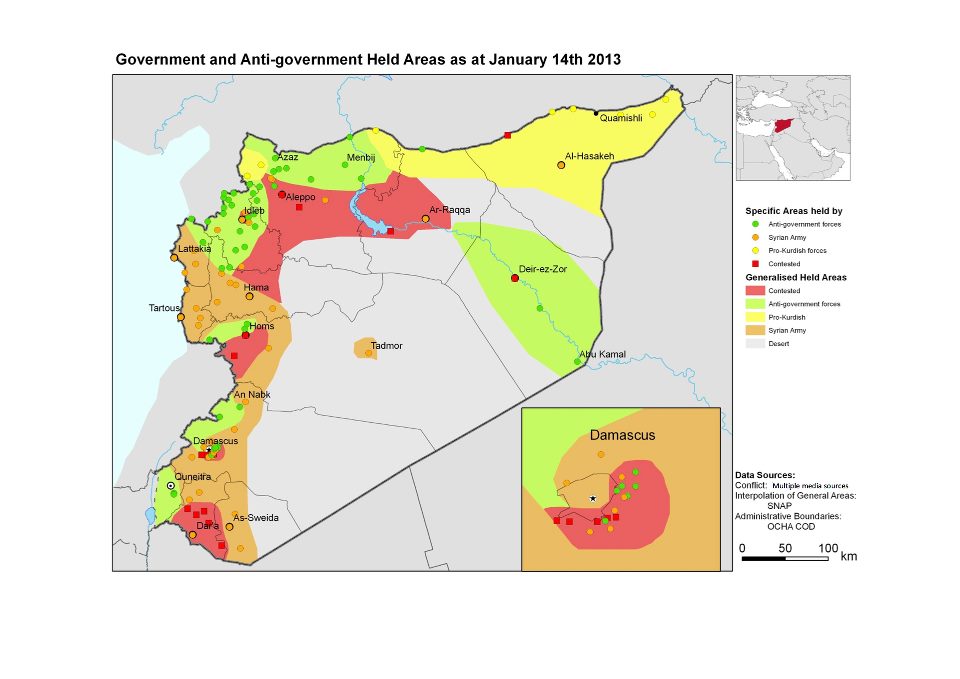
syria map

The map above was produced by the Relief Web website. Relief Web is a project of the United Nations Office for the Coordination of Humanitarian Affairs. The website, according to its homepage, aims to ‘provide reliable disaster and crisis updates and analysis to humanitarians, so they can make informed decisions and plan effective responses.”

The map purports to show an accurate breakdown of who controls what in Syria at the present time. But while broadly in accordance with the reality on the ground it contains at least one important error, which deserves to be pointed out, since adherence to the faulty map could have potentially disastrous consequences for visitors to Syria.

I’m concerned here with the part of the map dealing with Kurdish majority north-east Syria. I just returned from a reporting trip there, where I became aware of the map’s faults in a fairly practical way.

As you can see, the map depicts north-east Syria as controlled by ‘pro-Kurdish’ forces, which the map uses the color yellow to denote. The map accurately notes that the city of al-Hasakeh is controlled by the Assad regime’s army, whose color in the map is orange.

The map also accurately notes that the town of Sere Kaniyeh/Ras al-ain, which for some reason it nevertheless doesn’t name, is a ‘contested’ area (Arab rebels and Kurdish militiamen being the opposing sides in this contest.)

From there, however, the troubles begin. As observers will note, the map has the city of Qamishly colored in black. This is the only city in Syria colored in this way, and the map’s key does not explain what this coloring denotes. The map also has the area around Qamishly, and indeed the entirety of north-east Syria colored in yellow, indicating an uncomplicated reality of dominance by Kurdish forces.

This is an inaccurate depiction. In fact, Qamishly city and a considerable radius around it is in the hands of Assad’s army, as I discovered a couple of weeks ago when trying to reach Sere Kaniyeh from the town of Derik/Malkiyeh. Making this journey was essential for my reporting purposes, and its requires going through Qamishly.

Because I consulted sources other than the UNCHA map, I was aware that Qamishly was in regime hands. Still, I wasn’t prepared for the depth and extent of regime control. Qamishly city is filed with regime police, soldiers, flags, and a number of checkpoints.

I was travelling with a very experienced local Kurdish driver, and his wife, a translator. Because of this man’s local knowledge, we were able to avoid the checkpoints. As we drove west, the signs of regime dominance were still apparent, even 10 and 15 km outside the city. Regime flags, pictures of Bashar Assad, Ba’ath party banners.

As far as the town of Jawadiyah, maybe 20 km from Qamishly, the regime was in evidence, and in Jawadiyeh itself, a significant base is situated. After that, it was just a few minutes further drive before we hit the first checkpoint of the YPG Kurdish forces, and knew we were indeed back in Kurdish controlled territory. (And I, being in Syria without any formal permission, breathed for the first time in several minutes.)

The basic failure of the Relief Web map to conform with reality did not lead to any great consequences in my own case. That was due to the skills and knowledge of my hosts, and to my consulting of other sources. It is nevertheless, a notable professional failure.

The UN Office for the Coordination of Humanitarian Affairs has an overall global budget for 2012 of $285.4 million, according to its website. Possession of this sum, sadly, did not enable it to come up with a simple map outlining the division of forces in northern Syria which managed to approximate the actual situation. This is unfortunate. I write this article to caution journalists and others planning on working in Syria, and researchers and observers of the situation in that country against relying on the information provided in the Relief Web map of ‘Government and anti-Government Held areas’ of Syria, as published in January, 2013.

Posted in Uncategorized | Tagged , | 6 Comments

Syria’s Kurds end their silence

National Post, 23/2

As the civil war in Syria grinds on, one of the less noticed developments has been the emergence of a de facto Kurdish autonomous area in the country’s north east. Stretching across a chain of towns and villages from the border with Iraq to the disputed Sere Kaniye/Ras al Ain area, this Kurdish-ruled area is seeking to carve an uneasy position between regime and rebels.

The Kurds are opposed to the Assad regime, which brutally suppressed their aspirations over the last decades. At the same time, they are also deeply suspicion of the ambitions and intentions of Turkish-backed Islamist rebels.

The Kurdish creation of an autonomous zone has not gone un-noticed by the Syrian rebels. One of the key objectives of the largely Sunni rebellion is to maintain the territorial integrity of Syria. They suspect that the Kurds are planning to split off from the country. The result is an emerging ‘civil war within a civil war’. Rebel groups, apparently backed by Turkey, have clashed with Kurdish fighters in the flashpoint town of Sere Kaniyeh/Ras al-Ain. An uneasy ceasefire has now been signed in the town. Few expect that the last word has been said on the matter.

The Kurdish-ruled zone is situated in one of the most fertile areas of Syria, once known as the ‘breadbasket’ of the country. It is also the home of most of Syria’s oil reserves, making it a prize to be fought over between regime and rebels.

In late February, I travelled to this area. There is little good news coming out of Syria these days. But the Syrian Kurds, one of the region’s most oppressed minorities, looked like they were quietly carving out a safe zone for themselves amid the chaos. I wanted to see if that was in fact so, to assess the chances for long term survival of this area, and to ask what this might mean for the future of Syria as a whole.

I entered Syria ‘illegally’, accompanying a squad of Kurdish YPG militia fighters across the Iraqi border. The YPG (Popular Protection Units) are the PKK-trained Kurdish force that constitutes the sole military factor within the Kurdish autonomous zone in north east Syria.

We arrived in the town of Derik (Malkiyeh in Arabic). This town of 26,000 is one of the main centers of the Kurdish autonomous zone. The last regime security forces were expelled in November. I spent the next two days in Derik, observing the process whereby for the first time a functioning Kurdish apparatus of government was being created.

The old headquarters of the Political Security branch of Assad’s intelligence services is now the headquarters of the PYD (Democratic Union Party), the PKK-aligned movement which dominates the Syrian Kurdish autonomous zone. Flanking the building are two other new PYD-sponsored facilities, a center for Kurdish ‘revolutionary youth’ and a womens’ center.

The de facto domination of the PYD is the most immediately notable aspect of Derik.I spoke to one of the leaders of the party in Derik, 35 year old primary school teacher Talat Yunis. “The Kurds are with neither the regime nor the Free Army,” Yunis said, “the Kurds are a third point in the revolution.”

And what was the ultimate goal of this self-organization, I asked. Did his party seek independence, to split off from Syria? “The Kurds want self-government,” he replied, “but in the context of the Syrian nation. Any new government will have to accept self-rule in Kurdish areas – self-government, but within a democratic Syria.”

Yunis made it sound easy. Derik had within it an atmosphere of optimism that made this seem plausible. Under Assad, Kurdish was repressed in all its forms. Kurds were unable to speak their language outside of their homes, to study their culture, to give their children Kurdish names.

Now, in the cultural center in Derik, with the visage of Bashar Assad removed from the entrance, a play in Kurdish was taking place in the main hall. The sound of the tambour (a Kurdish stringed instrument), rang out from an adjoining room, as a group of men practiced Kurdish folk dancing.

But the atmosphere of liberation has a number of shadows over it. Firstly, not everyone welcomes the dominant role of the PYD in the governance of the Kurdish areas. While officially, a Kurdish ‘supreme committee’ bringing together the PYD with other, smaller parties is the governing body, everyone knows that the armed strength and mobilization of the PYD ensures that it is the sole true ruler.

For some local Kurds not affiliated with the PYD, this is a problem. One young woman I spoke to said that the party was repressive of voices other than its own, and had elevated ‘uneducated’ people to positions of power that they were abusing.

A broader problem facing the Kurdish enclave is that both sides in the civil war – the Assad regime and the Sunni Arab rebels – are opposed to its existence.

The Assad regime has largely abandoned northern Syria, and will probably never return. The rebels, on the other hand, are the new power in the north.

Sereh Kaniyeh is the point where the rival ambitions of Sunni rebels and Kurds collide. Twice – in November and mid-January, fighting has broken out in the town as the rebels sought to push their way in.

I travelled to Sere Kaniyeh from Derik, and met with fighters and commanders of the Kurdish YPG organization at a front line position.

The town has an eerie atmosphere. It is nearly deserted of civilian inhabitants. Large areas of it have been visibly devastated by the fighting. Burnt out buildings, debris, walls pock-marked by bullet holes mark the front line area. Remaining civilians stay in their homes, waiting for the food and heating materials provided by Kurdish relief organizations.

The frontline runs through the town. Islamist rebels of the Jabhat al-Nusra and Ghuraba al-Sham groups still hold two neighborhoods – Yusuf al-Azma and Sumud, constituting about 10% of the town.

Jamshid Osman, a YPG commander in Sere Kaniyeh, is convinced that the two rounds of fighting in January and November were part of a coordinated effort to destroy the area of Kurdish self-rule. Osman, in his late 20s and wearing an incongruous Russian-style military cap, has become well known throughout the Kurdish area because of the prominent role he and his men took in the fighting in Sere Kaniyeh.

“The Free Army took money from the Turkish government to fight in Sere Kaniyeh,” he told me, as we spoke at a house near the frontline dividing the sides. “Sere Kaniyeh is the first phase. They want to go on to Derik and Rumeilan and take the petrol and oil there.”

This Kurdish suspicion of a joint Turkish and Islamist plan to snuff out the emerging self-rule area is very widespread. It has some logic to it, and some evidence. The Islamist attackers do seem to have come across the Turkish border, and to have made use of a Turkish hospital to treat their wounded.

Few on the Kurdish side expect the ceasefire in Sere Kaniyeh to hold. As for their ambitions for ‘western Kurdistan’,– as Osman put it, “we’ll fight anyone who wants to make us slaves.”

Osman’s words should be noted, and taken seriously. The YPG have performed effectively and successfully in all their encounters with the Sunni rebels so far. As Syria fragments, ethnic and sectarian loyalties are coming to the fore. This fragmentation and reversion back to pre-existing ethnic and sectarian identities plays to the advantages of the Kurds, who have a more developed and crystallized identity of this kind than other population groups in Syria.

They are also able to draw on Kurdish political formations from outside the country – most importantly, the PKK and Massoud Barzani’s Kurdish Regional Government in northern Iraq.

The Syrian civil war may yet last a long time. The Kurdish position in it is clear. As one young student in Derik put it to me ‘we don’t want the regime on our lands – and we dont want the Free Syrian Army either.”

This desire to preserve autonomy and a measure of quiet amid the chaos of civil war in Syria is entirely understandable. Of course, the insanity now gripping Syria may prevent this modest ambition from coming to fruition. But to witness the fighters of the YPG on the frontline in Sere Kaniyeh, and the organizers and activists in the town of Derik is to see a people who have ended their silence. Any attempt to return them to it is bound to be strongly resisted.

Posted in Uncategorized | Tagged , , | Leave a comment

Syria’s War within a war

Jerusalem Post, 2/2/13

Clashes between Kurds, Islamist rebels point to increasing fragmentation of Syria

A civil war within a civil war has been under way for the last two weeks in the small Syrian-Kurdish border town of Sere Kaniye, in Hassakeh province in northern Syria. The town, known as Ras al-Ayin in Arabic, has witnessed fierce fighting between Islamist Syrian rebels and a Kurdish militia.

The rebels, led by the Salafi Jihadist Jabhat al-Nusra organization, are seeking to push into the town apparently as a first move in an attempt to undermine a de facto Kurdish autonomous area stretching to the border with Iraq. The Kurdish YPG (Popular Protection Units) have until now managed to prevent the jihadis from gaining all but a small foothold in the town.

The Sere Kaniye fighting is an indication of the increasing transformation of Syria’s civil war from an insurgency against the dictatorship of Bashar Assad into a many sided conflict in which the various ethnic and sectarian communities of Syria fight over the country’s ruins.

The de facto Kurdish autonomous zone in north east Syria has existed since last summer. The regime’s forces at that time withdrew from the area, apparently as part of a larger strategy in which Assad has abandoned most of the northern part of Syria in order to consolidate his forces around Damascus and in the western coastal area.

Since the departure of Assad’s troops, the north eastern enclave has been effectively under the control of the PYD (Kurdish Democratic Union), a Kurdish Syrian party closely linked to the PKK guerrilla organization. In a move reminiscent of that made by the Kurdish Regional Government in Iraq during that country’s civil war, the Kurds have made clear that they intend the area under their control to be off limits to both the Assad regime’s forces and the rebels fighting them.

This development has not gone un-noticed by the Islamist brigades that form the vanguard of the rebellion against Assad in Syria’s north.

In a recent interview with this reporter, Hadji al-Bab, one of the commanders of Aleppo’s powerful Tawhid Brigade, differentiated between Kurds who supported the revolution and those who supported a ‘separate Kurdish country.’ He claimed that the latter group were in fact working in coordination with the regime.

The Tawhid commander stressed that the territorial integrity of Syria was non-negotiable for the rebels, and added that minorities would be protected in the ‘Islamic state’ which was the revolution’s goal.

The first attempts by the Islamist rebels to break in to the Kurdish enclave came in November of last year. Sere Kaniye, situated at the edge of Hasakeh governate and on the Syrian-Turkish border, was a natural first target. Elements of a number of Syrian Islamist brigades, including Jabhat al-Nusra, Ghurab al Sham, Tawhid and Ahfad al Rasul first fought with remaining government forces in the town, then refused to vacate the area in line with requests from Kurdish local authorities.

An attempt by Islamist fighters to erect checkpoints and begin to impose extreme Islamic norms in the town, and the killing of Amed Xelil, a local Kurdish civilian leader, led to resistance from the Kurdish YPG. In the subsequent fighting, four YPG members and 18 of the Islamist rebels were killed, according to Kurdish sources.

The clashes continued until November 22, when a shaky truce took hold. Colonel Riad Asaad, nominal leader of the Free Syrian Army, criticized the actions of the Islamist fighters. In so doing, Asaad inadvertently showcased the growing irrelevance of the nominal, secular leadership of the FSA.

After a period of quiet, Islamist rebels again attacked Seri Kaniyeh on January 16th. On January 17th, Jabhat al Nusra fighters entered the town accompanied by a number of T-55 tanks. According to Kurdish sources close to the PYD, the Islamist fighters entered the town from across the Turkish border. The Kurds also maintain that Islamist fighters wounded in the fighting were transported back across the border for treatment in neighboring Turkish hospitals.

At least two of the tanks were destroyed by YPG fighters. There have been deaths on both sides. The fighting continues. The Islamist rebels have failed to make real headway into Sere Kaniyeh, as of now.

The fighting in this area constitutes a new front of civil war in Syria. Since November, the Assad regime has been absent from the town. The nearest government forces are situated far to the south. Instead, the war is one in which Islamist rebels, apparently backed by Turkey, are seeking to undermine an area of Kurdish autonomy and to prevent any possibility of secession.

The Sere Kaniyeh events show that it is now mistaken to think of the Syrian civil war as a single conflict, pitting the Assad dictatorship against a popular insurgency.

The Assads, for all their many faults, grasped a certain truth – that Syria, a state established by British and French colonialism, lacked any real binding identity, and could be held together only by force. The force of the dictatorship is now gradually receding and fading. As it does so, the incompatible component parts that it held together are beginning to separate.

The regime itself is turning into a structure operating on behalf of the Alawi minority. The Sunni Arab insurgency is also divided along ideological and tribal lines. The Kurds in north east Syria, meanwhile, are making clear that they want no part of either the Sunni Islamist rebellion or the reduced dictatorship. In a manner similar to their compatriots in Iraqi Kurdistan, they are seeking to create a defensible haven for themselves. The Islamist rebels are trying – so far without great success – to force their way into this haven.

The war within a war in north-east Syria thus offers stark evidence of the extent to which ‘Syria’, as a unified state, no longer really exists.

Posted in Uncategorized | Tagged , , , | Leave a comment

Some thoughts on the elections in Israel

With the vote-counting nearly completed, it is already possible to draw a number of conclusions regarding the 2013 Knesset elections in Israel

Firstly, the long-standing division of Israeli parties into ‘left’ and right’ wing blocs does not fully capture the reality. The norm among analysts is to cite the existence of two competing ‘camps’ in Israel – the ‘left and the Arabs’ bloc, and the ‘right plus the religious’ bloc. If seen in these terms the elections yesterday produced a tie, with each of these blocs winning 60 seats in the 120 member Knesset.

But if one considers that the ‘left’ bloc is supposed to include everyone from the centrists of Yesh Atid to the Nasserist Arab nationalists of the Balad movement, and the ‘right’ takes in Ultra-Orthodox Jews of Shas and secular, security-minded hawks in Likud, it becomes plain that this simplistic division is insufficient.

The ‘left’ and ‘right’ blocs were once characterized respectively as those parties committed to the possibility of territorial compromise as a road to peace with the Palestinians and the Arab world, and those opposed to such a path on security or nationalist/religious grounds.

This was always an insufficient distinction. But it ceased to make sense a long time ago. In Israel today, there are few true believers in ‘land for peace’, because of the obvious failure of experiments in territorial compromise to actually bring about a peaceful solution. At the same time, there are also fewer ideological adherents to the traditional ‘Whole Land of Israel’ philosophy of the right.

Rather, the salient fact of Israeli politics today is the existence of a large pool of voters who do not totally reject the possibility of compromise, but who are deeply skeptical of Arab intentions. These centrist voters are not fired up or primarily concerned with ideological and nationalist issues.

Amid the surrounding Mid-East chaos, they want normal lives for themselves and their children. Their priorities are largely identical to those of middle class voters in other western democracies – taxation, personal security, standards of education.

The big ‘surprise’ of the election results yesterday resulted from the presence of this public. This was, of course, the strong performance of the ‘Yesh Atid’ party of former journalist Yair Lapid. Lapid’s appeal – pragmatic, moderate, concerned with a fair sharing of the national burden – was precisely to these Israeli centrist voters. It worked.

But Lapid may want to note that his is only the latest in a long line of centrist lists that have done well initially by appealing to the Israeli center, but have subsequently failed to establish themselves as a permanent presence on the political scene.

Kadima, which last night went from 28 seats down to a projected 2, was an example of just such a party. Before this, Israelis remember the Center Party of former Chief of Staff Amnon Shahak, the Shinui party of Lapid’s own father, the Third Way list of Avigdor Kahalani, all the way back to the prototype Israeli centrist surprise of Yigael Yadin’s Democratic Movement for Change in 1977.

One of the central paradoxes of Israeli political life is that this middle-class, centrist public is the key presence and the backbone of Israeli society, but no party able to retain its undivided affections for long has yet emerged. Centrist lists in Israel tend to burn brightly but briefly. The system has a near insurmountable tendency in the end to go back to the dominance of the ‘historic’ parties of Likud and Labor, which derive from the rival, pre-state Revisionist and Labor Zionist movements. In this more limited sense, the ‘left-right’ division still makes sense.

The large, pragmatic center in Israeli politics, meanwhile, remains stubbornly invisible to many analysts in the international media.

A somewhat hysterical story of Israel’s imminent turn to the far right and the decline of Israeli democracy was told and re-told in the western media in the weeks prior to the elections. Even some of Israel’s less well informed friends began to buy into it.

There was little substance to this. It was based on the emergence on the national-religious side of Israeli politics of a new, young and charismatic leader, Naftali Bennett. Bennett succeeded in uniting the old National Religious Party support with the far right (in the process, removing other far-right lists from the Knesset.)

Bennett’s Bayit Yehudi list won 11 seats. If he seems to have failed, it is because he was built up to absurd proportions by an international media keen to cast Israel as a country falling to the radical right. In terms of what was actually possible, he has recorded a modest but notable achievement.

As for the western pundits – as one wag on a British website put it – ‘its almost as if they have absolutely no idea what they ‘re talking about when it comes to Israel.’

The ‘winner’ of the elections, of course, was the Likud Beyteinu list of Prime Minister Benjamin Netanyahu, in the sense that this list is by far the largest in the new Knesset, and Netanyahu is set to form the new government. But at 31 seats, it fell far short of the number its component parts (Likud and Yisrael Beyteinu) held in the outgoing parliament – 42.

This was the result of a lackluster campaign, and probably also of supporters of each of the component parts of the list being reluctant to vote for the other and thus taking their votes elsewhere.

The coalition negotiations will now begin. Likud Beyteinu and almost certainly Yesh Atid will be members of the new government. Their combined strength is around 50 seats. Other likely additions will be one or another combination of Bennett’s Bayit Hayehudi, the ultra-orthodox Shas and United Torah Judaism lists, Tzipi Livni’s HaTnua and the remains of Kadima.

Bottom line: the underlying strength and maturity of Israel’s democracy was demonstrated this week. With a region in flames all around them, Israelis pulled off an election with a high turnout (66.6%), conducted efficiently and transparently, focusing on a substantive discussion of the key issues facing the country, but largely devoid of deep division and rancor. The results indicate that a large, sane, pragmatic center is the core presence in Israeli political life. It is to be hoped that the government that emerges from the coalition negotiations will reflect this reality.

Posted in Uncategorized | Tagged , , , , | Leave a comment

A Gulf Apart

Jerusalem Post, 18/1.
Saudi and United Arab Emirates security forces recently apprehended a 10-man cell linked to the Muslim Brotherhood that was active in the UAE. The cell, according to Gulf media reports, was engaged in raising money for the Muslim Brotherhood in Egypt, propagandizing among Egyptians residing in the UAE and gathering information on the UAE’s defense facilities. It was also reported as being in “constant communication” with its parent movement in Cairo.

The arrest of this group has highlighted growing fears in some conservative Gulf states that the Muslim Brotherhood is now turning its attention to the Gulf monarchies.

But the monarchies are sharply divided in their response to the rise of the Brotherhood.

The 2011 to 2012 period brought a long-awaited windfall of political power for the Muslim Brothers. Franchises of the movement are now in government power in Tunisia and Egypt. The Brotherhood is playing a major role in the Western- supported political and military leaderships of the rebellion in Syria.

The Palestinian branch of the movement – Hamas – would almost certainly have consumed its Fatah rivals by now were the latter not protected by Israel and supported by the West.

Indeed, the real story of the Arab upheavals of the last two years can be summed up as the replacement of secular nationalist dictatorships by Sunni Islamist movements, among which Muslim Brotherhood franchises form the most important element.

The secular nationalist space in the Arab world has now largely been replaced by an area of Sunni Islamist domination.

Only one secular nationalist regime – Algeria – remains in secure existence. The oil-rich monarchies form the next natural target.

In the Gulf, however, the situation is not simple. Sunni Islamists and Gulf monarchs are not necessarily natural enemies.

The Gulf monarchs adhere to and rule in the name of conservative, Sunni forms of Islam.

The Muslim Brothers may be revolutionaries, but they are also conservatives, seeking to revive what they present as an authentic form of Islamic government. In the past, Brotherhood exiles from Egypt and the Fertile Crescent played a vital role in developing the education systems and manning the bureaucracies of Gulf states.

This has led to two widely variant Gulf approaches to the movement.

The first, exemplified by Saudi Arabia and the UAE, sees the Brotherhood as the most dangerous challenge to the stability and longevity of the monarchies. The UAE and Saudi Arabia fear the Brotherhood precisely because its beliefs render it potentially appealing to dissatisfied elements among the populations of these states.

Last July, Dubai police chief Dhahi Kalfan (a name familiar to Israelis because of his central role in the events following the killing of Hamas official Mahmoud Mabhuh in the emirate), accused the Brotherhood of plotting the overthrow of the Gulf monarchies.

The latest arrests follow the apprehending of 60 suspected members of the Brotherhood- linked al-Islah (“Reform and Social Guidance”) movement over the summer in the UAE.

UAE Foreign Minister Sheikh Abdullah bin Zayed al-Nahayan said after the arrests that “The Muslim Brotherhood does not believe in the sovereignty of the state.”

Saudi Arabian Interior Minister Prince Ahmed bin Abdulaziz, meanwhile, has called the Brotherhood “the source of all the problems in the Islamic world.” The Saudis, seeking a counterweight to the Brotherhood in both Egypt and Syria, have thrown their weight (and financial support) behind ultra-conservative Salafi Islamist forces.

By contrast, the second approach, of which Qatar is the main exponent, sees the Muslim Brotherhood as a suitable ally, client and instrument. Qatar has adopted this strategy with energy and alacrity, as may be observed from its growing ties with the Brotherhood government in Egypt, support for the Brotherhood in Libya and Yemen and close links with the Sunni insurgency in Syria.

Qatar has long provided sanctuary for Muslim Brotherhood members. In return, the movement has since 1999 refrained from activity within the emirate. Famously, Doha offered a base of activities for the Brotherhood-associated Sheikh Yusuf al- Qaradawi, whose enormously influential broadcasts were put out by the emirate’s satellite channel, Al Jazeera.

Key current and former staffers at the highly influential Al Jazeera (which, of course, never criticizes Qatar) are Muslim Brotherhood members. Among these are Waddah Khanfar, former general manager of Al Jazeera.

Doha has proved a generous benefactor to the Muslim Brotherhood government in Cairo. This week, Qatari Prime Minister Sheik Hamad bin Jassem al-Thani announced a $2 billion loan and a $500 million grant to Egypt. This is the second such package since the Muslim Brotherhood election victory in August (which was also financed with Qatari money.) Qatar’s massive oil and gas wealth and tiny citizen population evidently mean that it considers itself immune from any potential threat from the Sunni Islamists.

The emirate is inhabited by 250,000 Qataris, who enjoy the fortunate situation of being administered to by an additional population of around 1.6 million foreign workers, mainly from the Indian subcontinent.

Qatar’s presumed invulnerability to internal Islamist subversion enables it to partner with the Muslim Brotherhood and to wield influence within the new Sunni Islamist regimes now emerging.

This, in turn, will enable Doha to increase its diplomatic clout in mediating between such regimes and between them and other regional and global players.

The Saudis, the UAE and others may be furious with the Qataris for the stance they are taking, but little can be done about it. This is because the current United States administration comes down on the Qatari side of the argument, regarding the Muslim Brotherhood in its various manifestations as a potential ally. In the context of the apparent US choice of the anti-Western and anti-Semitic Muslim Brotherhood as a regional strategic partner, Qatar’s approach appears entirely in tune with the times. Given the aforementioned nature of the Muslim Brotherhood, however, it is also likely to contribute to the emergence of a vastly less stable Middle East.

Posted in Uncategorized | Tagged , , , | Leave a comment

Murders in Paris

PJ Media, 16/1.

Three female Kurdish activists were murdered in Paris earlier this month.

The execution-style killings took place at a Kurdish information office on the quiet Rue Lafayette, near Paris’s Gare Du Nord. One of the three women, Sakine Cansiz, was a founder member of the PKK (Kurdish Workers Party) movement, and a close associate of its jailed leader Abdullah Ocalan. The other two, Fidan Dogan and Leyla Soylemez, were activists in civilian movements supportive of the PKK.

These killings have shocked the Kurdish political world. This is the first time that Kurdish political figures have been targeted in Europe since the murder of four Kurdish nationalist leaders in a restaurant in Berlin in 1992 by the Iranian Revolutionary Guards.

The tragic murder of the three women activists is also the latest explosive indication that things are on the move for the Kurds. Too quickly for some, it would appear.

The Kurds seemed once to have been passed by in the geopolitics of the Middle East. The state borders that divided them looked set in stone, presided over by brutal and rock-solid dictatorial regimes.

The edifice of these regimes is now in ruins. And as Arab dictators fall to Islamist insurgencies and popular unrest, so the ambitions and national aspirations of the Kurds are returning once more to relevance and to the realm of the achievable. This is leading to political action — and reaction.

The investigation into the killings has begun, and Kurdish and Turkish media outlets are speculating as to the possible identity of the perpetrators. Many in the Kurdish nationalist movement believe Turkish far-right paramilitaries, possibly in cooperation with elements in the Turkish state, are most likely to have been responsible. Turkish officials, meanwhile, are seeking to portray the killings as the result of an “internal feud” within the PKK itself.

A third possibility cited by some analysts: the killings were carried out by an outside power with a reason to prevent any progress toward peace between Turks and Kurds. Syria and Iran have been mentioned as possible culprits in this regard. Both countries would stand to benefit from stirring up the conflict between Turks and Kurds, and both countries have a track record of using murders of this type as a tool of policy.

With the investigations into these killings just beginning, only speculation is possible regarding the likely perpetrators. More concrete conclusions, however, are possible regarding the political environment in which these killings took place.

January 2013 saw the surprising announcement of talks between imprisoned PKK leader Abdullah Ocalan and a representative of the Turkish state — Hakan Fidan, head of the Turkish external intelligence service MIT. The talks came after a year of intensified PKK activity following the collapse of a ceasefire in 2011.

Ocalan and the Turkish representative, according to media reports, succeeded in reaching a series of understandings intended to launch a diplomatic process that would bring an end to the conflict between Turks and Kurds.

Whether or not these talks produce a resolution of the Turkish-Kurdish dispute, that they are happening at all is testimony to how much things have changed.

Turkey is currently deeply concerned by the emergence of an enclave in northeast Syria which is dominated by the PYD, the franchise of the PKK among the Syrian Kurds. The Turks are doing their utmost to enfeeble and impoverish this new Kurdish autonomous area. Evidence has emerged of Turkish support for Islamist elements among the Syrian rebels — including the al-Qaeda linked Jabhat al-Nusra group — who have clashed with PYD fighters on the edges of the Kurdish enclave.

In addition, Ankara has made use of its flourishing relationship with Massoud Barzani — head of the more established autonomous Kurdish area in northern Iraq — to secure the closing of the borders between this area and the newly established Syrian Kurdish autonomous zone.

Barzani needs Ankara’s support in his face-off with the government of Nouri al-Maliki in Baghdad. Against this background, he is evidently unable to refuse Ankara’s request regarding the border, though this means mid-winter hardship for Kurdish residents of northeast Syria.

So there are now Kurdish autonomous zones in both Syria and Iraq, stretching along a massive border with Turkey. The Syrian zone is controlled by elements close to the anti-Turkish insurgents of the PKK, and in the Iraqi zone, the PKK also operates from the border area with the tacit acceptance of Barzani.

Ankara has every incentive to try to neutralize the problem.

Diplomacy and political processes form part of its effort to do so. But since Ankara is unlikely to offer anything more substantial than an amnesty for PKK members in return for their disarmament, greater powers for local authorities, and a liberalization in policy toward education in the Kurdish language, Kurdish ambitions can probably not be contained within this framework.

Erdogan wants to commence a political process vis a vis the Kurds before the issue transcends boundaries which he can control. Ankara’s overtures are an indication of how far the Kurds have come, and how much the region is changing.

The murders in Paris may well also be a harbinger of things to come, as powerful regional forces move to disrupt and stall Kurdish gains by making use of familiar, brutal means.

Posted in Uncategorized | Tagged , , , | Leave a comment

A Nation Once Again?

Jerusalem Post, 28/12/12

In Syria, the Assad regime’s retreat back to Damascus and the Alawi heartlands in the west of the country has made possible the emergence of a Kurdish autonomous area in the country’s northeast.

This area shares a border with Kurdish- controlled northern Iraq. As a result, a contiguous area of Kurdish control, stretching along the southern border of Turkey, has come into being.

This emergent reality is raising again a question long dismissed from serious strategic discussion: namely, that of the establishment of a Kurdish state.

However, the obstacles on the path to Kurdish sovereignty remain formidable, and the geo-politics of the situation are fraught and complex.

The Kurdish Regional Government (KRG) in northern Iraq, led by Massoud Barzani, possesses its own armed forces, political system, capacity for oil production, public services and Kurdish-language education system and media. Its capital, Erbil, has the feel of a boomtown, with construction cranes along the skyline and new malls and hotels emerging from the dust.

The quasi-independence of northern Iraq is leading to increasing tensions with the government of Prime Minister Nouri al-Maliki in Baghdad. In the course of the last year, the autonomous Kurdish region cut off oil deliveries to the center of the country in a dispute over payment. The KRG’s providing of refuge to a fugitive former Iraqi vice president, Tariq Hashimi, also raised Baghdad’s hackles.

The KRG’s efforts to boost its oil production capacity and infrastructure are viewed with suspicion in Baghdad, which sees these as a possible prelude to a bid for independence.

The latent tensions came to a head in November, with clashes between the Iraqi army and the KRG’s Pesh Merga forces along the poorly demarcated line dividing the Kurdish autonomous zone from Iraq. The two forces remain deployed in large numbers on either side of the “border.”

In October 2011, the KRG signed a contract with US oil giant Exxon-Mobil for exploration of areas on the southernmost tip of the KRG area. The Baghdad government has made clear that it considers such deals to be illegal and that Exxon-Mobil will be making a “grave mistake” if it begins the exploration next year, as scheduled.

The dispute remains unresolved. Yet the KRG is finding an unlikely ally in its face-off with the authorities in Baghdad.

That ally is Turkey. Ankara needs a source of crude oil. The Erdogan government is worried at the Shi’a Maliki government’s Baghdad’s increasing closeness to Tehran. The KRG offers a potential alternative source. In the course of 2012, Erbil announced the signing of a deal with Ankara for the construction of a new cross-border crude oil pipeline (which would rival the Kirkuk-Ceyhan pipeline, under the Baghdad government’s control). Oil consignments are also making their way in trucks across the border.

Ankara, which once viewed the development of a Kurdish autonomy in northern Iraq with extreme suspicion, now appears to see Erbil as a possible ally against Baghdad and Tehran.

But at the same time, Turkey has signally failed to develop any coherent policy able to satisfy the aspirations of its own 18 million-19 million-strong Kurdish minority. Instead, Ankara remains committed to a brutal counter-insurgency against the PKK guerrilla movement, which is demanding autonomy for the Kurdish majority areas of southeastern Turkey. More than 700 people died this year in the fight between the PKK and the Turkish armed forces.

The main headquarters of the PKK, meanwhile, are in the Qandil mountains area of northern Iraq, adjoining the border with Turkey. There is no love lost between the PKK and the Barzani government in Erbil. But the KRG draws the line before taking aggressive steps against the PKK militants in Qandil. So while Ankara, for its own reasons, is now a near-ally of the Kurds of northern Iraq, it remains opposed to the aspirations of its own Kurdish population.

This picture is further complicated by the situation in Syria. There, the de facto autonomous Kurdish region is dominated by the Kurdish Democratic Union (PYD), which is the Syrian franchise of the PKK. This situation derives from the reality of PYD strength on the ground. But it has also been uneasily accepted by Barzani and the KRG and their local allies. The result is that these forces are today nominally in alliance in the Kurdish area.

With the Assad regime looking increasingly beleaguered further south, it is possible that this Kurdish unity may shortly be subjected to a harsh test, as it seeks to secure its future against a resurgent Sunni Arab, Islamist (and Turkish-supported) attempt to maintain a unitary Syria.

So an autonomous Kurdish region in northern Iraq has built close relations with Ankara on the basis of shared interests. But this region harbors Kurdish rebels seeking autonomy and rights in a struggle against Turkey.

At the same time, the rulers of this Kurdish region and the anti-Turkish Kurdish rebels are in alliance in a third country – Syria – where they may shortly be defending themselves against a Turkish-supported attempt to reunify Syria.

All this means that while the Kurds have made real and impressive gains over the last year, an imminent bid for statehood remains unlikely. The Kurds have one of the most obviously deserving of causes on an ethical level. In northern Iraq, they have laid much of the basis for sovereignty.

But they still lack a unified national movement.

And they are faced by a tangle of rival interests – in Baghdad, Ankara and Syria, not to mention Tehran – which each have a reason for opposing the emergence of full Kurdish sovereignty. So the odds remain steep.

The Kurds may console themselves, of course, by noting that the Middle East and the wider world today boast a number of examples of partially sovereign quasi-states, which lack full sovereignty but seem fairly durable nonetheless.

The Hamas entity in Gaza is one such example; Hezbollah-dominated south and east Lebanon (at least before May 2008) another. The Palestinian Authority in the West Bank offers a third variant, and the Syrian Alawis may be in the process of carving out a fourth.

It may be the fate of the Kurds in the period ahead to carve out a similar such space, albeit with vastly more historical grounding on its side than any of these other examples.

Although they do not have a state just yet, the Kurds have already established themselves as among the unexpected winners in the tectonic shift currently under way in the Middle East.

Posted in Uncategorized | Tagged , , , , | Leave a comment

Coastal Retreat

Is Assad preparing a last stand in Syria’s Alawi mountains?

Jerusalem Post, 21/12
The beleaguered regime of Bashar Assad in Syria suffered further setbacks this week. The Syrian rebels are slowly clawing their way into Damascus. A fierce fight took place in the Palestinian refugee camp of Yarmouk in the capital. The battle pitched the rebels of the Free Syrian Army against fighters of the Popular Front for the Liberation of Palestine – General Command. The PFLP-GC is a proxy of the Assad regime, commanded by a superannuated former Syrian army officer of Palestinian origin – Ahmed Jibril.

The fight ended with the rebels in control of the camp. The Hajal al-Aswad district of Damascus also fell to the rebellion in the last days.

Ahmed Jibril’s next move, following the defeat of his fighters in Yarmouk, offers a clue as to the possible next phase in the Syrian civil war. The PFLP-GC leader and his son vanished from Damascus. Various sources have now reported that Jibril has turned up in Tartous, on the Mediterranean coast, deep in the heart of the majority Alawi Latakia Governate.

If these reports are correct, the veteran Palestinian leader’s move is the latest indication that while the battle for Damascus continues, the loyalists of the Assad regime are already planning for the next phase, after the city falls. For months now, there have been signs that the regime has been laying the foundations for a defendable Alawi-dominated enclave in the mountains of Latakia province.

Senior members of the Syrian security and political elite have begun to send their families from Damascus to this emergent stronghold. Assad’s most loyal Palestinian client may have just become its newest resident.

The problem with this enclave, from Assad’s point of view, is that any conceivable, defensible boundaries it could have would take in an area which currently contains a large Sunni population. Indeed, the main city of the governate, Latakia city, has a 60% Sunni majority. This means that there is a very real prospect of ethnic cleansing in this area, as the dictator’s hold on Damascus becomes more tenuous.

The Alawi enclave would stretch from the Mediterranean coast to the Orontes River valley, just west of the majority Sunni cities of Homs and Hama.

The establishment of such an entity would be a last roll of the dice for Assad.

The viability of a Latakia-centered Alawi would depend on its receiving recognition and support from Russia and Iran. This is not inconceivable. In the event of a rebel triumph in Syria, both Moscow and Teheran are likely to pay a very heavy diplomatic price.

Both countries have been staunch allies of Assad throughout the uprising. This has not gone un-noticed by the rebels. An FSA officer interviewed by this reporter earlier this year said that ‘if the revolution succeeds, we will neither depend on, nor have relations with, nor take weapons from Russia.’ The same man also said that the Syrian revolution would “break the dream” of Iranian domination of the region—and more specifically, Tehran’s strategic ambition to create a contiguous line of pro-Iranian states stretching from Iran’s western borders to the Mediterranean Sea.

The Iranians are surely aware of this, too. They are also aware that their main investment in the Levant – Hezbollah – stands to be the next domino in the path of the Sunni Islamist juggernaut if Assad falls. The Russians, meanwhile, wish to preserve the last of their regional clients, and the naval facility at Tartous.

Could all this be sufficient for these countries to maintain the lifelines necessary to enable an Alawi stronghold on the coast to survive? The Russians and Iranians may themselves not yet have decided the answer to this question. It must surely be uppermost on the minds of the regime’s inner core at the present time.

But most crucial is the question of whether such an enclave could stem the advance of the Sunni rebels long enough to even begin the discussion of its viability and continued existence. The Syrian rebels are fully aware of the danger posed to Syria’s future territorial integrity by the existence of putative minority enclaves. As such they see snuffing out any nascent Alawi statelet on the west coast as a task no less important than is the capture of Damascus itself.

So the rebels are now trying to push further into the western coastal area and take the city of Latakia. Without this port city, no Alawi statelet could possibly be viable.

As of now, rebel forces have succeeded only in pushing at the boundaries of the putative Alawi stronghold, taking control of a few Alawi villages on its periphery. It is worth remembering that, their gains notwithstanding, the Syrian rebels have yet to take complete control of any of Syria’s major cities. So Assad’s men have some time left to embark on the establishment of their enclave. The rebels have still to complete the conquest of Aleppo, and are presently engaged in seeking to take the city of Hama, as well as focusing on the crucial battle for Damascus.

The timing cannot be predicted. But keep watch in the days ahead for more pillars of the regime such as Ahmed Jibril taking to the road from Damascus to Latakia. The concentration of such figures in the western coastal area could be the best indication for the direction of events in the next phase of the Syrian civil war.

Posted in Uncategorized | Tagged , , | Leave a comment