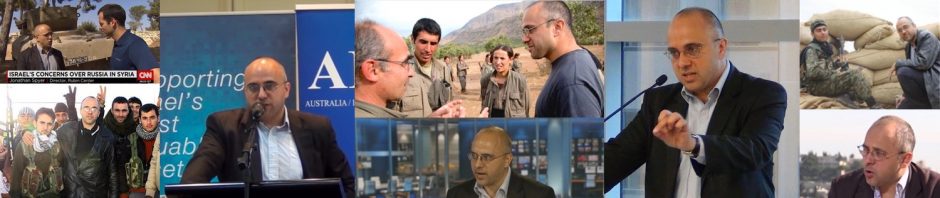
‘Tales From the Middle East Quagmire’ – Interviewed by Terrance Mintner for the Jerusalem Post magazine

22/12/17

In the summer of 2012, British-Israeli journalist Jonathan Spyer found himself in the basement of a hospital along with other Syrian civilians in bombed-out Aleppo City. They quickly took cover upon hearing the Assad regime’s aircraft patrolling the skies like a swarm of angry hornets. Their choice of refuge within Dar al-Shifa Hospital was a calculated move, a bet on human decency. Surely the regime wouldn’t target a hospital where the wounded and dying lay. Or would it? Assad, as many have painfully realized, isn’t too keen on clem ency for either the rebels or the non-combatants in his midst.

While they wait, the electricity suddenly gives out, after a massive bomb explodes outside in the street. Spyer and those around him cower in the pitch-dark basement for what must seem an eternity. We can imagine the thoughts racing through their heads.

Would the regime spare them or strike? And what about the rolling dice of human error or indifference? As has been widely reported, the regime often resorts to barrel-bombing rebel-controlled areas. The barrels, filled with TNT, metal bolts and fragments, cause great physical damage, as one expects, but also psychological havoc. “They were using dumb bombs, not smart bombs,” Spyer says, who is also a regular Jerusalem Post columnist. Their thinking was: “Throw it down there somewhere and it will land on someone.”

Landing on the hospital, a six-story building, such a bomb would likely cause the structure to collapse, turning it into a collective tomb for those inside.

At one point amid the intense fear, a young doctor named Khaled turns on a flashlight and trains it on his face, the only thing illumined in the pitch blackness. He commences a Muslim prayer chant involving a call and response, in hope of raising the spirits of those around him. His intervention eases the uncertainty and the danger soon passes.

“So, going into the shelter was a bit of a gamble,” Spyer says. “As it turned out, it worked.” But just two months later, he quickly adds, that bomb fell and the hospital was reduced to a smoldering pile of rubble.

In his newly released book, Days of the Fall: A Reporter’s Journey in the Syria and Iraq Wars, Spyer recounts the story in detail. He sees it as the most instructive episode he has witnessed as a journalist on the ground in Syria’s ongoing civil war, a conflict pitting the government of President Bashar Assad and his allies – Russia, Iran and Hezbollah – against a loose coalition of Sunni Arab rebel groups, including the Free Syrian Army, Kurdish forces and jihadist fighters. While the numbers remain murky, some observers believe the conflict’s death toll is fast approaching half a million.

Spyer recently sat down with The Jerusalem Post Magazine to flesh out why he believes the scene in the basement of Dar al-Shifa Hospital is a microcosm of the conflict as a whole. He also didn’t leave out other harrowing situations, his thoughts on social and religious reform in the Islamic world, and his personal motivations for thrusting himself into this quagmire.

(Speaking of harm, Spyer often traveled with his British and Israeli passports. He wonders what some people he met and interviewed, like ISIS members, would have done had they discovered the Israeli half of his national identity.)

So why is the hospital episode so telling? Spyer says it brings together three important aspects of the Syrian conflict: 1) the utter ruthlessness of the Assad re-gime and its allies; 2) the extent to which religion is the mobilizing factor in so much of the region’s politics; 3) the relative weakness of the rebellion.


Assad’s ruthlessness

As we have seen, and Spyer reiterates, “The regime has no qualms about launching air attacks on its own civilian population.” But how can this be? One would think that with observers – who can easily capture events with just a cell phone and relay the atrocities to the outside world – international criticism would mount exponentially, causing the regime to think twice, or cease its attacks altogether.

“Sadly, there is no evidence that it lessened its attacks in the face of criticism or stories emerging on the ground,” he responds.

Instead, he explains, there is plenty of evidence the regime did not weaken its resolve to target the rebels and the civilian populations surrounding them.Even after revelations that the regime carried out systematic murder and starvation of populations and prisoners in its vast prison system, it remains steadfast in its bloody approach. And what about its crossing of another red line: chemical weapons?

We recall the 2013 sarin gas attack in eastern Ghouta that killed 1,400 people, mainly women and children. The regime subsequently used the gas again just this year, prompting the Trump administration’s retaliatory barrage of Tomahawk missiles.

“There is no sense whatsoever in which the Assad regime appears to have been deterred from its strategy begun fairly early in the war, which is simply doing anything within its capacity to stay in power, regardless of the cost in human lives and societal infrastructure,” Spyer says. “It is a scorched-earth policy, immune to outside pressure.”

How can Assad blatantly get away with it? Spyer says Assad can pursue brutal policies, such as “carpet bombing entire civilian neighborhoods – 1940s style,” onlybecause his powerful allies – Iran and Russia – have made no attempt to rein him in. “Maybe if the regime had been isolated,” he speculates, “it would have hadto compromise or have done something else.”

Has the viciousness of the regime dimmed the journalist’s view of humanity? “Not really,” he says with a chuckle, using hand gestures that seem to glide along perfectly with his intonations, creating a sense of flow in his speech.

Spyer adds that he had such a darkened view of humanity to begin with. It’s an attitude that surely helps one cope with the surreal cruelties of the Syrian conflict. In this environment, he says, “one is able to operate if you’re a person who has very few illusions about the human capacity for cruelty and for violence.”

When pressed, Spyer reveals one thing about his reporting that, if it didn’t shock him, at least surprised him: The revival of slavery as an institution was something he thought would never happen again. He was referring to Islamic State’s enslavement of the Yazidi women – who were often used as sex slaves – and children in northern Iraq. After interviewing several escaped slaves in 2014, he was one of the first journalists to break the story.


Religion and regional politics

For Spyer, Khaled’s chants in the basement of the hospital represent the extent to which religion is the mobilizing factor in so much of regional politics.

When people are confronted with extreme situations of life and death, he explains, maybe religion is the only flag people can rally around. “Nothing else seems to have equal strength and depth.”

When we talk about religion, Spyer clarifies, “We are not really talking about an individual’s faith. Rather we are talking about markers or badges of ethno-religiousidentity.” In this sense, a person feels inextricably enmeshed in his or her community, one that is linked by blood, creed, familial relations and common origins.

Spyer says this powerful form of community exists underneath official definitions of a state’s citizenry.

“Officially, Syria is a non-sectarian state that guarantees equal treatment to all its citizens. In reality, it’s deeply divided among primordial communities, brought together without their consent into a state structure, and then largely held there by force.”

What we are witnessing now, Spyer continues, is “the breaking up or cracking of that bigger structure. People are naturally returning to a state of nature.”

The state and its official organs can no longer offer citizens the protection it once guaranteed. The result is a political vacuum being filled by people who are organizing themselves politically and militarily in the communal sense, along the lines of those preexisting ethno-religious loyalties.

Such loyalties are what undoubtedly propel the tensions between Sunni and Shi’a. This sectarian fault line is one of the main factors behind the region’s seemingly pervasive instability. Will this rift ever heal itself? Will Sunni and Shi’a hash out some viable form of coexistence?


It is often said that Islam must go through a reformation, like the one Europe or “the West” initiated exactly 500 years ago, after Martin Luther defiantly nailed his 95 Theses to the door of a German church in 1517, an act that split Christendom into warring camps of Protestants and Catholics. Today, there is no shortage of reformers in the Islamic world. One thinks of Ayaan Hirsi Ali, Tariq Ramadan or Maajid Nawaz.

Spyer points out that most of the reformers end up in the West, a telling point, considering their lives are in grave danger. The problem, he explains, is that thereform camp has no weaponry in this fight. It doesn’t have the ability to mobilize groups of armed young men.

“Political power in this region tends to grow out of the barrel of many guns. This is the currency, and if you can’t deal in it, you’ve come to the wrong exchange.”

He admits the whole idea of armed liberalism in the Muslim world sounds ridiculous. “We all know it doesn’t exist.”

Nevertheless, he agrees with the need for reform. “Islam needs to become criticizable,” he says. “There needs to be a public space in which you can criticize and analyze holy texts with modern tools, in which you can clear them away so you can analyze reality without them, without reference to them.”

Granted, this space does not exist, but is Islam on the way? Is it moving, via conflict, toward some sort of gradual resolution of its religious divides, as many,perhaps hopefully, predict? Spyer is skeptical. Citing Hezbollah, ISIS and Hamas, he sees no reason why these movements won’t continue to proliferate and flourish for years or even decades to come.

“I tend to find that human experience is very chaotic, without a plan or order, and that different societies can arrange themselves in radically different ways.”


A weak rebellion

When it comes to advantages, Spyer says the Sunni rebel forces have plenty of armed young men on the ground, plenty of courage and willingness to fight to the end. What’s utterly lacking are the technical means required to achieve decisive military gains. For example, they have little or no anti-aircraft capabilities.

There were certainly moments in the last few years when the Assad regime appeared to be teetering toward collapse. What saved it was the timely intervention of its allies. Spyer believes that Assad could now only be forced out if his allies choose to abandon him.

Minus that unlikely scenario, “there is a feeling he could be around for a long time.”

During his six years of reporting in conflict zones, Spyer certainly compiled his list of close calls and distressing situations. He has illegally crossed heavily guarded borders, where trespassers have been shot at. In another instance, this time in Iraq, he traveled with Shi’ite militias and witnessed a firefight with Islamic State fighters. He has heard plenty of bullets whizzing past.

One time he posed as a British pro-regime journalist in Syria and began working with pro-regime collaborators. All they had to do was Google his name and they would have easily discovered his Israeli citizenship. He seriously considered the dreadful possibility of being taken away in some unmarked van. Fortunately, that didn’t happen.

The close calls didn’t stop Spyer from laying claim to another bragging right: interviewing two ISIS members in 2014. At this time, however, the risks were con-siderably fewer. The jihadist group was part of the Arab rebellion and had not yet established its ill-fated, barbarous caliphate. Furthermore, the two fighters were unarmed and agreed to meet the journalist on much safer ground – in Turkey – just a short distance from the Syrian border.


Spyer discovered that most of the men fighting under this banner were not lunatics from all over Europe, as is commonly thought. Rather they were local men with local agendas. He admits it’s less glamorous to look into these more parochial concerns, but no less important if we hope to grasp how this group succeeded in attracting so many recruits.

They were also attracted to the organization’s perceived aura of purity. It wasn’t corrupt, unlike many of the rebel organizations which fed off local population, Spyer explains. By not siphoning off much needed food and supplies, and fashioning itself as a return to the ways of the prophet and his companions, ISIS achieved a reputation as a trustworthy and organized guardian of Sunni communities. The thinking was, “If ISIS goes down you can forget about Sunni people in Syria.”

In the end it was the wrong decision, he asserts. “Islamic State was a dreadful and evil group.”

ISIS would eventually become too extreme for even the likes of al-Qaida and its affiliates. It’s just one instance, among countless others, of the region’s unworldly extremism and skewed priorities.

Spyer retells another example, one that happened in 2012. He was following throngs of refugees pouring out of Aleppo City, a dreadful sight, he recalls. They trudged along hopelessly after leaving all their possessions behind. The refugees gathered in an area along the Turkish border, where they hoped the Assad regime wouldn’t bomb for fear of provoking a cross-border incident with the Turks. As the displaced made their way, the Danish cartoon controversy was raging throughout the Muslim world. A militia fighter who learned Spyer was British approached the journalist, demanding to know why Westerners can portray religion in this way. “This is not civilized behavior,” the fighter blurted.

“I thought, here is this man from the Syrian militia, part of utter chaos. Thousands of women and children were without any kind of defense, cowering against the possibility of murder by their own government, and this guy wanted to criticizeWestern civilization because we put a picture of Muhammad in a newspaper? This was a travesty to me.”

Spyer says he puts himself in harm’s way out of his loves for writing and the machinations of history and to understand political upheaval. There is also an altruistic drive. “By doing journalism in its purest form, you are out there alone or with your own team, miles away from other journalists. You often stumble upon stories that nobody else is going to get and you bring these truths to the world.”

“You experience degradation and suffering, that is true, but you are also witness to evidence of the most sublime aspects of human nature. The kind of generosity of young people, of armed young people who, before your own eyes, are willing togive up their own precious lives to save others who are helpless.”

He references Kurdish men and women fighters who in 2014 were willing to give their own lives to save 20,000 Yazidis trapped on Mount Sinjar, after barely escaping slaughter at the hands of ISIS.

“This is astonishing evidence of human altruism andgoodness, and that is available for view on the battle front as well.”


Posted in Uncategorized | 1 Comment

‘Days of the Fall’ now available

Over five years, Jonathan Spyer reported from the depths of the wars, spending time in Aleppo, Baghdad, Damascus, Mosul, Idlib, Hasaka and other frontline areas. He witnessed some of the most dramatic events of the conflict – the rescue of the trapped Yezidis from the attempted ISIS genocide in 2014, the Assad regime’s assault on Aleppo, the rise of independent Kurdish power in north east Syria, the emergence of the Shia militias in Iraq as a key force. ‘Days of the Fall: A Reporter’s Jirney in the Syria and Iraq Wars’ depicts these events, and seeks to place them within a broader framework.

https://www.routledge.com/Days-of-the-Fall-A-Reporters-Journey-in-the-Syria-and-Iraq-Wars/Spyer/p/book/9781138560413


Posted in Uncategorized | Leave a comment

Jerusalem Deals in Reality

The Australian, 15/12

The neighborhood where I live, on the seam line dividing Jew and Arab in Jerusalem, can be a useful place to take the temperature of the Israeli-Palestinian conflict.

In 2015, a wave of stabbing attacks against Israelis and Jews began.  This was the result of a campaign of incitement by Islamist groups according to which the government of Israel planned to change the status quo regarding the Temple Mount/Haram al-Sharif.

A number of the stabbers came from close by, and for a while, a police roadblock appeared on the main street.  Petrol bombs were thrown at a Jewish house in the neighborhood in February, 2016, at the height of that period of unrest.

In late 2014, just after the Gaza war, Palestinian youths threw stones at police in the neighborhood, after the police shot dead a man who had tried to kill a prominent Jewish activist who led a campaign to demand Jewish prayer rights on the Temple Mount.

Since the announcement by President Donald Trump of US recognition of Jerusalem as the capital of Israel this month, however, the neighborhood has been quiet and serene.  People are going on with their everyday lives.

The difference at ground level with previous periods of tension is notable and significant.

Of course, the situation in a single seam line neighborhood cannot reflect the whole picture. The occasion has not  passed without injury and loss of life.  Hamas declared three ‘days of rage’ following Trump’s announcement.  2 Palestinians were killed and 98 wounded in the subsequent demonstrations.

There was rioting in Wadi Ara, inside the borders of Israel.  An Israeli security guard was stabbed and critically wounded at Jerusalem’s Central Bus Station on Sunday. And in Gaza, the rocket launching activities of small militant groups are leading to a significant rise in tension.

But attendance at the Jerusalem and West Bank protests has been notably poor – a few thousand across the entire area.  This week, the demonstrations have dwindled further.
What might explain the relatively minor dimensions of the protests?

First of all, President Trump’s declaration was just that – a declaration.  With no immediate practical import.

But there are other important factors.  In Jerusalem, Christmas and New Year bring with them throngs of tourists.  Palestinian traders and businesses in the east of the city stand to gain from their presence.  Many do not want to help fan the flames of a situation that will lead to the tourists staying at home.

The general quiet of recent months has brought with it opportunities for engaging in commerce, education. People are keen to preserve these opportunities. This situation is fragile, of course. A single incident could transform it. But for the moment, it is holding.

One should also factor in the searing experience of the Second Intifada in the 2000-4 period. This was an armed insurgency ,in which 3000 Palestinians and 1000 Israelis lost their lives.  Together with the close-by examples of Syria, Egypt and Iraq, it constitutes a stark warning of the abyss that can wait beyond a decision for revolt.

The relative quiet in Jerusalem and the West Bank is in contrast to the fury expressed further afield against Trump’s declaration.

One of the salient features of the Israeli-Palestinian conflict, in contrast with other ethno-religious land disputes in the Middle East, is that it has an enormous symbolic significance for populations in the broader Arab and Muslim world and beyond who have no tangible and practical involvement with it.

Those whose interest is in the conflict as a symbol are not, of course, held back by the pragmatic and practical considerations of those who actually live it.

There has in consequence been in recent days a wave of fury against Israel and Jewish targets far from Israel itself.  This has included attacks on synagogues in Gothenburg and Malmo in Sweden, angry demonstrations replete with anti-Semitic chanting in London, Berlin and beyond. A grim warning from Turkish President Recep Tayep Erdogan to Trump that Jerusalem is a ‘red line’ for Muslims, and Hizballah leader Hassan Nasrallah telling a crowd (via video screen) in Beirut that the US announcement represented the ‘beginning of the end’ for Israel. The attempted suicide bombing in New York too may at least partially have been inspired by the suffering of Muslims in Gaza.
At the most absurd end, even Malaysian Defense Minister Datuk Seri Hishammuddin Tun Hussein said his country’s armed forces were ready to play some (unspecified) role on behalf of Muslim and Palestinian claims in Jerusalem.

What is it about this conflict that makes it raise these emotions across the globe, in a way that the far bloodier neighboring conflicts in, say, Syria, Iraq or Yemen demonstrably fail to do?

One explanation might be that these other conflicts are intra-Islamic affairs, while that between Israelis and Palestinians places a largely Muslim people against a largely Jewish one.  Another possible angle could be that Israel is associated with the democratic west, and hence its actions strike historic chords that are absent elsewhere. A third reason might be the traditional attitudes of contempt toward Jews that prevail according to all polling evidence throughout the Muslim world.

In any case, the reality is clear.  The embassies of Iran and Russia throughout Europe remain almost entirely untroubled by protests, despite the role of those countries in assisting Bashar Assad to murder hundreds of thousands of his own people over the last seven years.  US embassies throughout the Islamic world and Europe have, by contrast, in recent days witnessed furious crowds protesting Trump’s announcement.

And while Jerusalem and the West Bank remain largely quiet, the fury further afield is unabating.

There is a third interesting layer to all this.  Palestinian President Mahmoud Abbas on December 11 noted that no Arab country had expelled its US ambassador or taken any active measures following the announcement.  Nor is any such action imminent or likely.

In the tangible, decidedly non-symbolic world of Mid-East strategy and politics, as in the seam line neighborhoods of Jerusalem, the Trump declaration seems of secondary significance.

In the same week that the announcement was made, a far less reported event and the response to it reveals much about the underlying realities of the region.

An Iran-supported Iraqi Shia militia leader, one Qais al-Khazaleh, in a video released on Saturday, was shown visiting the Lebanese-Israeli border, in the company of members of Hizballah.   ‘’I’m here with my brothers from Hezbollah, the Islamic Resistance,’ Khazaleh says on the video. ‘ We announce our full preparedness to stand as one with the Lebanese people with the Palestinian cause in the face of the unjust Israeli occupation. [An occupation] which is anti-Islam, anti-Arab, and anti-humanity, in the decisive Arab Muslim cause.’

Al-Khazaleh’s statement was quickly picked up in the main outlets of both the Saudi and the Israeli media.  The visit became a major subject in media discussion in both countries.

Prominent Saudi journalist Abd al-Rahman al Rashid,whose columns tend to reflect official Saudi thinking, noted al-Khazaleh’s status as a servant of Iran, and wrote in the Saudi Sharq al-Awsat newspaper  ‘Now that Iran dominates Syria, Lebanon’s situation became annexed to the war’s results and agreements. Tehran’s domination increased to an extent that it now dares to send its militias and their leaders to demarcation lines with Israel attempting to drag it into a new war.’

This statement, from a Saudi journalist close to the corridors of power in Riyadh, reflects the real and non-symbolic nature of current power politics in the Middle East.  Al-Rashid holds the Iran-led camp entirely responsible for any deterioration.  Al-Khazaleh, it is worth remembering, is an Arab and a Muslim (albeit a Shia).  He refers to the Palestinian case as the ‘decisive Arab cause.’  No matter.  For al Rashid, he is aligned with Iran and Israel is Iran’s enemy.  So the Saudi journalist’s sympathies, without quite stating it plainly, are clearly with Israel.

Whatever the theological disagreements, both Israel and Saudi Arabia (along with a host of other regional players including the UAE, Jordan and Egypt) are currently primarily concerned at the advance of Iranian power in the collapsed spaces in the region – in Yemen, Iraq, Syria and Lebanon.  This core alignment is based on clear shared interests and it is unlikely to change as a result of Trump’s recent declaration.

This does not mean, of course, that these countries have any sympathy for Israeli or Jewish aspirations or claims in Jerusalem. They decidedly do not.  It does, however, mean that when it comes to practicalities, more tangible and urgent threats will  tend to take preference over symbolic matters.  The latter will be the subject of lip service. And not much else.

So in the neighborhoods of Jerusalem’s seam line, daily concerns and interests appear – currently at least – to precariously take precedence. In the halls of regional power, too, beneath the rhetoric, self-preservation currently trumps symbolism.

Outside of the region, far from danger, pure symbolism can be indulged at no potential cost. So ideas and maximal aspirations continue to run free, unfettered by the bonds of reality.   In the meantime, Iran is continuing to patiently advance its cause in the collapsed states of the Arab Middle East, amid the collapsed assumptions of Arab politics.


Posted in Uncategorized | 1 Comment

The first review of my upcoming book ‘Days of the Fall’

Dimitar Mihaylov, Israel Journal of Foreign Affairs, 2017.

A quarter of a century ago, in a widely read political travelogue entitled Balkan Ghosts, Robert Kaplan admitted that twentieth-century history had its origins in the Balkans, an area isolated by poverty and ethnic rivalry, mired in age-old hatreds. A quarter of a century later, we are compelled to confront another area of rivalry and hatred, which is chronicled in Dr. Jonathan Spyer’ Days of the Fall: A Reporter’s Journey in the Syria and Iraq Wars.

Kaplan tackles the end of the twentieth century and the Balkans, an area which by that time was on the threshold of enormous and radical changes; Spyer explores what is probably the most sensitive and complicated spot in the world, at least in the first two decades of the new century, namely, Syria and Iraq, both of which are engulfed in continuous turmoil and irreconcilable conflicts—an endless vertigo, if you will.

Whereas Kaplan looks at the world with curiosity and a profound understanding of how history reverberates in present-day realities, Spyer, through his candid narratives, provides something more insightful: a deep sense of empathy for ordinary people, caught “between a rock and a hard place” in several malignant and merciless conflicts. His journeys to the front lines—as an observer in these terrible wars—reflect his profoundly humane attitude to suffering and pain.

While following his tavels, we gradually enhance our understanding of the internal dynamic of the conflicts, both in Syria and in Iraq, and their atavistic burden deeply rooted in history. We are inevitably faced with the same question as with the Balkans: Are the people of the Middle East also “doomed to hate?”

“Tragically for the people of this area,” Spyer writes at the end of his book, “the conclusion remains to be written” (p. 216). This is because “the ideas, structures, energies and interests that produced the Syrian war [and to a greater extent the turmoil in Iraq] appear to still possess vitality and wide support” (p. 215). Although it seems that the conflicts have begun to wane, though by no means have disappeared, the root causes are still present.

Spyer’s humanistic attitude is coupled with his readiness to sensitively portray the suffering of the people encountered on his trips—not dispassionately or coldheartedly observing them from a safe distance. When the Syrian minister of information, Mohammed Torjman, tells a group of pro-regime foreign guests that the Syrian army never uses barrel bombs against the civilian population, Spyer immediately remembers how he stood with Syrians “in the basement at Dar al Shifa hospital” (p. 45) in Aleppo while a regime jet released a deadly barrel bomb. He was there not only as a witness to their pain and agony, but also to tell the world about “the street outside after the bomb had landed: the dead and the wounded” (p. 207).

In his journeys to the front lines, Spyer also proves to be an adroit observer. His multifaceted and versatile approach covers the two conflicts from a variety of angles. He meets and talks with people from all sides: “the Syrian rebels, the Iraqi and Syrian Kurdish forces, the regular Iraqi army, and the Shia militias” (p. 188). He even interviews notorious ISIS members (who appear to be not so monstrous when faced with honest questions), and two ministers of the Assad regime in Damascus. It is as if he is rotating a kaleidoscope in order to see all the different shades and colors of life he encounters.

Spyer’s book is of particular importance because of its panoramic coverage of the Kurdish political-military formations, both in Syria and Iraq. He meets with the legendary Peshmerga general Maghdid Haraki of Iraqi Kurdistan, who was later killed in a firefight with ISIS, and talks to ordinary functionaries from the Kurdish Partiya Yekĩtiya Demokrat (PYD) [Democratic Union Party] in Rojava (the Syrian Kurdish autonomous zone), young female fighters, and seasoned Kurdish political leaders. His book is a unique snapshot of the current Kurdish political-military topography.

Not only did Spyer seek to include the various walks of life that represent movements, parties, and interests in Kurdish territories, but also to convey the fact that developments in the Middle East are subtle and elusive, and people have a certain propensity to exaggerate and twist reality to reflect their own take on events. He concludes the book with the acute observation that “as always in Syria, the harmony was deceptive, and concealed something quite different” (p. 67).

However, one of Spyer’s character traits stands out: his brave heartedness. His courage is neither forced nor foisted upon us; rather, it comes to the fore naturally. There are moments when his inner voice tells him that he may find himself in deep trouble in rough-and-tumble situations. In western Iraq he says, “If I get killed here, it occurred to me, my true identity and connections will become apparent, and they’ll bury me somewhere in the dirt in western Anbar” (p. 138). When preparing to fly from London to Beirut, he pauses and contemplates whether his choice is prudent (Hizbullah controls the airport completely, he anticipates): “One direction leads to Heathrow Airport. The other goes to Uxbridge, where my family were living at the time” (p. 191). After only the briefest hesitation, he chooses to proceed to the airport.

Spyer, however, was not playing “Russian roulette.” He calmly calculated every risk. Unlike the late Steven Satloff, who was brutally executed after recklessly heading toward Aleppo via the town of Azaz in the summer of 2013 when ISIS and the Nusra Front were already present in the northern countryside, Spyer never acted foolishly or took risks beyond what was necessary. He always remained completely aware of his Israeli identity and his public activities. Throughout the book, he displays many qualities required for such dangerous missions; for example, he writes,: “The ability to prevaricate convincingly is a grubby and ambiguous talent. But I am generally quite good at this kind of work, and it has its applications” (p. 189).

While reading this important book and reflecting on its insights, I was struck by the similarities between my own thoughts and conclusions and those of the author’s. From April 2011 until June 2012, I was the head of the Bulgarian diplomatic mission in Damascus and observed events from that vantage point. I vividly remember, for instance, the strange death of The New York Times correspondent Antony Shadid. His demise was also noted by Spyer, who, like Shadid, was present incognito in the Syrian rebel zone.

Several of the observations in Spyer’s book coincide with those I reported to my ministry. I anticipated some of the others, but Spyer relates to them in a far more comprehensive manner.

The first such observation is how several internal events that grew from protest to a limited rebellion with local characteristics were “magnified into a regional contest, and drew in global powers” (p. 213). Like the Lebanese Civil War (1974–89), and unlike conflicts in Afghanistan and Iraq, the Syrian conflict was unique in that it gradually entangled regional and global powers into a quagmire with no permanent solution.

The sectarian character of the conflict, “the process in which the war in Syria metamorphosed from an uprising against a brutal dictatorship into a many-sided sectarian conflict” (p. 2), must also be highlighted. Iraq is not much different, so the sectarian nature of the two conflicts “led to the effective demise of the Syrian and to a lesser extent the Iraqi state” (p. 2). Whereas the sectarian and international dimensions of these conflicts are intertwined, they also foretell the future of the Middle East: “The war became a front in a larger geostrategic conflict pitting Shi’a Iran against its Sunni opponents, and drawing in Russia and the US. This was a war for the future of the Middle East, with implications of global importance” (p. 2).

Spyer exposes the false mantra espoused by the so-called Syrian political opposition. For a long time, it played a coquettish game with the West, claiming that it had influence on the ground. The fact of the matter, as he clearly explains, is that:

The Syrian opposition, of course, were dependent on the willingness of large numbers of young men to go up against the butchery of the Assad regime. Islamism produced young men willing to fight. Arab liberalism did not. The result: any notion of the rebellion representing the doorway to some better or more representative future for Syria or the region had long since departed (p. 166).

Spyer outlines and underscores the vitality of political Islam—not liberal Jeffersonian democracy—as a popular factor opposing the brutality of the regimes in the Middle East: “The strength of political Islam remains the language of popular politics among the Arabs of this area. More broadly the dominance of a political culture at odds with modernity, and ruled by conspiracy theories, grudges, magical thinking and the furious desire to revenge past humiliations is likely to ensure energies for continued warfare” (p. 214).

In this crucial time of division and disintegration, Arab nationalism and liberal ideas imported from the West proved to be a mirage:

The old and spent secular ideologies could offer nothing by way of comparison, of course. But it seemed that the west and its lifestyle and ways also had but little purchase. Primordial loyalties and communities were the thing to which people returned. Sectarian and ethnic markers were ascending to prominence as the state began to recede (p. 45).

The author’s analysis of how Iran is penetrating the Middle East, especially those areas with Arab Shi’a majorities or minorities, is ingenious. Spyer points to the model of the Iraqi Shi’a militias, which he calls “a virulent strain,” and wittily outlines the model: “[T]hey translated political power into military strength and reversed the process back again, operating deftly in the shadows, in the murky area between legal authority and murderous criminality” (p. 139). The model of Tehran leads to “effective dominance of Lebanon and a good part of Syria” (p. 185). As for Iraq, where Spyer penetrated the Shi’a militias, he observes a work in progress: “This strategy was now under way in Iraq, forged by capable cadres such as Abu Mahdi Al-Muhandis and Badr’s Hader Al-Ameri, with Qassem Suleimani of the IRGC above them. This was taking place under the noses of the US and its allies, who had broken and remade Iraq in 2003, but who had yet to understand these dynamics” (p. 185). Such a conclusion may come as an inconvenient truth for some Western decision makers, but Spyer hits the nail on the head and brings to light the technology of Iranian interventionism in the Middle East.

Spyer writes of a Pyrrhic victory,” and depicts the current positions of the regime in Damascus in the aftermath of the massive Russian military intervention in the fall of 2015. The author describes this trend in the following way: By mid-2016, it was obvious that victory in the sense that the rebels had originally understood it was no longer a possibility. There would be no triumphant march on Damascus” (p. 168). On the other hand, the regime in Damascus, completely depleted and already dependent on foreign assistance and military support, was celebrating a Pyrrhic victory and “the militias were feasting over the ruins” (p. 123). In another part of his book, Spyer portrays a vivid portent of this idea: “Bashar Assad was wearing a hollow crown, presiding over rubble” (p. 212).

His then turns to ISIS, viewed in the Western media in 2014 and 2015 as “a mighty, unstoppable force” (p. 150). Spyer divulges the true picture of a chaotic and declining organization: “[S]een from close-up, the Islamic State was a ramshackle, squalid, if psychotically violent affair” (p. 150). However, he hears voices from the Sunni community explaining why the organization is much appreciated and needed: “[I]f ISIS falls, you can forget about Sunni people in Iraq and in Syria” (p. 82). Spyer demystifies the ominous aura of this terror group and objectively views it as “emerging directly from the reality of the Levant in 2014” (p. 83). He is very astute in concluding, “It was utterly brutal, dysfunctional and sectarian. But it was speaking a language that was able to mobilize the Sunni Arabs of the country in a way that nothing else apparently could” (p. 83).

Spyer takes pains to explore the tragic fate of the minorities. At the request of a friend, Spyer searches for the traces of the Iraqi Jewish community and visits the district in which Jews had once lived in Baghdad—Taht al Takiya. Beyond that, he outlines a process of a Middle East in transformation, becoming more monolithic and dull, stressing that “[t]he Jews were the first minority to be ripped from the fabric of Iraqi society” (p. 144). The fact of the matter is that “the Baghdad Jews had escaped a worse fate because of the presence of Israel and its structures of rescue and defense” (p. 144), but other minority communities in Iraq and in Syria were far less fortunate. “The fundamental, unsettled dynamic” of gradually annihilating all minorities in the Middle East even to this moment “appeared unchanged, unresolved” (p. 144).

Spyer provides in-depth descriptions of the nature of both the Syrian and Iraqi regimes. Their political genesis is the Ba‘ath party (representing a concept that originated in the 1940s under the influence of European totalitarian movements). The author, though, is interested in something deeper—the psychology of tyranny and its effect on the human psyche, a subject dealt with by Abd al-Rahman al-Kawakibi (1854–1902) in his magisterial and pioneering book in Arabic The Nature of Despotism.

Spyer vividly recounts “the scenes where Saddam Hussein is greeted by soldiers who dance and proclaim their love for him and kiss his hand” (p. 204). His analysis of despotism is surprisingly precise, down to the most minute details, which are quite telling, “It consists of an interaction where one person who has power behind him watches with amusement as another performs in ridiculous and humiliating ways, abasing and infantilizing himself and going through gestures of submission, in order to avoid harm” (p. 204).

Finally, at the core of this extraordinary book is the uncertain future of all those ordinary Syrians and Iraqis who, for several years now, have been yearning for the dawn of a new day that will bring a world with less tyranny and oppression and more dignity and prosperity. One of his interlocutors, a rebel named Ahmed al-Imam, shrugs and says to Spyer, ‘‘To be or not to be. No choice but to continue” (p. 173).

Spyer, however, foresees a gloomier future. “Both [sides] were disparate collections of sectarian gunmen, loosely organized in the case of the regime, and unorganized in the case of the rebellion. Destined to fight one another to the end” (p. 174). This destiny is defined as “the fall,” with all Syrians and Iraqis who appear in his narratives witnessing “the crumbling of the countries in which they thought they lived” (p. 4). But there is another “fall,” more ominous and eerie: “an abyss of violence and cruelty that lurks always not far beneath the surfaces of everyday life” (p. 4). In other words, it is the unremitting vertigo of irreconcilable conflicts.

Days of the Fall is not to be missed. Just as Kaplan opined that twentieth-century history originated in the Balkans, Spyer’s opus raises a similar question: Does twenty first-century history emanate from the Middle East? After reading this book, one cannot but conclude that the answer is a resounding “yes.”

Posted in Uncategorized | Leave a comment

Interview with CBN in Mosul, 27.9.17

Posted in Uncategorized | Leave a comment

From Tehran to Quneitra: Iran’s ‘land bridge’ is almost complete

Jerusalem Post, 17/11

In the east of Syria, the so-called race to Abu Kamal between the US-supported Syrian Democratic Forces and the forces of Iran, the Assad regime and Russia appears to be close to conclusion – in the latter’s favor. Regime forces moved into the town last Thursday. They were then expelled by an unexpected Islamic State counterattack this week, and have now retreated to positions about two kilometers outside of Abu Kamal.
The Islamic State move, however, has the flavor of a last roll of the dice. Clearly, the Sunni jihadis will lose the strategic border town in the days ahead.

 
The US-supported SDF are covering ground rapidly to the north. But the forward units of the mainly Kurdish force remain about 25 kilometers north of Abu Kamal, in the area of the Kishma oil field.

 
Abu Kamal is the last link in the much-discussed Iranian “land bridge” from the Iraq-Iran border to the Mediterranean Sea and the border with Israel.

 
Control of the border crossing at al-Qaim/Abu Kamal and of the roads leading west from it will enable the Iran-led regional alliance to transport fighters and weaponry in both directions, according to choice. It will mean that in a future confrontation with Hezbollah, Israel could see its enemies reinforced by supplies and volunteers from among other Iranian clients, in precisely the way that took place with such effect in the Syrian war.

 
Of course, such efforts would not be invulnerable to Israeli attentions from the air, and would not confer an irreversible advantage on the Iranian side. But given the Iranian weakness in aviation, the land bridge would vastly increase the options and abilities of the Iranian side.

 
It is worth noting in this regard that in recent days Iraqi Shi’a militias crossed the border by land for the first time in the Syrian war, to join the battle against Islamic State in the Abu Kamal area.

 
The land bridge would convey economic advantages as well as strategic ones. It would allow for the transport of Iraqi oil to regime-controlled Syria, bypassing the area currently controlled by the SDF. This will be important in the reconstruction period ahead, regardless of the precise lines of control within Syria.

 
The imminent conclusion of conventional operations against the last remnants of Islamic State in eastern Syria will in turn bring with it a moment of crucial decision for the United States. A central facet of events in recent months in Syria has been the absence of a clear US strategy. The de facto relationship between US air power and special forces and the Kurdish YPG has proved to be a successful military partnership. This force, not the Assad/Iran/Russia side, is responsible for the greater part of the victory against Islamic State in Syria. Indeed, the regime side’s belated push east came precisely to limit the territorial gains of the US-backed SDF.

 
But throughout, there has been a clear discrepancy between the military support afforded to the SDF and the complete absence of recognition by the US or any other Western power of the broader Kurdish-led political project in northern Syria.
The Federation of Northern Syria, declared by the Syrian Kurdish leadership on March 17, 2016, indeed lacks the recognition of any other country.

 
Officially speaking, the reason for US involvement in eastern Syria has been the war against Islamic State. Neither more nor less. At the same time, there is evidence of extensive US military construction in Kurdish-controlled eastern Syria. Airstrips and bases have been built in Rumeilan, Manbij and Kobani. The powerful Saudi official Thamer al-Sabhan visited SDF-controlled eastern Syria in late October, accompanied by Brett McGurk, US special envoy to the coalition against Islamic State. The purpose of the visit, according to a Reuters report, was to discuss the reconstruction of Raqqa city.
All these snippets might suggest that the US has longer-term intentions in eastern Syria and does not mean to merely abandon its erstwhile allies, once the task of destroying the Islamic State “caliphate” is done.


A statement by US Defense Secretary James Mattis this week supported this impression. He noted that the US does not intend to “walk away right now before the Geneva process has traction,” and would fight Islamic State “for as long as they want to fight,” in order to prevent the emergence of “ISIS 2.0.”

 
If the US does decide to stay in eastern Syria, it will need to consider the logistics of how to supply this area, against the wishes of all neighboring entities. The Assad regime has already made clear that once Islamic State is defeated, it intends to reunify the entire area of Syria.

 
Turkey is opposed to the Syrian Kurdish enclave because of its links to the PKK. And the Abadi government in Baghdad, while happy to receive US weaponry and training, is in fact the ally of Assad and Iran, and as such also opposes the US-aligned Syrian Kurds.
Up until last month, the pro-US Iraqi Kurds controlled two border crossings to their Syrian brethren. But these were lost to the Iraqis and the Shi’a militias in the military action that followed the Iraqi Kurdish independence referendum of September 25.
So a difficult decision awaits the US. Much will depend on the choice made. But in any event, since the conquest of Abu Kamal by Iran and its allies looks inevitable, even if the US chooses to stick with its current allies in eastern Syria, this will not prevent the Iranian land bridge from coming into being. It is already a fait accompli.

 
From an Israeli point of view, this is a cause for concern. Israel’s focus is not related mainly to the Syria-Iraqi border, of course, but to the southwesternmost part of the corridor – where it is set to nudge up against the Quneitra crossing and the Israeli-controlled part of the Golan Heights.

 
The joint statement by President Donald Trump and Russian President Vladimir Putin released on November 10 fails, in Jerusalem’s view, to adequately address the issue of Iranian and Iran-supported forces close to Israel’s border. The statement issues no timetable for the withdrawal of these forces. And Russian Foreign Minister Sergei Lavrov was quoted on Tuesday as dismissing any notion that Russia had promised the withdrawal of Iranian groups from Syria.

 
It is unlikely, in any case, that Russia could bring about the unilateral withdrawal of its Iranian ally from its hard-won corridor. Iran is not dependent on Russia and pursues its own agenda in Syria.

 
Israel has stated clearly that it will continue to act to ensure its security.

 
What this means, in practice, is that as the Iranians continue to solidify and extend their gains in Syria, so the likelihood of direct friction between this project and Israel’s enforcement of redlines will grow.

 
Tehran is presently pressing forward. The key issue of the extent to which the US will continue to be a player in this arena is set to be resolved in the weeks ahead. But whatever the US decision, the taking of the dusty, al-Qaim/Abu Kamal crossing is set to turn Iran’s land bridge, from Tehran to Quneitra, from an objective into an established fact.


Posted in Uncategorized | 2 Comments

Interview with the Times of Israel

https://www.timesofisrael.com/israeli-journalist-describes-reporting-from-syria-and-iraq-hiding-his-secret/

Posted in Uncategorized | Leave a comment

Book Review: Beyond the Green Line, by Marc Goldberg. 


Beyond the Green Line is Marc Goldberg’s account of his service in the IDF, during the latter phase  of the Second  Intifada.  Goldberg, a native of London, served with an elite unit of the IDF’s Paratroopers’ Brigade.  The book takes the reader through the author’s immigration to Israel, his enlistment in the paratroopers, and his various tours of duty in the West Bank.

The ‘Second Intifada’ (2000-4) was an armed insurgency, in contrast to its earlier namesake.  From this point of view, ‘Beyond the Green Line’ belongs on the not insubstantial bookshelf of what might be called  ‘memoirs of counter-insurgency’. There have been many such accounts written by British and American veterans of the ‘9-11 wars’ in Iraq and Afghanistan.  Accounts of elite soldiering at the sharp end tend to cover a familiar list of subjects  – the preparation and training, the boredom, the bonding, the experience of danger, the disillusionment from former naïve visions of the military experience, and so on.

‘Beyond the Green Line’ has all these.  But what sets it apart is that the book is also an account of a young man inspired to take up arms in defence of a cause.  In Goldberg’s case, the cause is Israel and Zionism, and in particular the notion of Israel as the answer to centuries of Jewish  suffering.  Jewish sovereignty and the  IDF as a symbolic and practical answer to powerlessness are at the root of things here.

Goldberg, as he expresses it in the book  ‘hated Britain,’ and was ‘a Jew in the United Kingdom who felt like an outcast.’ As a member of a Zionist youth movement in London, he learned about ‘my people, about the Holocaust, about Israel and the rebirth of a nation.’  These set him on the way to the IDF and its airborne units.  This element places the author in somewhat different company from the writers of ‘conventional’ military memoirs.   While the author served in a regular army, not a militia force, there is a clear connecting line between the motivating sentiments of his journey, and an earlier and later cohort of writer-soldiers who left the safety of their birth countries to take up arms in the service of an ideal.

‘Lone soldiers’ as volunteers such as Goldberg are known in Israel, are latter day evidence of the fact that Israel, though an established nation state for over half a century, has never quite moved beyond being a nationalist cause for many young Jews.  The reason for this is two fold: firstly because Israel remains with enemies committed actively to its destruction, and secondly because while after a half century, Israel is mundane in its complexities and its solidity, it was brought into being to answer questions regarding the Jewish condition which remain unresolved.

There is a pathos to ‘Beyond the Green Line.’  It is at root the story of a loss of a young man’s illusions.  Goldberg’s entry into the ‘Orev’ unit within the reconnaissance battalion of the Paratroopers’ Brigade is a notable achievement. For a new immigrant with barely passable Hebrew, as he describes himself, it is testimony to the fact that the author must surely have been an infantry soldier of exceptional commitment and aptitude.

The author, however, never quite finds his war.    With a head full of youth movement ideology and hungry for action, he is instead pitched into the perplexing and complex task of crewing the latter stages of a largely successful counter-insurgency conducted in the midst of a hostile and occupied population.   The main work of Goldberg’s unit as he describes it consists of hunting for wanted members of Palestinian armed groups, in order to apprehend them before they can embark on the terror operations against Israeli population centers which were a feature of the time.  This involves tense interactions with the local populace (including a memorable scene in which the author is required to guard a group of British and American pro-Palestinian volunteers), and a great deal of chasing shadows.

The book does not contain scenes of intense combat, because this was not the nature of the author’s experience.  Instead,  we witness his  disappointment with the sometime feebleness of his enemy (a senior member of a Palestinian organization fails to use his weapon when Goldberg’s unit discovers him, instead weeping and  surrendering himself).   There are some close encounters with mortality, vividly depicted.  In particular, the description of an incident in Nablus when a member of his unit sets off a booby trap is powerfully described.

By the book’s end, the author has discovered the large gap between his pristine visions of soldiering in the cause of the revived Jewish sovereign state, and the somewhat more messy reality.  Thoughts of emerging as ‘Moshe Dayan or Ariel Sharon, but better’  put aside, he returns to London, and to ambiguity (later, Goldberg lived in Israel as a civilian, before again returning to London, where he now lives).

‘Beyond the Green Line’ is a memorable and well-constructed invocation of a particular, important and not particularly well-documented moment in Israel’s strife-torn history.  The literature on the Second Intifada is meager, in spite or perhaps because of the lasting trauma this campaign and its over 1000 Israeli fatalities inflicted on the country.   Goldberg invokes the strangeness of the time well.  The book is also an interesting focus on the role played by Israel in Diaspora Jewish identity, and what can happen when a member of such a community seeks to measure the Israel-idea of (in this case) North London Jewry against the complex and ambiguous reality.

It is also, finally, a worthwhile addition to the literature on the experience of counter-insurgency, and the particular phenomenon of Diaspora Jewish volunteers in the fighting units of the IDF.  Goldberg and the other IDF lone soldiers from the west like him are part of the landscape of the post-2001 world, of the strife- torn Middle East of the early 21st century with its seemingly endless wars of political religion and ethnic turf. They should be located halfway between those westerners who volunteer with rebel militias such as the Kurdish YPG in Syria, and those who serve in the regular armed forces of their home countries.  Marc Goldberg has done well to present his own story and in so doing, shine a light on this small but fascinating corner of the  Middle East experience.


Posted in Uncategorized | 1 Comment

Baghdad and Teheran’s Goal: The Destruction of Kurdistan

Jerusalem Post, 27/10

The advance of Iran-supported Iraqi government and paramilitary forces against their Kurdish opponents continued this week.  The Kurdish Regional Government, in a statement issued on the morning of October 25th, offered to ‘freeze’ the results of the referendum on independence conducted on September 25th, in light of what they called the ‘grave and dangerous circumstances’ currently prevailing.  The KRG proposed an ‘immediate ceasefire’ and a halt to all military operations in the Kurdistan Region, along with the commencement of ‘an open dialogue between the Kurdistan Regional Government and Iraqi Federal Government on the basis of the Consititution.’

The proposal was swiftly rejected. The spokesman for the Popular Mobilization Forces, the Iran backed Shia militias, described it as ‘worthless.’   The government of Iraqi Prime Minister Haider al-Abadi wants the total annulment of the referendum’s results.  That is, Baghdad and the Iranians are not seeking compromise.  They want a decisive victory over the Kurds.

The KRG’s proposal had a certain feel of desperation about it.  And not by chance. The Kurdish predicament in the north of Iraq today is indeed grave.

The full dimensions of the Iraqi government and its backers’ intentions regarding the future of Iraqi Kurdistan have not been precisely announced.  Rather, the preferred dimension in which IRGC Qods Force Commander Qassem Suleimani and his Iraqi representatives like to operate is one of carefully fostered confusion and ambiguity.   But as the fighting continues, it is beginning to become apparent that the ambitions of Baghdad and its backers go beyond merely a return to the pre-2014 status quo.

Rather, the intention appears to be to prevent any further notion of secession – by crippling the KRG militarily and economically, and taking control of the nodes connecting it to the outside world.

This policy has proceeded along a number of axes in the month since the referendum.

Its application began immediately following the vote, with the abrupt and unexpected announcement of the closure of the airports at Erbil and Suleimaniya to international traffic.  The announcement led to a rushed exit for many foreigners who had come to observe the referendum. The airports were closed on September 29th.

The second phase was the move into Kirkuk Province.  The Iraqi army and Shia militias attacked the city on October 14th.  With the fall of Alton Kupri, just 50 km south east of the KRG’s capital in Erbil, on October 20th, the Iraqis secured their control of the province.  In so doing, they cut the oil production capacity of the KRG by 50% with a single stroke.

Government forces have not at this stage attempted to move into Erbil Province.  Rather, the action is shifting westwards, to the Iraqi-Syrian border area, and the effort by the Iraqis to cut the KRG’s land links to the outside.

On October 17th, Iraqi forces, led by the Interior Ministry troops of the Federal Police,  seized the Rabia border crossing, which had constituted the main land link between the KRG in Iraq and the Syrian Kurdish controlled area, known as Rojava or the Federation of Northern Syria.

Iraqi forces have continued northwards in recent days. They are now located just south of the Tigris River. To the north-east is the FishKhabur-Semalka border crossing, which links the KRG and Rojava by way of a bridge and barges.  It is the last link between the two Kurdish entities.

The vital Kirkuk-Ceyhan oil pipeline also runs through the village of FishKhabur.  The Iraqis appear determined to secure control of both the pipeline and the border crossing.  If they do so, they may then continue north east toward the Khabur/Ibrahim Khalil crossing, just a few kilometers further east. This is the last open link between the KRG and Turkey. Its loss would cut the KRG off from the outside world, making travel to it possible only by way of Iraq itself, and sealing the Kurds in.

Further south along the long frontline, the Kurdish Peshmerga is clashing with the Iraqis in the area of Tel Skef and Baqofa, and further south again in the area of Makhmur (the latter area includes also the KRG’s main oilfield at Khurmala).  Reports concerning the direction and extent of the fighting are confused and unreliable. The Peshmerga are claiming to have stalled the advancing Iraqis at various parts of the line.

Information is emerging, meanwhile, of large scale ethnic cleansing of Kurds in the  area of Tuz Khurmatu near Kirkuk, after the entry of Shia militias on October 16th.  Nearly 35000 civilians have fled the area over the last ten days.  Lynn Maalouf, Director of Research for the Middle East at Amnesty International, described the current situation in the following terms, in a statement on the Amnesty website: ‘Thousands have lost their homes, shops and everything they owned. They are now scattered in nearby camps, villages and cities, wondering whether they will ever be able to return.’  A number of Kurdish civilians have been killed in random attacks.

So as of now, the emerging picture is one in which the Iraqi government and Iranian client forces have set their war aim as the reduction of the Kurdish Regional Government to the status of a broken, divided, dependent and surrounded entity, lacking links to the outside world and with emphatically no remaining hopes of secession or self-determination.

That is, an attempt is under way to reverse the gains made by the Iraqi Kurds over the last 25 years.

Should such a goal be achieved, it would represent an impressive victory – for Baghad, certainly, but more profoundly for Teheran, and for the methods of the IRGC/Qods Force and its leader , General Qassem Suleimani.

It would also be recorded by all regional forces as a resounding defeat for the west, and conclusive evidence that it pays little to be aligned with the US and its allies in the Middle East, since when the crunch comes, you will be on your own.  The assault by the Shia militias and the Iraqis, it should be noted as a final irony, is being carried out largely with US-supplied weapons.

The days and weeks ahead promise to be fateful ones.  Primarily for the Iraqi Kurds, certainly, but also for the broader power balance in the region.   Baghdad and Teheran’s goal at present appears to be  the defeat and effective destruction of the KRG in Iraqi Kurdistan.

Posted in Uncategorized | 2 Comments

The Fall of Kirkuk: An IRGC Production

American Interest, 19/10

Iraqi forces took Kirkuk city from the Kurds this week with hardly a shot fired. Twenty-two Kurdish fighters were killed in the sporadic and disorganized resistance, while seven Iraqi soldiers also lost their lives. It is a remarkable setback for the Kurds, who just a few weeks ago held an independence referendum. The loss of Kirkuk especially, given the city’s vast oil resources, lessens the likelihood that an independent state will emerge from the Kurdish Regional Government area in northern Iraq.

Now the Iraqi forces are rolling into other areas conquered by the Kurdish Regional Government in the course of the war against ISIS, including Sinjar city, close to the border with Syria. Meanwhile, an exodus of Kurdish civilians is streaming in the direction of Erbil and Suleymaniya cities. Kurdish forces are withdrawing from the areas of Makhmur and Khanaqin as well. Yezidi civilians, who bore the brunt of the ISIS assault in the summer of 2014, are again uncertain of their fates as they wait for the arrival of Iraqi forces.

The capture of Kirkuk recalls other swift and decisive assertions of control that the Middle East has witnessed in recent years. Perhaps the closest parallel might be the Hezbollah takeover of west Beirut in May-June 2008. Then, too, a pro-Western element (the March 14 movement) sought to assert its sovereignty and independent decision-making capabilities. It had many friends in the West who overestimated its strength and capacity to resist pressure. And in the Lebanese case as well, a sudden, forceful move by an Iranian client swiftly (and, it seems, permanently) reset the balance of power, demonstrating to the pro-Western element that it was subordinate and that further resistance would be fruitless.

There is, of course, a further reason to note the similarity between Kirkuk in October 2017 and Beirut in 2008. Namely that in both cases, the faction that drove its point home through the judicious use of political maneuvering and the sudden application of force was a client of Iran’s Islamic Revolutionary Guards Corps. In Lebanon, the client was Hezbollah, the prototype of the IRGC-sponsored political-military organizations that Iran is now using to exert its influence across a huge swathe of the Middle East. In Iraq, the equivalent force is the PMU (Popular Mobilization Units) or Hashd al-Shaabi. These fighters spearheaded the entry into Kirkuk, working in close coordination with the Iraqi army’s 9th Armored Division, the Emergency Response Unit of the Federal Police, and the U.S.-trained counterterrorism service.

The Shi‘a militias of the PMU were raised in June 2014, following a fatwa from renowned Iraqi Shi‘a cleric Ayatollah Ali al-Sistani. At that time, ISIS was heading for Baghdad, hence the need for the rapid mobilization of auxiliary fighters. The PMU’s forces now consist of about120,000 fighters in total. And while dozens of militias are associated with it, a handful of larger formations form its central pillars. The three most important groups are all pro-Iranian and directly connected to the Revolutionary Guards. These are Ktaeb Hizballah, headed by Abu Mahdi al-Muhandis; Asaib Ahl al-Haq, headed by Qais al-Khazali; and the Badr Organization, commanded by Hadi al-Ameri. All three of these leaders are closely linked to Qods Force Commander General Qassem Suleimani. They are, as one region-based diplomat put it, “Iran’s proconsuls” in Iraq.

Al-Ameri, al-Muhandis, and Suleimani himself were all present in Kirkuk on October 15 and16, laying the groundwork for the takeover of the city. Badr and Ahl al-Haq fighters also played a prominent role in the incursion into the city. However, they were not the only Iran-linked element in Kirkuk. The Kurdish retreat appears to have been the product of a deal between the Iraqi central government and the Kurdish party that dominates in Kirkuk, the Patriotic Union of Kurdistan. According to eyewitness reports, the PUK’s peshmerga forces abandoned their positions, rendering a coherent defense of the city impossible.

The PUK-Iran relationship dates back 25 years, to the days when both were engaged against the Saddam Hussein regime in Baghdad. Due to this alliance, the PUK only reluctantly supported the Kurdish independence referendum of September 25. Indeed, the fractured nature of Kurdish politics, the absence of a single, united military force, and the differing international alliances and orientations of the two main parties in the KRG—namely the Kurdish Democratic Party of President Masoud Barzani and the PUK—have long constituted a central vulnerability of the Kurdish system in northern Iraq. We appear to have witnessed a masterful exploitation of this vulnerability, a sudden and decisive turning of the screw.

Details have emerged in the Kurdish media of a supposed agreement reached between Bafel Talabani, eldest son of former PUK leader and Iraqi President Jalal Talabani, and Hadi al-Ameri of the PMU. (Some sources claim that it was al-Muhandis, not al-Ameri, who represented the PMU.) The deal would establish a new authority in the Halabja-Sulaymaniyah-Kirkuk area, to be jointly administered by the Iraqi government and the “Kurds” (or rather, the PUK) for an undefined period. The federal government would manage the oil wells of Kirkuk and other strategic locations in the city, while also overseeing the public-sector payroll.

The establishment of such a client or puppet authority would put paid to any hopes for Kurdish self-determination in the near future. The deal was intended to split Iraqi Kurdish politics in two, and make impossible any further moves toward secession. The latter cause is vehemently opposed by Iran, which wants to control Iraq from Baghdad and maintain its unfettered access to the Levant and the Mediterranean Sea.

This deal was only feasible because of smart investments that Iran made in the politics of both Iraqi Shi‘a Arabs and Iraqi Kurds during previous decades, plus the judicious mixing of political and military force, an art in which the Iranians excel. Indeed, Iran’s influence in Iraq, both political and military, goes beyond the PMU and the PUK. The Federal Police, another of the forces involved in the march on Kirkuk, is controlled by the Interior Ministry. The Interior Minister, meanwhile, is one Qasim al-Araji—a representative of the Badr Organization, Hadi-Al Ameri’s group, which sits in the government of Prime Minister Haider al-Abadi.  And of course, Abadi’s own party, Dawa, is a Shi‘a Islamist outfit with strong ties to Iran.

So the long-developed, mostly unseen influence that Iran exerts on both Iraqi and Kurdish political and military life is powerful indeed. All we are seeing this week is its abrupt activation.

As Andrew Bernard noted in an article in American Interest a couple of days ago, President Trump’s response on the clashes was to assert that the US was ‘not taking sides, but we don’t like the fact that they’re clashing.” This is in effect to accede to the Iranian ascendancy in Iran, given the discrepancy in power between the sides and the deep Iranian and IRGC involvement with Baghdad.  Such a stance does not, to put it mildly, tally with the President’s condemnation in his speech last week of Iran’s ‘continuing aggression in the Middle East.’  It remains to be seen if anything of real consequence in policy terms will emerge from the President’s stated views.  For the moment, at least, the gap between word and deed seems somewhat glaring.

As of now, the advance of the Shi‘a militias and their Iraqi allies is continuing. The demoralized KRG has abandoned positions further west. In Sinjar, Khanaqin, Makhmur, Gwer and other sites on the Ninawah Plain, the Iraqis are pushing forward. The intention appears to be to take back the entirety of the Plain, where the peshmerga of the ruling KDP, not the PUK, were dominant. Yet they too have so far retreated without resistance. It is not clear at present how far the PMU and the Iraqis intend to go, or at what point the peshmerga will make a stand.

It is a black day for the Kurds, from every point of view. The fall of Kirkuk confirms the extent to which Iraq today is an Iranian-controlled satrapy. And it vividly demonstrates the currently unrivaled efficacy of the Iranian methods of revolutionary and political warfare, as practiced by IRGC throughout the Arab world.


Posted in Uncategorized | Leave a comment