Interview with Jamie Glazov at Frontpage

Frontpage Interview’s guest today is Jonathan Spyer, a researcher at the Gobal Research in International Affairs Center in Herzliya, and a columnist at the Jerusalem Post.

He is the author of the new book, The Transforming Fire – The Rise of the Israel-Islamist Conflict.

FP: Jonathan Spyer, welcome to Frontpage Interview.

JS: Thanks, Jamie. Good to be here.

FP: Tell us about your book and its main argument.

Spyer: The book is concerned with the emergence over the last decade of a new conflict, or rather a new mutation of an old conflict.

I suggest that the old Arab-Israeli conflict has been in a long process of winding down since the mid-1970s, as the Arab states that once led it gradually leave the field of engagement.

However, the combination of popular Islamist movements in Arab countries and the state interest of the Islamic Republic of Iran is producing a new alliance which is committed to the destruction of Jewish sovereignty.

So the book describes the emergence of this alliance, the basis of its strategic optimism and its belief system, the response of the Israeli society and state to the challenge posed by this new alliance, and the main engagements between the two sides so far, with a particular focus on the 2006 Second Lebanon War.

The book is a combination of analysis, interview, reportage and personal experience. So I draw examples from my experience in the 2006 war, and in earlier experiences in the West Bank, alongside broader political analysis and the experiences and perspectives of others who I interviewed.

FP: Illuminate for us the belief system of the new alliance bent on annihilating Israel.

Spyer: The alliance committed to Israel’s destruction contains within it many forces, with quite disparate ideological and belief systems. There are Iranian or pro-Iranian Shia Islamists, of course, but there are also fanatically anti-Shia Sunni salafis within the ranks of Hamas.

There are also ostensibly secular nationalists, exemplified by the Syrian regime and by the less important remnants of secular Arab nationalism who place themselves under this banner. Yet despite their disparities, they share certain defining common features.

All are anti-American and anti-western, believing themselves to represent the ‘authentic’ regional currents, challenging the West and its local hirelings.

All believe that, as such, they represent the rising force in the region, and that the US and its allies are demonstrably in decline. All are anti-Jewish and anti-Israel, and portray Israel as a product of western domination of the region.

All are committed to a militarist and politicidal, somewhat social darwinist view of politics as endless struggle (or ‘resistance’), in which the side with the greater will and faith (in their view, themselves) will ultimately win total victory.

So this is not a particularly complex or sophisticated belief system, which contains clear contradictions and fault-lines, but it enjoys the passionate commitment of those engaged on its behalf.

FP: The book includes details of a trip you made to Lebanon. Tell us about the trip.

Spyer: Lebanon is one of my central research interests, and with the Israel-Islamist conflict, as with so many earlier regional conflicts and processes, the country is an ideal setting for observing and considering the phenomenon.

I have a lot of friends and contacts in the country with whom I communicate regularly. A couple of years back, the chance emerged for me to visit Lebanon in the company of a journalist colleague. Of course, I was happy to take up this opportunity. In the course of the visit, I met with a large number of analysts, activists and ordinary Lebanese, and also had the chance to travel to south Lebanon and spend a day in the openly Hezbollah-controlled area of the country. It was fascinating, and deeply informative.

FP: Can you describe your day in the openly Hezbollah-controlled area of Lebanon? Share some of your observations and experiences.

Spyer: Well we spent the day travelling through the villages and towns of southern Lebanon, sometimes stopping to take a closer look in a number of places. I was able to get a sense of the strength of the Iranian allegiance in the area – we saw a number of Iranian flags, and of course posters, pictures and improvised statues of Khomeini, Khamanei and other leaders.

This very pronounced aspect of southern Lebanon was striking, given Hezbollah’s insistence to the outside world at the time (in 2007) of its status as an independent Lebanese actor.

I was also able to observe close up the destruction that still remained from the 2006 war, with large areas of Ait a Shaab and Maroun a Ras and Bint Jbeil still completely in rubble at that time. We were able to get a sense of the inefficacy of UNIFIL, which was entirely absent from the populated areas.

And of course through talking to people, I also got a general though inevitably superficial sense of the sentiments of some of the inhabitants of the area. I also managed to revisit Marj Ayoun and El Khiam, which were of particular interest to me because of certain experiences during the 2006 war.

In general, it was a fascinating experience, confirming for me the absolute importance for serious analysts and researchers of getting out in the field and taking a look around, if you really want to gain an understanding – this remains a central professional axiom for me.

FP: Who is currently winning the Israel-Islamist conflict?

Spyer: Despite some significant setbacks, and with some qualifications, I would say that the Iranian/Islamist side is currently making gains, not only or primarily in its fight with Israel, but across the region.

This side has just demonstrated that it gets to decide who can form a government in Iraq, it effectively dominates Lebanon through Hezbollah, and it has succeeded in planting what looks more and more like a permanent split in the Palestinian national movement, giving itself a veto on any diplomatic progress between Israelis and Palestinians.

These gains have been made not because of any great skill on the part of the Iranians and their Islamist allies, but rather because of the weakness and confusion of the West.

But the gains are only relative.

It is worth noting that where this alliance comes up against strong and determined opposition, it tends to be stopped in its tracks. I would cite Israel and Egypt as two examples of strong states that each in its own way has stood its ground and faced down this alliance.

Operation Cast Lead is a good example of what can be achieved in this regard, in a war which in essence saw Israel and Egypt combine to face down a local member of the Iranian-led alliance.

Egypt’s efforts to repress domestic manifestations of this alliance, and the ongoing strength and buoyancy of Israeli society and economy are further proof of the limited strength of the Iran-led alliance.

It is worth remembering that Iran in the final analysis is a third world country, and its allies are terror groups, capable of and willing to commit acts of great violence, and also willing to die in the pursuit of their goals. This gives them a certain strength, but it is ultimately a brittle strength, unlike the strength which derives from a strong, powerful state and economy.

FP: Shed some light for us on the weakness and confusion of the West. What is causing it?

Spyer: My sense is that large parts of the populations of the western democracies have lost a vivid sense of the worthiness of their own societies and the very great virtues of the western democratic system.

In western Europe especially, one has a sense of societal fatigue, cynicism, lack of direction, even decadence. This absence among large numbers of people of an active faith in the rightness of the free way of life they enjoy I think produces a certain moral and subsequently political flabbiness. This makes it a difficult and slow process to identify obvious and real threats and enemies.

The threat of Islamism, both domestically and internationally for these countries, is perhaps the classic example of this. For those of us, like Israelis, who come from the ‘frontiers’ of the democratic world, from the points where that world intersects with rival and hostile systems, this easy, blurred outlook is a luxury we can’t afford.

We aren’t the only ones to feel that way.

Other ‘frontier democracies’ like Poland and in a different way India share a similar outlook to Israel in this regard, and this makes for the very easy communication and friendship which we have with these countries. But in the western heartland there has been a fading of this energy, and it needs to be won back.

That’s the real fight, in a way. Once this energy and commitment returns, I think support for and solidarity with Israel tend to accompany it as a matter of course. Where this commitment is absent, there you find the unreasoning hostility to Israel and sometimes the desire to see it thrown to the wolves.

FP: How will this conflict end do you think?

Spyer: The conflict will end in one of two ways – either in the destruction of Jewish statehood, or in the defeat and decline of Iran, and the fading of Islamist movements and ideologies into irrelevance. I think it will be the latter.

As I said, the Iran/Islamist alliance is ultimately an alliance of backward states and movements whose only currency is the uncompromising practice of political violence. This can get you only so far.

As the alliance suffers blows from determined Israeli and Arab resistance to it, as its promises of building successful powerful countries recedes – with its rule producing only brutally repressive regimes such as the Hamas enclave in Gaza, so its luster will gradually fade.

There may be decisive military engagements along the way. This is impossible to predict. But the Iran/Islamist alliance commits the fatal error of a massive underestimation of its enemy. It knows nothing of the reality of Israel, and imagines it to be a lost, artificial country whose citizens have little commitment to it.

This is a fundamental misunderstanding, and as the hubris of this alliance is worn away by defeat, setback and lack of achievement, so the masses currently excited by it will turn away in disappointment.

FP: Expand for us on the strengths of Israel and also why the Iran/Islamist alliance so profoundly underestimates it.

Spyer: The Iran/Islamist alliance underestimates Israel for a number of reasons. Firstly, there is a traditional Islamic contempt for the Jews, which sees them as a naturally weak and subaltern people, not fitted for the bearing of sovereignty.

This view is deeply rooted, and seen from it, Israel looks like an absurd pretension and a surely temporary anomaly. Secondly, strategic optimism of a sometimes unreasoning variety has been a very characteristic element of Arab ideological movements in modern times.

They are always able to convince themselves that they are on the road to victory, even when to the rest of us, they seem to be in tatters. In this regard, as in many others, the current Iranian regime has imbibed a great deal of Arab political culture. Some Iranian friends of mine regard Ahmedinejad and the Revolutionary Guards element as representing a quite alien political pattern, taken from the Arab world and grafted onto Iran.

I don’t have sufficient expertise in Iran to know if that’s true. But certainly the extreme self belief, hubris and arrogance of this regime and its various clients is very familiar to any student of modern Arab political culture.

Regarding Israel’s strengths, well, the country’s economic achievements and so on are not news to anybody. I think there is a deeper element at work, though.

Israel is a very powerfully rooted country, whose people have a vivid sense of who they are, rooted in Jewish history. This is not a case of people recruited for service by some brittle modern ideology. Rather, Israel is built ultimately on a profoundly powerful, pre-modern, even primordial sense of Jewish identity which modern Zionism has, so to speak, carried into modern political form. This is a very potent element. It is still in the process of coming to fruition in myriad ways, but it has already created a very strong core.

Of course, one could argue that there are still profound contradictions to be worked out in Israel regarding making this core loyalty work properly in a democratic setting, and regarding the correct balance between tradition and modernity.

Israel has not yet answered many questions relating to this. But the root identity of the country is firm and strong.

This is something which Israel’s many adversaries – and here one must include the ‘moderate’ Palestinians of the West Bank Palestinian Authority as well as the Iran/Islamist alliance – are absolutely determined not to accept. Yet it remains the case.

FP: Jonathan Spyer, thank you for joining Frontpage Interview.

Posted in Interviews | Leave a comment

The Syrian Model for Success

US President Barack Obama’s recent decision to appoint a new ambassador to Damascus is further proof positive of the effectiveness of the strategy pursued by Syria over the last half decade. It also showcases the sense that the current US administration appears to be navigating without a compass in its Middle East diplomacy.

The appointment of experienced and highly regarded regional hand Robert Ford to the embassy in Damascus is not quite the final burial of the policy to “isolate” Syria. The 2003 Syria Accountability Act and its sanctions remain in effect. But with Syria now in possession of a newly minted American ambassador, in supposedly pivotal negotiations with Saudi Arabia over the Special Tribunal in Lebanon, with its alliance with Iran intact, having repaired relations with Iraq, and in continued, apparently cost-free defiance of the International Atomic Energy Agency over inspections of its nuclear sites, the office of President Bashar Assad could be forgiven for feeling slightly smug.

Syrian policy appears to have worked. And since there are few more worthy pursuits than learning from success, it is worth observing closely its actions on the way to bringing about its resurgence.

Syria’s regional standing was at its nadir in 2005: Assad was forced to abandon his country’s valued and profitable occupation of Lebanon; the US was in control in Iraq; Israel appeared to have turned back the assault of Damascus-based Islamist terror groups. The future seemed bleak for the Assad family regime.

How did we get from there to here? The formula has been a simple and familiar one, involving the potential and actual use of political violence and the subsequent offer of restraint.

Thus, Syria set out to successfully prevent the achievement of stability in Lebanon. A string of murders of anti-Syrian political figures, journalists and officials began almost before the dust had cleared from the departure of the last APC across the border in 2005.

The semicoup undertaken by Syrian-allied Hizbullah and its allies in May 2008 set the price of further isolation of Damascus at a rate higher than either the US or “pro- Western” Arab states were willing to pay. The process of Saudi-Syrian rapprochement began shortly afterward.

It has now reached the somewhat surreal stage where Damascus, which was almost certainly involved in the killing of Rafik Hariri, is being treated as a key player in helping to prevent the possibility of violence by Syrian and Iranian sponsored organizations in the event of their members being indicted for the murder.

With regard to Israel, the defense establishment and part of the political establishment maintain an attitude of patience and forgiveness toward the Syrian regime. This, to be sure, has its limits. Damascus’s attempt to develop a nuclear capacity was swiftly and effectively dealt with in 2007. On two known occasions in recent years, Israel has brushed aside Syria’s domestic defenses to engage in targeted killings against senior military or paramilitary figures on Syrian soil.

Yet the belief that Syria seeks a way out of the supposedly stifling bear hug of the Iranians remains prevalent in defense circles and in large parts of the political establishment.

This perennial article of faith means that in the event of Syria’s feeling lonely, it need only raise an eyebrow in Israel’s direction for the eager suitor to come running.

This took place, for example, in October 2007, at a time when Syria had good reason for feeling isolated.

The commencement of Turkish-mediated negotiations with Israel helped in cracking the wall of Syrian isolation.

Once other powers began to get on board the dialogue train, of course, the negotiations could be allowed to quietly fade away. The latest indications are that the defense establishment persists in its faith. The result is that Syria, as long as it stays within certain limits of behavior, is able to domicile and support organizations engaged in armed action against Israel, at no cost.

ON IRAQ, a number of regional analysts have suggested that part of the reason for the Obama administration’s persistent and largely one-sided policy of engagement with Damascus derives from the porous border between Syria and Iraq. The maintaining of this open border by the regime as an artery providing fresh fighters for the Sunni insurgency constituted a useful tool of pressure. The US now wants quiet as it prepares to withdraw from Iraq. Once again, the simple but effective methods of the protection racket appear to pay off.

More broadly, Syria originally favored Iyad Allawi’s candidacy for prime minister, but fell into line with big brother Iran’s backing of Nouri al- Maliki. Relations with Maliki have now been repaired, despite Syria’s suspected involvement in a series of bombings in Baghdad early last year.

Finally, with regard to its nuclear program, Syria has banned all IAEA access to the site of the destroyed al-Kibar reactor, since 2008. This decision followed an initial IAEA report concluding that the facility had similarities to a nuclear reactor, and noting the discovery of uranium particles at the site.

In November last year, an IAEA report noted that “with the passage of time, some of the information concerning the site is further deteriorating or has been lost entirely. It is critical, therefore, that Syria actively cooperate with the agency.” Critical to the agency, maybe.

Less critical, apparently, to the Syrians.

WHAT LESSONS may be learned from this relatively comprehensive list of interactions? What might an aspiring Middle Eastern regime or movement glean from the Syrian experience of the last half-decade – all the way from the hurried departure from Lebanon to the return of the US ambassador.

There are two obvious lessons.

The first is that if you are in a confrontation with the West, hang tough, because the West and its allies will eventually tire, particularly if you are willing to raise the stakes to a level on which the other side will not be willing to play. The currency Syria has traded in, with subtlety and determination, is political violence.

Terror and the sponsorship of murder – in Iraq, in Lebanon and against Israel – appear to have come at no real cost and eventually to have paid dividends.

The second lesson is to maintain your close alliance with the big regional spoiler, but at the same time express your willingness to dialogue with and maintain relations with everyone else. This, it appears, will have the result that you will come to be seen as an indispensable country. This status, however, will only last for as long as you maintain your alliance with the spoiler – in this case, Iran. So on no circumstances must this firm connection be put in jeopardy.

In other words, the Syrian success story teaches all aspiring family police states and anti-Western regional movements that the sponsoring of violence against the West and maintaining alliances with its enemies are the key to emerging from isolation, punching above your weight and even, in the fullness of time, establishing friendly and respectful relations with the West. QED. Lesson learned.

As to why exactly the US, Israel and their regional allies should find it beneficial to promote and reward this model as the exemplar of political behavior in the region, the answer lies beyond the limited analytical tools of this column. The writer wishes great success to anyone seeking to figure it out. It continues to elude him.

Posted in Articles | Leave a comment

North Korea and the Mid-East ‘Axis of Resistance’

The North Korean artillery attack on a South Korean- controlled island has returned the secretive “Democratic Peoples’ Republic” of North Korea to world headlines. A casual observer might assume that the drama on the Korean peninsula is of little relevance to the strategic process in the Middle East. A casual observer would be wrong.

This latest evidence of the North Korean regime’s unique approach to its relations with the rest of the world matters a great deal to the Middle East, and particularly to Israel. This is because Pyongyang is a key armorer and facilitator of the Iran-led “resistance axis.”

North Korea is a militarily-advanced state which has placed itself outside of the boundaries and the rules of the international system.

The fact that it is willing to provide weapons and knowledge to anyone that can pay for it is a key element in facilitating the Iran-led axis’s challenge to order in the Middle East.

Earlier this month, a UN report revealing North Korean provision of nuclear and ballistic materials to Iran and Syria was published. The report had been compiled and completed in May. China, which acts as Pyongyang’s protector on the international stage, acted to prevent its publication.

Until now.

The report indicated that North Korea has employed clandestine means, including the use of “multiple layers of intermediaries, shell companies and financial institutions,” to “provide missiles, components and technology to certain countries, including the Islamic Republic of Iran and the Syrian Arab Republic.”

The report went on to detail how North Korea uses a range of “masking techniques” to conceal transactions, including containers with false declarations of contents and ships with false routes and destinations. It contended that four specific cases “not in compliance with the law, involving the export of arms” have surfaced since the last round of sanctions was imposed on Pyongyang in June 2009.

The UN report appeared also to confirm earlier allegations that the North Koreans were responsible for building the Syrian plutonium reactor destroyed by IAF aircraft at al-Kibar in September 2007.

While not specifically relating to this facility, it states that North Korea has “provided assistance for a nuclear program in the Syrian Arab Republic.”

Iranian defector Ali Reza Asghari has said that Iran helped finance the participation of North Korean personnel in the destroyed Syrian reactor.

Iranian scientists were also present at the site, the goal of which was to produce weapons-grade plutonium.

North Korean assistance also plays a vital role in the Iranian missile program.

Teheran’s Shihab missile project is a product of the relationship.

The Shihab is based on North Korea’s Nodong missile series. Iran is reported to have purchased 12 Nodong missile engines from North Korea in 1999, beginning the development of the Shihab-3.

The Shihab-3, which has a range of 1,300-1,500 kilometers, places Israel within range.

Iranian officials were present at the testing of the advanced Taepodong- 2 missile in North Korea in July 2006. This missile is the basis for the Iranian development of the Shihab-6, which has not yet been tested.

These are intercontinental, nuclear capable ballistic missile systems, thought to have a range of 5,000-6,000 kilometers.

One report has also suggested that Iran and North Korea are jointly seeking to develop a reentry vehicle for the Nodong/Shihab-3, which would be intended to carry a nuclear warhead.

In addition, an Iranian opposition report in 2008 identified the presence of North Korean experts at a facility near Teheran engaged in attempts to develop a nuclear warhead to be placed on intermediate range ballistic missiles such as the Shihab-3 and the Nodong. The report was cited by Agence France Presse.

There have also been claims by serious researchers of a North Korean role in the construction of the Hizbullah underground tunnel network which played a vital role in the 2006 Second Lebanon War.

A wealth of evidence thus exists to indicate that Iran, Syria and almost certainly Hizbullah are direct and substantial beneficiaries of North Korean weaponry and know-how. North Korean involvement with Iran and its allies encompasses both the conventional and nonconventional arenas.

The latest sensational disclosure of a North Korean uranium enrichment plant will serve to further concentrate minds regarding Pyongyang’s activities in the Middle East. While North Korea was known to have enough weaponized plutonium to produce six atomic bombs, this is the first evidence to have emerged of potential for a uranium- based weapons program.

North Korea is obviously not motivated by any ideological affinity with Iran and its allies. It might be argued that the regime shares certain common points with Bashar Assad’s Syria.

Both countries are republican monarchies, family dictatorships ironically ruled in the name of supposedly egalitarian ideologies.

But Pyongyang is not seeking partners for the construction of socialism in the Middle East. It is limping under UN sanctions imposed because of its nuclear program. So it is seeking hard cash, fast and with no questions asked.

The events on the border between the Koreas this week cast into bold relief just how bizarre and unpredictable this regime is. The strategic game in the Middle East is much bigger than North Korea, of course. But ending this regime’s ability to arm and train the most destructive forces in the Middle East must form a key interim goal in containing and rolling back the Iran-led “resistance axis” which is the key challenge currently facing Western policy in the region.

Posted in Articles | Leave a comment

Interviewed by Ilan Evyatar

It’s fight or flight
By ILAN EVYATAR
29/12/2010

The 2006 Second Lebanon War found Israel woefully unprepared for the Islamist enemy and its new battlefield tactics, says Jonathan Spyer.

In the final days of the 2006 Second Lebanon War, Jonathan Spyer and his Armored Corps reserve unit were sent to capture ground north of el-Khiam, a village just a few kilometers away from the border. As they headed back and dawn approached, his company commander’s tank broke down and Spyer and his crew were given the job of towing it back to Israel in a race against time to avoid Hizbullah’s antitank teams who would come out at first light to hunt for their prey.

As the sun rose they became a perfect target. A missile crashed into the company commander’s tank and seconds later another slammed into Spyer’s. With one man dead, Spyer and the rest of the crew endured a harrowing onehour wait, hiding in a ditch, before they were rescued by IDF forces.

It was an incident that left him with a palpable sense of anger at the IDF’s lack of preparedness for the clash with Hizbullah and one that he says “encapsulated a lot of what went wrong in the war.”

But for Spyer, a research fellow at Herzliya’s Inter-Disciplinary Center, the war was about a lot more than his own personal experience. It was a watershed moment in the rise of a new conflict, one he calls “the Israel- Islamist conflict.”

In a newly published book, The Transforming Fire: The Rise of the Israel-Islamist Conflict, Spyer, through both first-person account and analysis, examines the rise of that conflict and how, since the collapse of the peace process in 2000, the old conflict with Arab nationalism over real estate and recognition has given way to a fundamentalist struggle. Israel has found itself facing an alliance of countries and organizations, with Iran at the forefront, committed to the strategic goal of ending its existence as a Jewish state.

A frequent contributor to The Jerusalem Post, the UK-born Spyer explains that he was not only trying to trace the parameters of this new conflict, but also to gauge the temperature of the response to this latest challenge.

“My sense,” he says, “is that Israel is a society that in any case is going through deep processes of change. The response to this new conflict is being filtered through those processes of societal change. Israel is becoming less and less European in outlook, more traditional, more religious. At the same time, Israel is a very dynamic and open free-market society. So it’s quite a new Israel that is emerging, that is having to deal with this new conflict. Israel is responding in the way that Israel often responds – it has not been good at strategic planning, it hasn’t been good at thinking long term.

“The book, in my own humble way, is an attempt to suggest to people a way at looking at this thing in a bigger sense. We’re not good at that as a society. The result is that we usually take some pretty nasty blows at the beginning of the process.”

WHILE HE sees the Second Lebanon War as the watershed moment of “a totally unprepared Israel coming up against a new enemy and a new form of warfare,” Spyer also, ironically, identifies a positive outcome.

“The other side of that coin,” he says, “is that Israel, once it has received that initial slap, tends to respond creatively, quickly and dynamically to the new fire that it has to put out. In that respect, some good things have happened in terms of the system’s thinking and response. But we won’t really know if we have managed to respond correctly until the next big test comes along. Since 2006 the other side has, of course, been preparing furiously for the next round. Iran is preparing for the next round and Syria is preparing for the next round, and we won’t really know until the next set takes place whether we have managed to respond sufficiently.”

In addition to the military, political and strategic level, Spyer also finds positives in the way Israeli society has responded. “One of the central claims of the Islamists is that Israeli society is weak,” he says, “that Israeli society lacks the will to deal with a conflict of this kind. That particular claim has not borne itself out at all.

“Actually Israeli society has responded with much greater fortitude, with much greater stoicism to this situation, certainly than the enemy thought we would, and more than many of us thought. If you look at the public’s response to the second intifada, with hundreds of people being murdered in terrorist attacks, society didn’t crumble. Society didn’t respond with extremism and vengeance, or conversely with moral collapse. Neither of those things happened and society continued to get up every morning and live.

“In that sense there is room for guarded optimism. It is a huge challenge, though, and we are going to need all the creativity and all the energy which we have as a society to engage with this.”

While Spyer doesn’t see the war as broad strategic failure, he says it did “highlight some very serious flaws in the system – of complacency, of underestimating the enemy, of failing to respond to the seriousness of the challenge. All those things were highlighted in very unflattering colors. This was a very serious moment for Israel, but if we look at Operation Cast Lead in Gaza two years later – even though Hamas is a less challenging kind of enemy than Hizbullah – then we have seen some improvements in Israel’s performance, in spite of the massive PR problems that emerged from the campaign.

“Militarily, for example, Israel undoubtedly performed in a far superior way than had been the case in 2006. With regard to the broader media-diplomatic- political war that is taking place alongside the military issue, once again the system is just starting to get to grips with the delegitimization aspect, the desire to cut Israel off from its natural hinterland in the Western world. Israel, and the Jewish world as a whole, are only just starting to respond to that.

“There is a very energetic desire at least to begin to engage – to start to work out an effective response. We don’t yet have an effective response. We do have a desire to develop one, which is already something. Lebanon 2006 painted Israel in a very unflattering light and we are beginning to respond to it. There is some evidence that in Gaza we responded on a military level quite well, but on a political and diplomatic front we are still way behind the curve. The enemy is far ahead of us, in terms of its energy, its organization, its networks. We are starting to respond, we are starting to get there, but the report card should say ‘can do better.’”

For Spyer, the initial failure to grasp the severity of the rising tide of Islamism stems from the general sense in the Western world in the 1990s that “our societal model had won and that there were no serious challenges remaining.” Israel, too, reflected that reality. In the midst of a hi-tech fever and looking to reap the fruits of globalization, for a lot of people “the conflict was old, boring, finishing, and it was time to get on with new stuff.”

“Unfortunately,” he says, “that prevailing sense led much of society to ignore quite apparent signs that the conflict had a long way to run yet, that its energies had not burned out and that it was likely to erupt again at a certain stage – as it did at the end of 2000. It has been argued that the Western world received a wake-up call after the tragedy of September 11. One could say that Israel received a similar wakeup call a year earlier. Israel’s 1990s, let’s say, ended in the autumn of 2000; for the whole of the Western world they ended a year later.

So having awakened to that reality, what should Israel be doing?

We have a general engagement on three fronts, military and strategic, political and diplomatic and a third one, where we occasionally get peeks into an ongoing, clandestine war that is taking place throughout the region, a shadow war between Israel and Iran and its friends.

On the issue of the clandestine war, I have no experience. I sincerely hope that the people our taxes pay to do that stuff know what they are doing. There is some evidence that that is the case.

In terms of the political and military aspect, it is very important for Israel to link up with moderate forces wherever it can. It is crucial for Israel not to see this conflict in isolation: It’s not Israel against the region, versus the Arabs.

On the contrary, Israel has natural allies – allies of convenience, not love – throughout the Arab world. The Iranian threat is no less heinous to Saudi Arabia, to the small Gulf states, to Lebanese democrats, to Palestinian democrats for that matter, than to Israel.

If we look at the WikiLeaks cables, we can see just how salient that matter is when the doors are closed and they don’t have to grandstand anymore.

What they currently, actually, want to talk about, constantly, is the Iranian threat. So there is a huge basis for broadening the political outlook, for locating Israel as part of a broader response to this Iranian challenge.

Israel needs to be doing all it can to get the Western world to realize that this is the real picture of what’s happening in the region. It’s not just about the Israeli-Palestinian conflict – this endless Sisyphean desire to get the socalled peace process on track. There is a much broader picture of crucial importance that Israel needs to be working daily to imprint on the minds of its Western allies. Right now, it has not done that.

There isn’t yet a perception in Washington, certainly not in European capitals, that this conflict is being engaged and that its result matters greatly to all of us. So on that political level there is a huge amount to be done.

On the military level, there is a need for Israel to respond to a new kind of warfare, which is not going to be the old style of mobile armored warfare that Israel excelled at in the past. It’s going to be a very different style of asymmetric warfare – based on the use of missiles, based on the use of guerrilla forces – and this represents new challenges for Israel. My main contribution is on the political diplomatic end of the campaign, which has only just begun.

Can victory be achieved in this kind of conflict?

There isn’t going to be any Berlin 1945 kind of moment with grim-faced American generals accepting the surrender of the Revolutionary Guards. I think what it’s more likely to resemble is the classic projection of the Israeli- Arab conflict with Egypt and the Egyptian system and secular Arab nationalism at its center. Ultimately that conflict was not won by a single knockout blow – although it faced a Waterloo moment in 1967. It was eventually won because Arab nationalism, and the states and movements associated with it, slowly ran out of steam. They did not construct a successful societal model and could not construct a workable military model that brought victory to their side.

They had based their whole appeal on that, and as that [failure] gradually, through defeat after defeat and setback after setback, became apparent, the charisma of those movements reached the top of its trajectory and went slowly into decline.

The watershed moment was of course was [Anwar] Sadat’s decision to take Egypt away from the Soviets and go over to the American side. Over time that movement ran out of steam and began to look more and more decrepit and less and less attractive to masses of people in the region because it simply could not, had not, delivered on the promises it had made in the moment of its youth.

I suspect with regard to this Islamist challenge, this time focused on a non-Arab state in Iran, that the victory will look somewhat similar. Over time, this very aggressive, very angry, very optimistic group of people will come to look a little bit less impressive. In the end they will suffer a series of defeats and will fade or fall, or the regime may choose to realign itself and end its challenge to Israel and the West. That’s the kind of picture we are looking at.

Could there then be a Berlin 1989 moment rather than a 1945 moment?

I don’t think that’s likely. The difference between Berlin 1989 and Teheran now, in spite of the demonstrations we saw after the stolen elections, is that in Berlin the ruling authorities, the communists, were decrepit, were old, were tired and were more or less ready to throw in the towel. The crowd in Teheran is not at that moment; they are still very hungry and very much on the way up. They came to power through violence and will do more or less anything to stay in power. The prospect of the Iranian people emerging like a deus ex machina to save us would be wonderful, but I don’t see it happening.

Do you see Iran as willing to directly engage in conflict with Israel?

It will do everything to avoid that. In a certain sense the whole strategy of Iran and its friends is a strategy of how to win a strategic conflict even though you have an obvious and wide conventional military disadvantage.

This is an attempt to use all the things they know they’re good at. They know that at a conventional level they can’t beat Israel, so maybe above that with WMD or maybe below that with asymmetrical warfare, with political warfare. These are the ways which, in spite of that discrepancy, they can perhaps win. So I think they will do everything they can to avoid direct engagement.

Having said that, in Lebanon in 2006, it becomes clear that the Iranians were doing everything other than directly engaging Israeli forces. A very large contingent of Revolutionary Guards, we now know, was present in Lebanon and Syria at the time. They were the ones who, under cover of the Iranian Red Crescent, under the cover of ambulances, were getting weaponry and ammunition through to Hizbullah.

A YEAR after the war, Spyer traveled to Lebanon as a civilian. He was told that, on the day when his own tank was hit, intelligence was picking up communications in Farsi, although that has never been officially confirmed. “It’s not hard to imagine how that would work,” he says. “I mean some very sophisticated antitank systems were in operation on that day and one could imagine that perhaps the IRGC wouldn’t entirely trust the Arabs to work them themselves, so its not a ludicrous scenario by any means. Clearly they’ve been involved and they are involved to the hilt.

“So they are engaged, but as for state-to-state warfare, I think they will do everything they can to avoid that. Still, if Israel were to launch an attack on Iran’s nuclear facilities, then its not unimaginable, for example, to think there could be a ballistic missile response.”

If Iran did manage to go nuclear do you believe the regime would be willing to risk a nuclear strike against Israel?

The central danger from a nuclear Iran is not that it would immediately launch a nuclear strike on Israel, but rather that it would use its nuclear capability as a shield behind which it would continue and increase its subversive activities across the region. This is also the main concern of many Arab states. Iran is already in the process of launching a bid for regional hegemony. A nuclear Iran would be effectively invulnerable and would be able to increase the range and extent of its activities.

You seem to take the view that Turkey and Syria are part of the Islamist camp.

Yes. But I think it’s complicated, and we have to separate out the two. With regard to Turkey, I do think that the AKP, the ruling party, is an Islamic political phenomenon, a phenomenon which is of massive import to Turkey’s strategic stance vis-a-vis the region and vis-a-vis the West. Turkey is undergoing a major change from what is was in the Cold War, a key NATO ally in this region, to being an Islamic power turning toward the East and the Middle East region as a whole.

Many analysts take a different point of view and see a policy that wants to engage both East and West.

They do want to engage with the West. The question is on what terms? It’s not that I would place Turkey as moving toward the Iranian-led camp. That’s not going to happen because Turkey is too big and important to be No. 2 in an Iranian-led alliance. If Turkey is going to be part of any alliance, it’s going to be leading it.

If we are looking at a changed region, in which American power to a certain degree is receding and all sorts of other countries are looking to fill the vacuum, then the implication is probably for Iranian-Turkish rivalry further down the line rather than an Iranian-Turkish alliance.

Isn’t that something we need to be taking advantage of? Shouldn’t Israel be seeking to have good relations with Turkey?

Absolutely. Israel should not in any way be be taking an antagonistic view toward Turkey. We should be trying our best in every way to maintain relations and of course relations do still exist. In spite of the Mavi Marmara, in spite of comments by [Turkish Prime Minister Recep Tayyip] Erdogan, it’s not over yet. We need to do everything we can not to turn Turkey into an enemy; Turkey isn’t an enemy and there is no reason it should be so.

But we also have to be aware that the direction AKP is currently taking Turkey is one of concern, not only to Israel but also to the West. In other words it’s a new Turkey we are going to be dealing with, and we will find a way to deal with it. I don’t think it’s a Turkey that will align itself with the Iranians, it’s not one which will pose the kind of direct threat to Israel which the Republic of Iran currently does, but it is one that we are going to have to be aware of.

I don’t think we should underestimate the emotions Erdogan and the people surrounding have regarding Israel. He has been described as somebody who “hates” Israel. It’s for real, certainly, but there is room for maneuver given the nature of Turkey in a way that there is not with Iran. And we should know how to play one against the other. They are two separate phenomena, but two real challenges.

What about Syria? How do you see Syria as being part of that camp?

Syria is something quite different. Syria is a charter member of the pro-Iranian camp and I think that Syria will continue to be so. I know that there are those in our defense establishment who believe very strongly that Syria, one way or another, can be enticed away from the Iranian-led alliance. I don’t want to reject the possibility, but all attempts to engage Syria over the last half a decade have proven completely unsuccessful, and Syria has benefited hugely, from its point of view, from its relations with Iran.

It’s because of its relations with Iran that Syria is managing to rebuild its strength in Lebanon, to influence events in Iraq, to help influence events among the Palestinians. These are all products of the Syrian-Iranian relationship. Why would you end that when it seems to be bearing fruits?

Isn’t it though more of a question of interest than ideology?

With the Assad regime it is more a question of interest than ideology, but it’s a question of the Assad regime’s interests, not Syria’s interests. The regime wants to survive, and we can see that the regime has always benefited, since it came into existence, from aligning with the big strong regional spoiler and then turning that alliance into a situation where it can punch above its weight diplomatically in the region, and in which it can drop hints that it can be bought off and then cleverly play the one camp against the other. That’s what Syria is engaging in now.

With regard to ideology, it is accepted wisdom to say that this is a nonideological regime and that it’s about survival, but we need to complicate that picture a little.

We don’t know what is going on in [President Bashar] Assad’s mind, of course, but there are those who would tell us that Bashar’s relationship with [Hassan] Nasrallah and Hizbullah is something quite different to any relationship that his father had with his various terrorist or paramilitary clients. Hafez Assad had contempt for these guys and would use them and discard them almost according to will or to need. It’s hard to quantify, but there is a sense that Bashar does buy into this camp, into this “authentic regional force operating against all sorts of puppets and servants of the West.”

There is a sense that he may take some of that seriously and that it isn’t just stone cold cynicism. If that is the case, then it’s a cause for concern, but it also helps us to understand why it is less likely that Syria will realign from its position and why it has proven so resistant to doing that so far – despite the very energetic enticements offered to it by [French President Nicolas] Sarkozy, by the Saudis and by the Obama administration.

How close is Lebanon to becoming a Hizbullah-led Iranian proxy?

The Iranians are winning in Lebanon. Frankly, the March 14 movement, the government and the anti- Iranian forces, the pro-Western forces are largely kept on as a “decoration” to conceal the power relations in which Hizbullah is peerless, is dominant. The talk now is of the indictments to be handed out by the special tribunal [investigating the assassination of former Lebanese prime minister Rafik Hariri] and I want to ask who is actually going to go and arrest these Hizbullah fighters [who may be indicted]. Hizbullah will of course resist by force of arms. What force exists to challenge it? The answer is currently none. The March 14 movement, as we know from May 2008, doesn’t have a force which can resist Hizbullah. The international community isn’t going to dispatch men to drag out these Hizbullah suspects.

So I suspect that what will happen is not that there will be a Hizbullah coup, but rather that the international community will become increasingly aware of the fait accompli – of an already existing situation of Hizbullah dominance, of Hizbullah’s unchallenged power in Lebanon. We are already there. Hizbullah and therefore Iran already have a position of invulnerability in Lebanon at least vis-a-vis any internal Lebanese forces that might at one stage or another want to put up a fight. If Hizbullah is not ruling Lebanon openly today, if Hassan Nasrallah is not declaring himself to be the new Shi’ite president of Lebanon, it is because he doesn’t want to, not because he can’t.

Do you see America and the West as failing in their strategic understanding of the dynamics of the region?

Essentially there is a failure of conceptualization. There is not yet an understanding in Western policy circles, in Europe and also in Washington, that this is the nature of the game being played, this is the central dynamic of the region, this is the central challenge and that we as the West will either engage with it or we will face a region with more and more instability and less and less room for the West and its allies to promote their own interests. It’s fight or flight, either we are going to stop this process or we will have to accept a situation in which we are being pushed back in the region, and the force that is pushing us is not one that can be accommodated in ways of mutual interest; rather, it is one whose interests and ambitions directly threaten the wellbeing and perhaps even the existence of important presences in the region, of which Israel is one.

How do you see the Obama administration on that count?

I’m afraid the Obama administration must be given a fairly low ranking. There has not been this conceptualization. On the contrary, there has been the opposite view; it has adopted the almost silly view that the Israeli-Palestinian conflict is the key strategic issue in the region and everything depends on that. You begin with that and you end with the absurd situation that the addition of a balcony in an apartment suddenly becomes a greater strategic threat to the peace of the region than Iran’s ongoing rush toward domination of Iraq, Lebanon and the Palestinian camp, and toward a nuclear capacity.

That’s an absurd situation, but it starts off with the wrong thinking that the key issue is the Israeli-Palestinian one and the Iranian challenge is a product of that. It’s the other way round. It’s not that the Israeli-Palestinian conflict is the motor driving other processes in the region. Right now it’s another process, the Iranian push across the region, that is driving the Israeli-Palestinian conflict.

Posted in Interviews | Leave a comment

Review of ‘The Transforming Fire’ by Sol Stern

The second Lebanon war in the summer of 2006 forced Israelis to come to grips with the definitive end of the Oslo era and the shattering of two fundamental assumptions about the nature of their conflict with the Palestinians. The first was that the struggle was over real estate and borders and the “occupation.” The second was that economics mattered: that is, that an improvement in the material conditions of Palestinians would nudge their leaders finally to accept a compromise peace based on dividing the land.

No Israelis came face to face with the new reality more brutally than the soldiers on the front lines of the war zone. And few have documented the experience or analyzed its lessons with greater acuteness than Jonathan Spyer, a thirty-something scholar and journalist specializing in the Middle East conflict. Spyer, who emigrated from England at the age of nineteen to serve in the Israel Defense Forces (IDF), is now a reservist in an armored combat unit. Appropriately enough, his new book, Transforming Fire, both riveting and politically timely, begins like an Israeli war memoir, with an automated phone call ordering him to report immediately to an assembly point in one of Jerusalem’s Orthodox neighborhoods.

From there, it was but a two-hour bus ride to the northern border with Lebanon and the latest battlefield. After a few days spent checking equipment and ducking Hizballah rockets, Spyer’s armored unit was ordered to engage the enemy forces firing at Israel from the town of el-Khiam about five miles across the border.

Just about everything that could have gone wrong with this ill-conceived mission did go wrong. It was planned to last three days, but just as the Israeli tanks reached the outskirts of el-Khiam, they received an order to turn around and head back. Unfortunately, the message arrived at the break of dawn when the unit should have been seeking cover; instead, they were fully exposed to Hizballah’s missiles. The company commander’s tank was disabled, and Spyer’s crew had to try dragging the vehicle behind them with cables. Unable to move faster than 5 kilometers an hour, both carriers took several more direct hits, killing one reservist. Abandoning their tanks, Spyer and his comrades scrambled for cover through an irrigation ditch, barely eluding the hundreds of Hizballah fighters in the area until, through a stroke of luck, they were rescued by an Israeli armored vehicle. The entire harrowing operation spanned a mere thirteen hours.

What makes Spyer’s description of his brief sojourn in Lebanon all the more chilling is his use of this near-death experience as a metaphor for the IDF’s general lack of preparation for war and the government’s strategic and diplomatic bungling of the fighting and its aftermath. Israel was led in 2006 by Ehud Olmert, a distracted prime minister facing charges of financial corruption; by a defense minister, Amir Peretz, who had spent his entire public career as a trade-union apparatchik; and by a chief of staff, Dan Halutz, whose previous military experience had been confined to the air force. For good measure, the foreign minister, Tzipi Livni, was a neophyte.

Such were the unsettling political facts that agitated Spyer’s fellow reservists—all responsible adults and in many ways a cross-section of Israeli society—in the hours after their return to base. And against this backdrop, Spyer raises the most profound questions about Israel’s future. In his judgment, the reality is that the Jewish state now faces a new mode of warfare: Islamist/jihadist (rather than political/nationalist) in character and relentless in its seriousness. With Hizballah and Hamas sitting on its northern and southern borders, and with Iran, the principal backer of these two terrorist organizations, about to go nuclear, the Jewish state has entered into what Spyer characterizes as a permanent cold war. By its nature, this overarching struggle is wholly unrelated to whether or not Israel ends its “occupation” of the West Bank.

It is hard to disagree with Spyer’s diagnosis. If anything, his cold-war analogy is inadequate to describe the situation. Israel’s mortal enemies are not an ocean away as in the U.S.-USSR cold war; they are a short bus ride from Jerusalem in either direction. Nor are the Islamists interested in any territorial or political settlement; they are interested in Israel’s elimination. This is, in sum, a 30- or 40-year or perhaps even longer hot war, on and off, that will challenge Israel’s democratic society and severely test the fortitude of its people in unprecedented ways.

Indeed, the Islamists have already scored a partial success by launching and pursuing a world-wide campaign to delegitimize the Jewish state. Even as they decry Israel as aggressive, expansionist, and all-powerful, their strategic outlook is based on an assumption of the opposite—that is, of Israeli weakness and loss of nerve. And, among some of Israel’s supporters or erstwhile supporters in the West, this strategy has already produced a failure of nerve of its own. The New Yorker’s editor, David Remnick, for instance, has recently let it be known that “even people like me, who understand that not only one side is responsible for the conflict and that the Palestinians missed an historic opportunity for peace in 2000, can’t take it anymore.”

It is the particular contribution of Spyer’s book to make it clear that, for their part, Israelis have no choice but to keep on “taking it.” Hearteningly, and despite failures like the Lebanon war, he also shows that the country’s center is in fact holding; that a new political consensus has formed, transcending the old divide between “greater Israel” and “land for peace”; and that at the heart of this consensus is popular support for a re-partition of the land, tempered by a mature skepticism regarding the existence of a partner ready to strike such a deal. Would that the Remnicks of the world possessed a fraction of the resolve-under-fire shown by Jonathan Spyer and his countrymen.

Posted in Books | Leave a comment

The Transforming Fire

The Transforming Fire sets out to explain how the rise of Islamism is changing the nature of the conflict between Israel and its Arab neighbors.

Imprint: Continuum
Pub. date: 18 Nov 2010
ISBN: 9781441166630
240 Pages, hardcover World rights
Translation Rights Available $29.95
Description
For a time, the Arab-Israeli conflict seemed a fight over real-estate and recognition, but in recent years it has transformed into an existential battle between Israel and radical Islamism. Today, Israel faces a rising force that is committed to its demise.

Spyer provides a vivid account of what can now be called the Israel-Islamist conflict, outlining the issues at stake and gauging each side’s relative strengths and weaknesses. Israel faces not one united Islamist movement, but an array of states and organizations that share a wish to destroy Jewish sovereignty.

Combining narrative and argument, Spyer uses first-person accounts of key moments in the conflict to highlight the human impact of this battle of wills. A thought-provoking, balanced work, The Transforming Fire provides a new understanding of a particular aspect of the larger conflict between radical Islam and the West, which may well become the key foreign policy challenge of the 21st century.

Table of Contents
Prologue. “Not all of us will be coming back”
1. History’s Resurrection
2. Muqawama: Islamism’s rise
3. A New Jerusalem
4. The Middle East Cold War
5. Conversations in the Season of Remembrance
6. Broken Borders
7. A Grave Missed Opportunity
8. The Verdict of Deir Mimas
9. The Transforming Fire

Author(s)
Jonathan Spyer, Jonathan Spyer immigrated to Israel from Britain in 1991. He is a senior research fellow at the Global Research in International Affairs Center in Herzliya, Israel, and a columnist at the Jerusalem Post newspaper. Spyer holds a PhD in International Relations from the London School of Economics and a Masters’ Degree in Middle East Politics from the School of Oriental and African Studies in London. He served in a front-line unit of the Israel Defense Forces in 1992-3, and fought in the war in Lebanon in summer 2006. Between 1996 and 2000, Spyer was an employee of the Israel Prime Minister’s Office. His articles have also appeared in the Guardian, Haaretz, London Times, Washington Times,Toronto Globe and Mail, the Australian, British Journal of Middle East Studies, Israel Affairs and Middle East Review of International Affairs.

Reviews
“With talent and insight, Jonathan Spyer humanizes the impact of Israel’s having to fight a new enemy, not states but Islamist terror organizations, Hizbullah and Hamas in particular. Reading his book is poignantly and vicariously to live through the past decade of Israel’s turmoil, with its many attendant tragedies and its few triumphs.” — Daniel Pipes, Director, Middle East Forum

,

“Jonathan Spyer’s The Transforming Fire is a dazzling book but it is not a simple book. Steeped in learning, alert to nuance, comprehending of momentous changes in the world of the Muslims, he has written a work that deeply understands the Islamic threat to Israel and how Israel will defeat it.” –Martin Peretz, Editor in Chief, The New Republic

,

“Jonathan Spyer, one of the smartest commentators on the Middle East, has written a brilliant, heartbreaking account of life and death in contemporary Israel. A seamless weave of analysis and memoir, “The Transforming Fire” should be on the very short list of indispensable books about Israel and the Middle East conflict.”
-Yossi Klein Halevi, author of At the Entrance to the Garden of Eden, and Israel correspondent and contributing editor of The New Republic.

,

“To read The Transforming Fire is to discover a thoughtful Israeli who might well have been killed fighting Islamists. Making sense of it, Jonathan Spyer is clear that among other consequences Islamism has given the old Arab-Israeli dispute a new ideological character, one so intractable that Arabs and Israelis will be engaged in a test of strength for a long time. This is one of those rare books in which experience and ideas support one another, and altogether illuminate what to expect in today?s Middle East.” –David Pryce-Jones

,

Posted in Books | Leave a comment

The Revolutionary Guardsman that wasn’t…or was he?

The Revolutionary Guardsman that wasn’t… or was he?
By JONATHAN SPYER
Jerusalem Post, 29/12/2010

Analysis: Capture of a Quds Force operative on Afghan soil would have been highly sensitive for Afghanistan’s government.

On December 18, a press release from the International Security Assistance Force in Afghanistan reported the arrest of a man described as a “key Taliban weapons facilitator” in the Zharay district of Kandahar province.

In the following days, ISAF officials confirmed that the man captured was an operative of the Quds Force of the Iranian Revolutionary Guards Corps. The Quds Force is the clandestine element of the IRGC tasked with facilitating the extensive contacts of the Corps with insurgent movements across the Middle East.

Operatives of the force maintain the Iranian link with Hizbullah. Quds members have been apprehended by US forces in Iraq in the period between 2006 and 2008. However, this was the first recorded case of an operative of the force being detained in Afghanistan.

Except it wasn’t. A subsequent press release issued by ISAF on December 24 determined that the “cross-border weapons facilitator detained December 18 is not a member of the Iranian Quds force, as was originally reported. Initial intelligence reports led ISAF to believe he was a member of the force, but after gathering more information, it was determined that while the individual may be affiliated with several insurgentrelated organizations, he is not a member of the Quds group.” No further details were available.

The capture of a Quds Force operative on Afghan soil would certainly have represented a major achievement for ISAF.

But it would also have been extremely politically sensitive for the Afghan government.

Whatever the particular allegiance of the Kandahar weapons facilitator arrested by ISAF, Iranian assistance to the Taliban and involvement with the drug trade from Afghanistan is extensive and well-documented.

Taliban commanders interviewed in The Times of London earlier this year revealed details of the training of hundreds of Afghan insurgents by Iran.

Taken across the border to the Iranian city of Zahidan, the Taliban men were trained by Quds personnel in mounting ambushes, and in laying the improvised explosive devices which have reaped a heavy toll among NATO personnel in Afghanistan.

In 2007, British special forces intercepted a consignment of roadside bombs as it was being transported into Farah province in Afghanistan from Iran.

Both current ISAF commander Gen. David Petraeus, and his predecessor Gen. Stanley McChrystal, have confirmed Iranian involvement in Afghanistan. Petraeus specifically linked the Iranians to al- Qaida elements who “use Iran as a key facilitation hub, where facilitators connect al-Qaida’s senior leadership to regional affiliates.”

McChrystal, meanwhile, noted the movement of weapons between Iran and Afghanistan, and the training of fighters by Iran.

A recent report in The Long War Journal news site provided further details. According to the report, a sub-command of the Quds Force – the Ansar Corps – has been tasked specifically with aiding the Taliban and other insurgents in Afghanistan. Based in Mashad, Iran, the Corps works in parallel with the Ramazan Corps, which performs a similar function vis-à-vis insurgents in Iraq.

Gen. Hussein Musavi, commander of the Ansar Corps, was this year placed on the US Treasury’s list of specially designated global terrorists, because of his work in providing support for the Taliban.

Yet despite the overwhelming evidence of Iranian support for insurgency in Afghanistan, the issue has remained largely outside of the realm of public discussion.

This is because the Iranians, in the style which should by now be familiar, are combining guns for the insurgency with deft political maneuvering and economic activity.

At the same time as they offer support for the Taliban, Teheran also maintains a robust relationship with the government of Hamid Karzai in Kabul.

It was revealed earlier this year that Karzai’s government had received large cash payments from Iran, presumably in return for political influence.

Cross border trade is brisk.

Landlocked Afghanistan is heavily reliant on Iran for its fuel supplies. These were abruptly and without explanation halted three weeks ago, but have in the last days been resumed. The result of this ambiguous situation is beneficial for Teheran.

Afghan officials, who one might imagine would have an interest in identifying a foreign backer for an insurgency directed against the government they represent, often indignantly reject any suggestion of links between Iran and the Taliban.

The Iranians have demonstrated in Iraq that the best way to achieve political influence is by backing and maintaining relations with a variety of elements, including groups apparently opposed to one another.

The allegations, denials and subsequent retraction regarding the affiliations of the weapons smuggler apprehended in Zharay last week may or may not have been the latest fruit of this Iranian practice.

What cannot be denied is that Iranian fingerprints are all over the activities of the Taliban.

There are no ideological similarities between the partners, of course.

Rather, the relations are based on a sense of common purpose adequately expressed by one of the movement’s commanders interviewed by the Times.

“Our religions and our histories are different, but our target is the same,” he said. “We both want to kill Americans.”

Posted in Articles | Leave a comment

Hizballah’s Throne of Bayonets

This article appeared in the Jerusalem Post, 24/12/2010

Posted in Articles | Leave a comment

The Perfect Iranian Storm on the Horizon

Published by Michael Totten at Pajamas Media 25/8/10:

Jonathan Spyer is not your typical Israeli journalist and political analyst. He has a PhD in International Relations, he fought in Lebanon during the summer war of 2006, then went back to Lebanon as a civilian on a second passport.

I can’t say I felt particularly brave venturing into Hezbollah’s territory along the Lebanese-Israeli border, but it takes guts for Israelis to go there. If Hezbollah caught him and figured out who he was, he would have been in serious trouble.

No one he met in Lebanon knew where he was from. Everyone thought he was British. And no one in Israel but his friends and colleagues knew he went back to Lebanon on his own. He decided, though, that he may as well “out” himself on my blog. His secret journey will soon be revealed anyway when his book comes out in November called The Transforming Fire: The Rise of the Israel-Islamist Conflict.

We met in Jerusalem this month and discussed his two trips to Lebanon—with and without a passport—and the perfect Iranian storm brewing on the horizon.

MJT: So why did you go back to Lebanon?

Jonathan Spyer: Lebanon is a fascinating place, and I wanted to visit for all sorts of reasons. I especially wanted to get back to where we were during the war. There is a green valley, which I imagine you know very well, between the towns of Khiam and Marjayoun.

MJT: Yes, I know where you’re talking about.

Jonathan Spyer: We were down there in that valley during the war, and our tanks got shot up. I wanted to get back there and look at it from Khiam. I hired some guides in Beirut and asked them to take me. We took the coast road down, then drove all the way across southern Lebanon to the eastern sector. And I stood in Khiam and looked down into that valley.

We got stuck there because of a cock-up. The infantry in our division were supposed to capture Khiam. There were 300 Hezbollah men there. We were operating at night. After a series of screw-ups, our column of tanks ended up heading through that valley toward Israel with 300 Hezbollah men looking down on us in the morning. So you can imagine what happened.

And to make it even more ludicrous, we weren’t even moving at the right speed. The steering mechanism on one of our tanks was broken, so we had to drag it with reinforced cables. We were going about five kilometers an hour. We were hardly moving at all. And we got blown to bits by Hezbollah’s missiles. Our armor is pretty good, though, so only one of our guys was killed.

An Associated Press photographer was also in Khiam at the same time, so the AP has a photograph of our tanks in flames. [Laughs.] I’m laughing because I found that photograph on a pro-Hezbollah Web site, and this tough revolutionary guy was on there boasting and saying “the people in those tanks died horrible deaths!”

MJT: Yes, I know where you’re talking about.

Jonathan Spyer: We were down there in that valley during the war, and our tanks got shot up. I wanted to get back there and look at it from Khiam. I hired some guides in Beirut and asked them to take me. We took the coast road down, then drove all the way across southern Lebanon to the eastern sector. And I stood in Khiam and looked down into that valley.

We got stuck there because of a cock-up. The infantry in our division were supposed to capture Khiam. There were 300 Hezbollah men there. We were operating at night. After a series of screw-ups, our column of tanks ended up heading through that valley toward Israel with 300 Hezbollah men looking down on us in the morning. So you can imagine what happened.

And to make it even more ludicrous, we weren’t even moving at the right speed. The steering mechanism on one of our tanks was broken, so we had to drag it with reinforced cables. We were going about five kilometers an hour. We were hardly moving at all. And we got blown to bits by Hezbollah’s missiles. Our armor is pretty good, though, so only one of our guys was killed.

An Associated Press photographer was also in Khiam at the same time, so the AP has a photograph of our tanks in flames. [Laughs.] I’m laughing because I found that photograph on a pro-Hezbollah Web site, and this tough revolutionary guy was on there boasting and saying “the people in those tanks died horrible deaths!”

Jonathan Spyer: I wrote back and said, “Listen. With the exception of one person who was killed, the people in those tanks all got out, hid in the fields for over an hour, and got back across the Israeli border. All of them were operational again within 48 hours.”

Anyway, we were stuck in this field beneath Khiam for about an hour. We hid in an irrigation ditch. They were growing tomatoes and, I think, corn down there. We had the body of our friend with us on a stretcher.

Hezbollah was firing mortars at us. And a ten-man Hezbollah squad came down out of Khiam to take a look. Every tank in the area laid down a carpet of fire, and they turned around and went back. It wasn’t worth it for them to try to go down there, and it saved us from getting into a fire fight.

After an hour or so, we got picked up by an armored vehicle which just happened to be passing by. At first I thought, “Great, they’ve finally sent someone to come get us,” but no. They hadn’t. A group of armored engineers just happened to be in the vicinity. We stood up like guys on a desert island and yelled help help! [Laughs.]

Our friend’s funeral was the next day. We had the night off. I came down to Jerusalem and got drunk. And the next day I was back in the war.

So I was very interested when the chance came along to go back to Lebanon. My professional interest in Lebanon— which has become one of the most important professional aspects of my life —dates from then.

MJT: Whose idea was it for you to visit?

Jonathan Spyer: A journalist friend of mine up there invited me. He said, “Do you want to come to Lebanon?” And I couldn’t say no. Of course I wanted to go to Lebanon!

We spent most of our time in Beirut, and we also took a trip up to the Cedars. And I said I wanted to go to the south. He didn’t want to go, but he knew some guys who could take me. They showed up at 6:30 in the morning in a beat up car, and off we went.

I partly wanted to go because of my military experience, but mainly because I’m a Middle East researcher who takes a particular interest in Lebanon. I wanted to see what is—as both of us know—a different country. You head down the coastal road, you get past Tyre and Sidon, and you enter a different country.

MJT: It’s true.

Jonathan Spyer: The topography is different, including the human topography. The posters you see are totally different. The atmosphere is totally different.

MJT: It’s like a fanatical Iranian province.

Jonathan Spyer: That’s right. And you have to experience it to understand just how strange and extreme the situation actually is. Between Beirut and Tel Aviv there is this enclave of Iran, this strange dark kingdom. And I found it fascinating.

At the entrance to one of these towns, there’s an old piece of the South Lebanon Army’s armor, a T-55 tank I think. And Hezbollah put up this huge cardboard statue of Ayatollah Khomeini.

MJT: I know exactly where you’re talking about. I have a picture of kids playing on that very tank.

Jonathan Spyer: I also saw Iranian flags down there. That’s how blatant and obvious it all is.

MJT: You don’t see the Lebanese flag in the south.

Jonathan Spyer: Right. Only the Hezbollah flag, the Amal flag, and the Iranian flag. It was a real eye-opener. I knew this already, but it’s something else to see it in person. And it’s also interesting how that part of the country interacts with the rest of Lebanon.

It was my first experience visiting a society that functions like the old Soviet bloc in at least one way. People have an acute sense of this unseen power which is both nowhere and everywhere. People in that part of Lebanon always have to be careful, even if they don’t always exactly know why. They understand why in the larger picture, of course, but even with everyday things they have to be careful.

MJT: You don’t feel that in the rest of the country.

Jonathan Spyer: Right.

MJT: I don’t. Not in Beirut or anywhere else Hezbollah doesn’t control.

Jonathan Spyer: Only in the south. In Beirut, it only surfaced when I spoke to people about going down to the south. I’d be hanging out in these lovely bars and restaurants with lively people enjoying these nice airy evenings, and as soon as I’d mention that I was going down there, they’d suddenly become serious and say, “Don’t do it.”

Jonathan Spyer: Right.

MJT: I don’t. Not in Beirut or anywhere else Hezbollah doesn’t control.

Jonathan Spyer: Only in the south. In Beirut, it only surfaced when I spoke to people about going down to the south. I’d be hanging out in these lovely bars and restaurants with lively people enjoying these nice airy evenings, and as soon as I’d mention that I was going down there, they’d suddenly become serious and say, “Don’t do it.”

MJT: I’ve had that experience lots of times.

Jonathan Spyer: And I’d say, “Why not? Tell me why I shouldn’t go down there.” They’d say I should check in with Hezbollah or the Ministry of the Interior.

And I’d say, “Well, what if I don’t? What if I just head out of the city? What’s supposed to happen to me if I just go?”

No one actually knew.

MJT: Right, they don’t. No one will tell you you’re going to get kidnapped or killed or beaten up or anything else. They just think it’s a bad idea to go down there.

Jonathan Spyer: They just say, “You shouldn’t do that.” To me, that’s power. It’s real unseen power. Any force that can put that kind of fear into people is something we need to look at.

It’s not exactly like the Soviet bloc, but it’s similar. In communist countries they had the ostensible government, but the parliaments didn’t have any power. The Communist Party and the security services had all the power. Lebanon reminds me of that in some ways. There’s the ostensible government which takes out the garbage and educates most of the citizens, but there’s another force that wields the hard power.

MJT: It’s totalitarian down there in South Lebanon.

Jonathan Spyer: Absolutely. Absolutely.

MJT: There’s no other word for it. It’s not just authoritarian.

Iran itself isn’t even totalitarian anymore. It used to be, and the government wants it to be, but it has to contend with massive unrest and civil disobedience now.

Jonathan Spyer: The Iranian regime has the same ideology as Hezbollah, but it’s acting against the wishes of the population it’s controlling. It’s like Poland in 1988. But I don’t think that means the Iranian government is going to fall any time soon. I don’t think it’s Poland in 1988 in that sense.

MJT: You think it’s more like Czechoslovakia in 1968?

Jonathan Spyer: I think the difference between Iran today and Poland in 1988 or Iran in 1978 is that in those cases they had a decadent and exhausted ruling class. What they’ve got now is a hungry and fanatically devoted ruling class. Its project is implausible in the long term, but for the foreseeable future they are willing to kill. They’ve killed before, and they got into power by killing. They’re quite prepared to kill lots of people to stay in power. To get through this, the Iranian opposition will need something very strong indeed. And I’m not convinced that the Green Movement is anywhere near that strong yet.

MJT: If the government fell tomorrow, though, would you be surprised?

Jonathan Spyer: Actually, I would be. I’d be pleasantly surprised, but I’d be surprised.

MJT: I won’t be surprised if it falls or if it doesn’t. If the North Korean government fell all of a sudden, that would surprise me. There’s no indication whatsoever that that might happen. If the Iranian government falls, though, no one can say it came out of nowhere or that there was no evidence that it might happen.

Jonathan Spyer: Sure, I know what you mean.

MJT: You’re right, though, that the government and armed forces are willing to fight. The revolution in Romania that overthrew Ceausescu started out like the one last year in Iran, but it was over in a couple of days because the army turned on the government. The whole thing barely lasted 72 hours, and the army itself put Ceausescu on trial and executed him.

Jonathan Spyer: The people most prepared to wade up to their knees in blood end up holding on in revolutionary contexts. When governments fall it’s often because a bunch of other guys are more determined and ruthless. Maybe the revolutionaries have better ideas for how to govern, but in order to get there they have to be prepared to go further than the state. And right now in Iran I don’t see that.

The government’s ideology and modus operandi is much more typical of the Arab world than it is of Iran’s. It’s almost like they’re occupying the country, even though they are Persians. Their style isn’t Iranian at all.

With Hezbollah, it’s different. They’ve managed to hook into the pathologies of much of the Arab world. And I’m sorry to say it’s not just a product of the regimes on top with sophisticated and cynical people below like in Poland and perhaps in Iran. The Arab world, I’m sorry to say, is not really like that. The people believe in this stuff just as much as the big men on top do.

MJT: They do. There’s lots of support in Syria for the government’s campaign of resistance.

Jonathan Spyer: Yes. Neither of us have been to Syria, but you and I both know someone who has.

There really is a visceral hatred of Israel there. There is also a less visceral but nevertheless real hatred of America and the West. And also among the Palestinians here.

MJT: In Lebanon, of course, it’s much more complex.

MJT: I’ve had that experience lots of times.

Jonathan Spyer: And I’d say, “Why not? Tell me why I shouldn’t go down there.” They’d say I should check in with Hezbollah or the Ministry of the Interior.

And I’d say, “Well, what if I don’t? What if I just head out of the city? What’s supposed to happen to me if I just go?”

No one actually knew.

MJT: Right, they don’t. No one will tell you you’re going to get kidnapped or killed or beaten up or anything else. They just think it’s a bad idea to go down there.

Jonathan Spyer: They just say, “You shouldn’t do that.” To me, that’s power. It’s real unseen power. Any force that can put that kind of fear into people is something we need to look at.

It’s not exactly like the Soviet bloc, but it’s similar. In communist countries they had the ostensible government, but the parliaments didn’t have any power. The Communist Party and the security services had all the power. Lebanon reminds me of that in some ways. There’s the ostensible government which takes out the garbage and educates most of the citizens, but there’s another force that wields the hard power.

MJT: It’s totalitarian down there in South Lebanon.

Jonathan Spyer: Absolutely. Absolutely.

MJT: There’s no other word for it. It’s not just authoritarian.

Iran itself isn’t even totalitarian anymore. It used to be, and the government wants it to be, but it has to contend with massive unrest and civil disobedience now.

Jonathan Spyer: The Iranian regime has the same ideology as Hezbollah, but it’s acting against the wishes of the population it’s controlling. It’s like Poland in 1988. But I don’t think that means the Iranian government is going to fall any time soon. I don’t think it’s Poland in 1988 in that sense.

MJT: You think it’s more like Czechoslovakia in 1968?

Jonathan Spyer: I think the difference between Iran today and Poland in 1988 or Iran in 1978 is that in those cases they had a decadent and exhausted ruling class. What they’ve got now is a hungry and fanatically devoted ruling class. Its project is implausible in the long term, but for the foreseeable future they are willing to kill. They’ve killed before, and they got into power by killing. They’re quite prepared to kill lots of people to stay in power. To get through this, the Iranian opposition will need something very strong indeed. And I’m not convinced that the Green Movement is anywhere near that strong yet.

MJT: If the government fell tomorrow, though, would you be surprised?

Jonathan Spyer: Actually, I would be. I’d be pleasantly surprised, but I’d be surprised.

MJT: I won’t be surprised if it falls or if it doesn’t. If the North Korean government fell all of a sudden, that would surprise me. There’s no indication whatsoever that that might happen. If the Iranian government falls, though, no one can say it came out of nowhere or that there was no evidence that it might happen.

Jonathan Spyer: Sure, I know what you mean.

MJT: You’re right, though, that the government and armed forces are willing to fight. The revolution in Romania that overthrew Ceausescu started out like the one last year in Iran, but it was over in a couple of days because the army turned on the government. The whole thing barely lasted 72 hours, and the army itself put Ceausescu on trial and executed him.

Jonathan Spyer: The people most prepared to wade up to their knees in blood end up holding on in revolutionary contexts. When governments fall it’s often because a bunch of other guys are more determined and ruthless. Maybe the revolutionaries have better ideas for how to govern, but in order to get there they have to be prepared to go further than the state. And right now in Iran I don’t see that.

The government’s ideology and modus operandi is much more typical of the Arab world than it is of Iran’s. It’s almost like they’re occupying the country, even though they are Persians. Their style isn’t Iranian at all.

With Hezbollah, it’s different. They’ve managed to hook into the pathologies of much of the Arab world. And I’m sorry to say it’s not just a product of the regimes on top with sophisticated and cynical people below like in Poland and perhaps in Iran. The Arab world, I’m sorry to say, is not really like that. The people believe in this stuff just as much as the big men on top do.

MJT: They do. There’s lots of support in Syria for the government’s campaign of resistance.

Jonathan Spyer: Yes. Neither of us have been to Syria, but you and I both know someone who has.

There really is a visceral hatred of Israel there. There is also a less visceral but nevertheless real hatred of America and the West. And also among the Palestinians here.

MJT: In Lebanon, of course, it’s much more complex.

Jonathan Spyer: Except in the south. In the south, Hezbollah holds power not only by force, but by consent. It doesn’t ask permission from people, but it has their consent.

MJT: It’s limited, though. I’ve talked to Lebanese Shias who support Hezbollah only so far as Hassan Nasrallah doesn’t impose an Iranian-style regime on the country.

Jonathan Spyer: Except in the south. In the south, Hezbollah holds power not only by force, but by consent. It doesn’t ask permission from people, but it has their consent.

MJT: It’s limited, though. I’ve talked to Lebanese Shias who support Hezbollah only so far as Hassan Nasrallah doesn’t impose an Iranian-style regime on the country.

Jonathan Spyer: Sure.

MJT: So Hezbollah’s support is limited and conditional. But it’s there.

Jonathan Spyer: And Hezbollah is smart enough to understand that.

MJT: Surely you saw uncovered women in the Hezbollah areas.

Jonathan Spyer: Of course.

MJT: But you don’t see that in Iran.

Jonathan Spyer: Right.

MJT: Hezbollah could force women to cover themselves, but it would lose some support if it did.

Jonathan Spyer: You see more Palestinians here wearing the headscarf than you do amongst the Hezbollah supporters in Lebanon. Go to any street in east Jerusalem, and most of the women will be wearing the headscarf. I was only in Beirut for a few days, but I saw far fewer headscarves there than I do here.

MJT: It’s strange, isn’t it?

Jonathan Spyer: In the early 1980s, before the first Intifada, it just wasn’t like

that in the Palestinian areas. You didn’t see many headscarves then.

MJT: They’re much more Islamicized now, aren’t they?

Jonathan Spyer: There’s a popular return to religion in many Middle Eastern societies. During the last couple of decades, after the failure of so many secular nationalist projects, people have turned back to what’s familiar to them. And in this part of the world, that’s religion.

MJT: The secular regimes have indeed failed spectacularly. There are a few exceptions—like Tunisia, for instance—but there aren’t very many.

Jonathan Spyer: In the Arab world, the failure of these regimes really does deserve to be described as spectacular.

MJT: Tunisia is a lovely Mediterranean country, but next door Libya is almost as hellish as North Korea.

Jonathan Spyer: Tunisia was the first Arab country to call for recognition of Israel. What’s really striking is that the Arab regimes with the biggest and most ambitious visions are the ones that failed most spectacularly.

MJT: The stronger the ideology, the more catastrophic the failure.

Jonathan Spyer: I think it’s hard for Arab intellectuals to come to terms with this. The big projects they most wanted to see are complete failures. I mean, none of them get excited about the Gulf emirates.

MJT: They’re not revolutionary.

Jonathan Spyer: And what they have to face up to now—and you know this very well—is that the three most powerful countries in the Middle East are not Arab.

MJT: Yes.

Jonathan Spyer: Israel, Turkey, and Iran. This is difficult for Arabs to deal with.

MJT: Many have a hard time even admitting it. I pointed this out years ago and got all kinds of grief in my inbox from Arabs who said I had no idea what I was talking about.

Jonathan Spyer: I’m sure.

MJT: They said I’m a stupid American who knows nothing of the Middle East, but they’re in denial. The only Arab country calling shots right now is Syria, and that’s only because Bashar Assad is a sidekick of the Persians.

Jonathan Spyer: A Palestinian friend of mine just the other day was telling me how Turkey and Iran are competing with each other to be the standard bearer of the Palestinian cause. Iran, with its sponsorship of Hamas and Hezbollah, and Turkey, with its flotillas, are the two countries with all the creative ideas. What do the Arab states have next to that? Nothing. Arabism’s flagship cause is championed by two non-Arab states.

How Syria fits into all this is one of the biggest divides here in Israel. There are those in the defense establishment who believe Assad’s championship of the resistance is entirely cynical and instrumental, and they want to pry him away from Iran.

MJT: His foreign policy is just instrumental and cynical, but I don’t believe for a minute he can be pried away from Iran.

Jonathan Spyer: I don’t either. And I’m glad that the people around the prime minister don’t buy it.

MJT: How do you know they don’t buy it?

Jonathan Spyer: Because I know some of them. The people around Netanyahu don’t believe this is possible.

MJT: I’m glad to hear that, because I’ve met lots of Israelis who do. And I think they’re crazy to think that. A lot of Israelis simply do not understand Syria.

Jonathan Spyer: Absolutely. They aren’t naïve people by any means. On the contrary. But they find it very hard to accept the irrational and ideological elements in Middle East politics. They themselves are not irrational or ideological. They’re extremely rational, and they assume everyone else is, as well. And so they make massive errors.

MJT: It’s a common problem all over the world. Lots of people assume everyone else is just like themselves. Americans often assume most people in the Arab world want what we have. I’ve met plenty of Arabs who believe the United States is involved in these dark conspiracies like their own governments are.

Jonathan Spyer: Yes. Arabs often think they’re being mature and sophisticated by talking this way, but in order to have a proper, grown-up, three-dimensional understanding of American foreign policy you need to understand that the idea of America is one of the things that informs American foreign policy. If you don’t understand that, you won’t be able to understand what the U.S. is doing and why.

And some of the planners and thinkers here in Israel still believe that everyone at the end of the day wants the same things they want. That isn’t the case, and you will make grave errors if you assume that it is. I’m not a fan of Netanyahu’s prime ministership down the line, but he does have people around him who understand the role ideas play in this region. It stops us from making the kinds of errors that, for example, Ehud Barak made in 2000.

MJT: I thought Barak’s withdrawal of Israeli troops from Lebanon was the right thing to do, and so was offering Arafat a Palestinian state. I supported both, and I still do even in hindsight, but we have to be honest about the results of those policies. War followed both, and Israelis will have to be extremely careful about withdrawing from the West Bank and the eastern half of Jerusalem.

Jonathan Spyer: Absolutely. Many people still say we all know what the final settlement is going to look like, so we just need to get the two sides together and work it out. To that I say, “No. You don’t know what the final status is going to look like. The final status you have in mind is what you came up with by negotiating with yourself.”

I was an early skeptic of the Oslo peace process.

MJT: Why? I wasn’t, but you were right and I was wrong. What did you see then that I didn’t?

Jonathan Spyer: We all get things wrong in the Middle East, but that time I was right. I’m not saying I was some kind of genius—I was just a kid—but I did manage to call that one for whatever it’s worth.

All you had to do at the time was be interested enough in Arab political culture to listen carefully to what the other side said. That’s all it took. Once you did that, you’d have to be a moron not to see what was coming. Most people weren’t doing that.

MJT: It’s the same in the U.S. today. Too many people don’t want to listen to what’s being said in the Arab world. A lot of it is deeply disturbing. I could be wrong, and I don’t like to psychoanalyze people, but I think that’s the problem. They’re afraid of the implications of all this crazy talk in the Middle East. So they pretend they don’t hear it, they explain it away, or they say it’s not serious.

Jonathan Spyer: I think that’s right.

MJT: I don’t like what I often hear either, and I don’t know what we should do about it, but I’m aware of it, and it’s there whether I like it or not.

Jonathan Spyer: That’s the bottom line. And from there you have to build a rational policy. You may not like it, but what else can you do?

Israelis were exhausted by a half-century of war before the peace process started. Every family in the country was shaped by it. There was an immense longing in the 1990s for peace, normalcy, and the good life. We had an intense will and longing for that. So when the Oslo crowd came to town and said, “You can be born again, you can have peace with the Arabs,” people bought into it.

They were idealists, and they were rationalists. If a note of triumphalism creeps into my voice, it’s only because I remember how arrogant they were during the 1990s when they thought they were right. They were extremely contemptuous toward everyone at the time who was trying to warn them. We were described as anachronisms from a different century.

MJT: That’s what I thought at the time.

Jonathan Spyer: Okay. Fine. It’s okay.

MJT: I was young. I wasn’t writing about the Middle East then.

Jonathan Spyer: Sure. It’s fine. Everyone gets this place wrong.

MJT: No one has ever been right consistently. I don’t think it’s possible.

Jonathan Spyer: It’s not.

MJT: This place is too weird.

Jonathan Spyer: [Laughs.] Yeah. It is.

MJT: It took me years to understand how this place works just on the most basic level because it’s so different from the part of the world I grew up in. I first had to stop assuming Arabs think like Americans. Then I had to learn how they think differently from Americans. I still don’t fully understand them, and I probably never will.

Jonathan Spyer: It’s hard. I used to try to figure it out by extrapolating from the Jewish experience, but it doesn’t work. Their response to events is totally different. It’s useless. You have to throw this sort of thinking into the trash or you can’t understand anything.

MJT: When the U.S. went into Iraq, I thought Iraqis would react the way I would have if I were Iraqi.

Jonathan Spyer: Sure.

MJT: But they didn’t. But I wasn’t only projecting. I knew they weren’t exactly like me. They’re Iraqis. I guess I expected the Arabs of Iraq to react the way the Kurds of Iraq did, and the Kurds reacted the way I would have reacted. But the Arab world isn’t America, and it is not Kurdistan.

MJT: The Arab world has its own political culture, and it’s not like the political culture I know, or even like other Middle Eastern political cultures.

If the Palestinians had a Western political culture, the problem here could be resolved in ten minutes. If you Israelis were dealing with Canadians instead of Palestinians, you would have had peace a long time ago. And if the Palestinians were dealing with Canadians instead of Israelis, there would still be a conflict.

Jonathan Spyer: That’s exactly right. And that’s why it’s so frustrating sometimes when people say, “If only the two sides could sit down and talk.”

Israel has had its own moments of nationalist madness and score-settling and that sort of thing, but there’s less and less of it over time. Even within my living memory Israel has matured astonishingly. People here are a lot more disenchanted, a lot less likely to get carried away and follow political leaders.

MJT: I’ve gotten that way, too, recently, but it doesn’t come naturally. I am an optimist by nature, but the Middle East has taught me the pessimistic and tragic view of the world. I hate it, but it is what it is. A person can’t be an optimist for very long here without being unhinged from reality.

Jonathan Spyer: Cynicism isn’t a good thing, but neither is silly idealism. We have to walk a tightrope in order to keep this country viable. We have to be sufficiently skeptical and realistic, yet we also have to be open-minded and keyed into the 21st century high-tech society.

Jonathan Spyer: We have to maintain a balance in order to continue this project in the midst of people who hate us. And I think we’re doing quite well. We’re managing it. The North Korean government just has to sit on people. England has America looking after it if things go badly, so in the meantime the English can go on being post-modern. Here it’s tricky. We can’t just be Sparta. We have to be free-thinking people.

People here love life. You can feel this intense vitality in the air. It’s one of the reasons why people love it. I know people who don’t like this place politically, but they like being here. Nobody ever felt that way about East Germany.

MJT: It’s like that in Lebanon, too. It’s a crazy place with incredible problems, but it has this wonderful energy. Beirut does anyway.

Jonathan Spyer: Life crackles in the air there like it does here. I think that’s proof of health. And I don’t feel that in Western Europe.

MJT: I want to know what you think about an Iranian nuclear weapon. It’s everyone’s favorite topic to speculate on, though nobody really knows anything.

Jonathan Spyer: Nobody really knows, but I’m of the school which says if they get a nuke they will use it to become the dominant power in the region.

MJT: I think so, too.

Jonathan Spyer: I’m not of the school that says they’ll use it the next day against Israel.

MJT: I’m not of that school either, but I can’t dismiss it entirely.

Jonathan Spyer: I’m afraid none of us can dismiss it entirely. We would be rash indeed to dismiss it entirely. But if I’m reading the Iranian leadership right, they want to stick around on earth for a while and wield massive amounts of power. They want to build an oppressive system stretching all the way to the Mediterranean.

MJT: The guy who’s in charge of the Iranian branch of Hezbollah said that’s exactly what they want to do. They’re trying to build a new Persian Empire.

Jonathan Spyer: We hear this constant refrain from Iranians that they have a real civilization, that they aren’t like Jordan and Qatar. They’re more like China and India.

MJT: They’re right about that.

Jonathan Spyer: They are. And it’s a dangerous thing when people have a feeling of historical justification and want to bring the world to order again. We’ve had experiences with that. It’s a worrisome combination. I think those ideas wedded to nuclear weapons is unacceptable. And I’m of the opinion that either the West or Israel will come to the conclusion that a nuclear Iran is worse than the military action needed to stop it, and will therefore take action.

MJT: Even with Barack Obama as president? He’s not doing at all well in the United States at the moment, but he’s going to be around for a while.

Jonathan Spyer: I don’t want to speculate about Obama, but if there is a rational national-security set-up in the United States which can influence the president on matters of crucial national interest—and I assume there is something like that—my sense is that system will, at a certain point, kick in and say we can’t afford to have an Iran with nuclear weapons. At a certain point, I think we’ll get to that stage. It’s not the end of the world if we don’t, but we’ll be facing a massively changed Middle East, and a massively dangerous Middle East.

MJT: How do you think that would change the Middle East?

Jonathan Spyer: The Iranians will have a free hand for the kind of subversion they’re already engaged in. We could well see countries falling to Iranian subversion. More likely, at least in the short term, we’ll see countries accommodating themselves to the new big man on the block, and that will of course include the Gulf states.

Jonathan Spyer: There are a certain number of countries in this region—and we could both name them—that will always accommodate themselves to the strong horse. They just have to figure out who the strong horse is. That’s why they get really nervous when they’re not sure who it is, and that’s why they’re terrified now. They don’t know who’s on the way up. Is America really a sunset power in this region, or is that a bunch of propaganda coming out of Tehran? America really does seem to be disengaging.

MJT: But to what extent, and for how long? We could turn that around in an instant tomorrow, and nobody would be able to stop us.

Jonathan Spyer: Yes.

MJT: Obama could say we tried to be nice, and it didn’t work.

Jonathan Spyer: The United States, at the end of the day, has core national interests in this region. And once the Americans understand that they really are threatened, they will have no choice but to be more assertive, regardless of the ideology of a particular president at a particular time.

MJT: The entire world has an interest in stability in this region.

Jonathan Spyer: Yes.

MJT: We’re just the only ones who can do much about it. So we’re stuck with the job whether we like it or not. And most of us don’t.

Jonathan Spyer: If the U.S. leaves a void here, the secondary powers in the region—Israel, Turkey, and Iran—will begin tussling with one another for dominance.

MJT: That could be extraordinarily dangerous.

Jonathan Spyer: All three are young, hungry, countries. Jostling between these three won’t be pretty. So I think the U.S.—acting for the sake its own interests as well as those of the rest of the world—will have to reassert itself. Maybe I’m too optimistic. If that doesn’t happen, I think Israel will step up.

MJT: What is it that U.S. policy-makers don’t currently understand about this part of the world? If you could have their ears for five or ten minutes, what would you tell them?

Jonathan Spyer: I’d tell the current bunch in power that they need to ditch this sophomoric idea that the Israeli-Palestinian conflict is the key to the region’s malaise.

They need to get that out of their heads. That’s not what I’d want to talk about. That’s not even an adult conversation. Once we can clear that up, we can talk about something serious.

A perfect storm is brewing in the Middle East. We’re experiencing the convergence of two historical phenomena. The first is the rise of Iran, which we’ve already talked about. We have an ambitious ideological elite committed to radical Islam and the expansion of power. Second, in country after country in the Middle East, various forms of radical Islam are becoming the most popular and vivid forms of political expression. We have Hamas among the Palestinians, Hezbollah among the Shia of Lebanon, the Islamic Action Front in Jordan, and the Muslim Brothers in Egypt.

We have an ideological wave from below with a powerful and potentially nuclear-armed sponsor on top. That’s the picture I’d want to place in the minds of the people in Washington. It’s the key regional dynamic through which most smaller processes have to be understood.

So if you like the Israeli-Palestinian conflict and want to talk about that, now we can tackle it in a rational grown-up way. The Palestinian national movement has split—most likely permanently—into two camps. And the most powerful of the two is that which results from this convergence of a popular Islamist wave on the one hand and a hegemonic state sponsor on the other. These two phenomena have completely transformed Palestinian politics. They have completely transformed the Israeli-Palestinian conflict. And they have completely transformed our options.

We could also talk about Lebanon. Or just about anything else. And again, we have to look at it through the prism I just described. That’s what I’d say to them if I had five minutes.
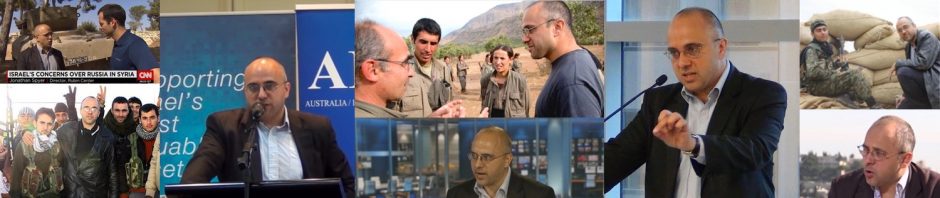
Posted in Interviews | Leave a comment

Fight or Flight

Posted in Articles | Leave a comment