Lebanon – a Return to Civil War?

Jerusalem Post- 02/02/2008

The recent killing of Captain Wissam Eid of the Lebanese Internal Security Force, and the shooting deaths of eight Shi’ite rioters – including four Hizbullah supporters – at the Mar Mikhael intersection in southern Beirut last week offered the latest evidence of the potential of the political stalemate in Lebanon to spill over into renewed civil conflict. Substantive compromise on the issues dividing the country seems impossible. The overriding cause of the crisis is Syria’s determination to prevent political stability in its smaller neighbor on any but its own terms. The key issues lying behind the Lebanese political crisis are inseparable from the larger regional balance of power, and above all, the emergence of a new regional Cold War which places the United States and its allies against Iran and its clients – including Syria and the Lebanese Shi’ite Hizbullah.

The latest manifestation of the crisis concerns the issue of the successor to president Emil Lahoud, who stepped down last November. Since then, a deadlock has emerged over the succession. There is agreement that the successor should be General Michel Suleiman, chief of staff of the Lebanese army. But the precise terms of the succession remain under dispute. In January, 2008, the Arab League in Cairo claimed to have produced a compromise acceptable to both sides. At the conference, Syria declared its acceptance of a formula devised by Arab League Secretary-General Amr Moussa, heralding a breakthrough. According to this proposal, Suleiman would be appointed president, and a new national unity government would be formed, giving equal weight to the ruling March 14 Party and opposition ministers. Neither side would have veto power, and the balance was to be made up of minister appointed by the new president. It is now apparent, however, that the pro-Syrian opposition will not accept this arrangement.

Syria is expressing its opposition through the activation of client organizations within Lebanon. Hizbullah has threatened to escalate street protests in the next few weeks if the opposition’s demand for a blocking capability in a new cabinet is not accepted. Many analysts consider that the spate of recent terror attacks, one of which killed Eid, are part of Hizbullah’s effort to inflame tensions in the interest of its Syrian patron. The January 15 bombing at the US embassy in Beirut – in which four people died, and the violent, tire-burning Shi’ite protests of the last days all fit into this pattern. It is worth noting that during the protests on January 27, an RPG 7 shell was fired by unknown persons in the Mar Mikhael area. Lebanon has been struck by an ongoing series of assassinations of anti-Syrian political figures in Lebanon over the last two years. Eid’s killing was the latest of these, following on from the murder of Deputy Chief of Staff Francois al-Haj in December. Eid was involved in the investigation into the murder of former prime minister Rafik al-Hariri in April, 2005. He was also responsible for monitoring Hizballah activity in the southern suburbs of Beirut. The force of which he was a member, the Internal Security Force, has been seen as staunchly loyal to the Saniora government, and its commander, Ashraf Rifi, is a known critic of the Damascus regime.

The Syrian regime is trying, above all else, to prevent the formation of a proposed international tribunal into the Hariri’s murder. Preliminary UN investigations centered on possible Syrian involvement in the killing. The nightmare scenario for Damascus would be for the tribunal to request the transfer of senior regime figures for trial in the Hague. Syria is determined to prevent this at all costs. This fact, above all others, appears to be driving the current Hizballah escalation of violence. Iran, the other international backer of the Lebanese opposition, is understood to be playing a longer game in the Lebanese context. Iran’s key asset in Lebanon is Hizballah, which it helped found and which it finances and trains.

The Iranians have no direct interest in an immediate political escalation in Lebanon. Rather, they need time for Hizballah to recoup the losses and damage it suffered in Second Lebanon War. Teheran’s key concern is that Hizballah rebuild its strength as an Iranian regional military asset – a process which is now proceeding apace. Iran is also understood to wish to avoid open sectarian conflict between Shi’ites and Sunnis, since such a conflict would undermine its desire to project its power throughout the region, and to claim the mantle of the key anti-Western force in the Middle East. However, it appears to be Syria’s more urgent agenda that is now dictating events, and which may yet take Lebanon to the abyss and beyond it. A new Arab League attempt to resolve the situation is under way, and Moussa is on his way back to Beirut. Given the underlying realities of the situation described above, this attempt will almost certainly be added to the list of failures.

The current signs indicate that this failure may herald increased destabilizing activity by opposition forces – in the main Hizbullah, which remains by far the best-organized and most capable political-military force among the opposition. Thus, more attacks of the type that took place on January 15 may be expected, along with increased street activities similar to those witnessed early last year, and in recent days at Mar Mikhael. The government, meanwhile, shows no sign of backing down, and has proved able to marshal forces of its own. The prospect is one of increased strife, with the specter of civil war perhaps closer than at any time in recent memory.

Posted in Uncategorized | Tagged , , , , | Leave a comment

Why might Syria wish to sow Chaos in Lebanon Now?

Jerusalem Post- 20/05/2007

Thirty eight people lost their lives on Sunday in fierce fighting between the Lebanese military and Sunni jihadist operatives near the Nahr al-Bared Palestinian refugee camp, close to the northern Lebanese city of Tripoli. This outbreak of violence represents the heaviest toll in intra-Lebanese violence since the conclusion of the Lebanese civil war of 1975-90. The events in Nahr al-Bared cast light on a side of the Lebanese crisis which has until now been largely ignored by the international media. This is the emergence in recent months of an organization of armed Sunni Islamist operatives in the largely-Sunni north of the country. So far, much of the coverage has suggested that the group in question, known as Fatah al-Islam, may be linked to the al-Qaida network. Nevertheless, informed opinion suggests caution before drawing the simple conclusion that Fatah al-Islam is merely Osama bin-Laden’s latest local franchise. Fatah al-Islam is a breakaway of a Syrian-backed Palestinian organization called Fatah-intifada, which itself split from the mainstream Palestinian Fatah group in 1983. Fatah-intifada has little presence outside of the Palestinian refugee camps of Lebanon and Syria, and is widely regarded as a tool of the Syrian regime with little popular support.

The group, led by a Palestinian called Shakir al-Abssi, surfaced in the Nahr al-Bared camp last November and is thought to contain around 100 fighters from the camp. The group includes Sunni Islamists of a variety of nationalities, about half of whom are drawn from the Sunni Lebanese community. Apart from Palestinians, there are also said to be Syrian and Saudi citizens among its ranks. While Syrian officials have been keen from the outset to describe al-Abssi and his group as operating “in favor of al-Qaida,” Lebanese authorities suspect that the group may in fact be a client of the Syrian authorities themselves, established to act as an instrument of policy in Lebanon, fomenting disorder.

The Assad regime has a long history of utilizing terrorist and paramilitary groups for such a purpose. Fatah-intifada itself was used by Hafez Assad in a power struggle with Yassir Arafat in the Lebanon refugee camps between 1985-88. The regime is known also to have engaged operatives of the Syrian Social Nationalist Party to carry out assassinations in Lebanon during the civil war period. Suspicions regarding Fatah al-Islam center on the fact that Shakir al-Abssi was sentenced in 2003 to three years in prison in Syria after being convicted of plotting attacks inside the country. This was an unusually lenient sentence.

By comparison, for example, Syrians suspected of involvement in the Muslim Brotherhood are routinely given 12-year terms. Al-Abssi, after his release, turned up among pro-Syrian Fatah-intifada circles in Nahr al-Bared and shortly afterward emerged as the leader of the new group, Fatah al-Islam. These facts have led General Ashraf Rifi, head of the Lebanese Internal Security Forces (FSI), to conclude that “this is a Syrian creation to sow chaos.” Which raises the question, why might the Syrians wish to sow chaos in Lebanon, and why now? A draft resolution for the unilateral establishment of an international tribunal on the murder of former Lebanese Prime Minister Rafik al-Hariri was circulated in the UN Security Council by the US, France and Britain last week.

It is known that the Syrian regime is determined to prevent this tribunal at all costs, since it is believed that senior Syrian officials may be found to have been involved in the Hariri killing. Could it be that the regime in Damascus might see an escalation of tension in Lebanon as currently helpful – as a tacit reminder to the international community of what Damascus is capable of when put in a corner? This is the view of senior officials in Lebanese government, and is in keeping with earlier practices of the Damascus regime.

Posted in Uncategorized | Tagged , , , , , , | Leave a comment

Nasrallah’s Existential Dilemmas

Jerusalem Post- 25/02/2008

In a speech last week broadcast at the Sayed al-Shohada Mosque in south Beirut, Hizbullah General Secretary Hassan Nasrallah promised his supporters that Israel’s ‘disappearance’ was an ‘established fact.’ The Hizbullah leader railed from his unknown hiding place against the ‘robbing and murdering Zionists’, whom he accused of killing prominent Hizbullah official Imad Mughniyeh. Behind the Hizbullah leader’s customary defiant rhetoric, however, his movement currently faces a series of dilemmas. Firstly, the movement’s attempt to bring down the government of Prime Minister Fuad Saniora, launched in late 2006, has gone nowhere. A few Hizbullah supporters (and a lot of tents) remain at the movement’s ‘permanent demonstration’ in downtown Beirut. But the Saniora government has stood firm. The constitutional crisis over the presidency is dragging on.

There is a growing sense that Hizbullah’s only non-Shi’a ally, the Free Patriotic Movement of Michel Aoun (Christian Maronite), is becoming an irrelevancy, because of the failure of Aoun to emerge as a realistic presidential candidate. The result of this is to make Hizbullah’s camp look more and more like a narrow, sectarian Shi’a force. The movement has spent the last decade and a half cultivating an image of itself as a ‘patriotic’ Lebanese and pan-Arab movement, rather than a sectarian, Iran-sponsored militia. This image is now looking increasingly frayed. The recent clashes at Mar Mikhael in southern Beirut, in which Hizbullah and Amal demonstrators clashed with the army, has served to reinforce this sense. The Army remains one of the few national institutions generally trusted by the Lebanese. The events since the killing of Imad Mughniyeh have further entrenched the sense of Hizbullah as a Shi’ite militia, operating on behalf of Iran. Mughniyeh was associated with the movement’s first phase, in the 1980s, when it had openly engaged in attacks on US and French forces, and acts of international terror such as the hijacking of TWA flight 847.

In subsequent years, Hizbullah leaders had denied any connection with Mughniyeh. This fiction had been faithfully re-produced by journalists and analysts close to the movement, and contributed to the carefully-cultivated sense Hizbullah wished to convey of a Lebanese and pan-Arab, rather than narrow Shi’ite force. The open embrace afforded Mughniyeh by the movement following his killing of course put paid to this image. Revelations of Mughniyeh’s activities on behalf of Hizbullah and Iran over the years have subsequently emerged in the Arabic media. Most recently, it has been reported that Mughniyeh was involved in bringing members of the Iraqi Shi’ite Mahdi Army to the Lebanese Beqa’a valley, where they trained in paramilitary methods. Mughniyeh is also reported to have been involved with a Kuwaiti Shi’a opposition group, the ‘Tharallah’ organization. This activity was conducted in cooperation with the Quds force of the Iranian Revolutionary Guard. As Nasrallah swears revenge on Israel from his place of hiding, meanwhile, there is growing evidence of the war-weariness of ordinary Shi’ite Lebanese.

Many inhabitants of southern Lebanon have not yet recovered from the damage inflicted by Israel in the Second Lebanon War. A year and a half after the war, the destruction it wrought is still very apparent in the border towns of the south. A section of Maroun a Ras, for example, remains in rubble and uninhabited. Shi’ite civilians interviewed recently by Agence France Presse sounded far from enthusiastic at Nasrallah’s latest speeches. One border villager asked reporters “Why must we pay the price every four years or so,” adding that “They should leave us to live in peace, wars are no longer acceptable.” Another said “That war took us 100 years back. It’s enough.” So Hizbullah currently faces growing political isolation in Lebanon, an increasing sense of the return of the movement’s original image as a Shi’a agent of Iran, and a populace weary of war and longing for a chance to return to normality. Nasrallah may well conclude that the quickest way to escape isolation, once again re-brand the movement as the defender of Lebanese and Arabs, and re-galvanise its core supporters would be to seek another round of fighting against Israel.

Certainly, all estimates indicate that while the rubble may remain in the border towns, the movement has successfully recuperated the losses in arms and equipment sustained in the 2006 war. The killing of Mughniyeh makes some form of retaliation inevitable. But here the Hizbullah leadership faces the final item in the list of dilemmas. In 2006, the movement encountered an Israeli government and military caught off guard, confused and under-prepared. If pulled once again into confrontation, Israel will be concerned above all to commit all necessary force to reversing the ambiguous, troubling result of July-August 2006. The Hizbullah leader and his backers in Teheran will no doubt be weighing the odds and their options carefully in the weeks and months to come.

Posted in Uncategorized | Tagged , , , , , | Leave a comment

A Question of Power

Jerusalem Post- 10/05/2008

The recent events in Beirut pose a simple, fundamental question: Who rules in Lebanon? The answer proposed by Hizbullah last week is that the government of Fuad Saniora and Saad Hariri is to be permitted to hold the formal reins of administration – on condition that they well understand the inherent limits of their position. Most important, any attempt to interfere with the Iranian-created and Iranian- and Syrian-sponsored military infrastructure in the country will result in a swift, disproportionate and bloody response. Hizbullah and its backers have made clear that if the choice is between civil war and accepting limitations on the autonomy of their military infrastructure, they will choose the former. At the same time, their actions in Beirut last week made clear that as long as this point is accepted by the March 14 government, they will permit a return to the former stalemate.

Recall the sequence of events: Lebanon has been locked in a standoff between the pro-US March 14 Movement and the pro-Iran and pro-Syria opposition ever since the latter launched a campaign to achieve veto power over government decisions, in the months following the war of 2006. The Saniora government refused to bow to the opposition’s demands. The result has been ongoing political tension punctuated by periodic flare-ups, such as that of January 2007, which have brought the country to the brink of civil war. The latest tension emerged from a Hizbullah-sponsored series of labor union protests. But the key event precipitating Hizbullah’s military takeover of West Beirut was the decision by the government to act against Hizbullah’s independent military infrastructure through two bold moves: First, the government sought to dismiss the security chief at Rafik Hariri International Airport, Wafiq Choukair, who is known to be close to Hizbullah.

This move came after prominent March 14 leader and Druse strongman Walid Jumblatt revealed that Hizbullah had installed surveillance cameras at the airport’s Runway 17. The runway overlooks the hangars containing private jets, an air force base, and the VIP visitors building. Jumblatt further argued that Iranian flights to Beirut should be stopped, as they could be carrying equipment for Hizbullah, and called for the Iranian ambassador to be expelled. In a second, related move, the government launched a judicial investigation into the Iranian-built independent telecommunications network maintained by Hizbullah. This network is thought to extend from Beirut across the south of the country, and into the Bekaa. For Hizbullah, these actions by the government clearly trespassed beyond a red line: namely, the tacit acceptance by the Saniora government that the means by which Hizbullah and its backers conduct their activities in Lebanon are off-limits to the organs of the Lebanese state. The response was swift and furious. Hizbullah gunmen poured onto the streets of West Beirut and engaged the untrained pro-government Sunnis who sought to oppose them. Eleven people were killed and 30 were wounded in the subsequent fighting, which ended with the surrender or flight of the pro-government elements.

Hizbullah simultaneously carried out a series of acts designed to humiliate the government and to demonstrate its ineffectiveness. Hizbullah men blocked the roads to and from the airport, cutting Lebanon off from the outside world, forced the pro-government Al-Mustaqbal TV station and other pro-government news outlets off the air, and burned the offices of the Al-Mustaqbal newspaper. The headquarters of Saniora and Saad Hariri was besieged. Following this demonstration of strength, Hizbullah expressed its willingness to hand all captured areas over to the Lebanese army. The message was clear.

The events of the past days are an attempt by the pro-Iranian regional alliance to guard the perimeters of its main asset in Lebanon – namely, the well financed and trained Hizbullah military infrastructure. Iran wishes to maintain this structure, but not to seize formal power in Lebanon. Rather, it is an instrument to be activated against Israel, at the appropriate moment. In the meantime, Teheran and Hizbullah are content to leave the Saniora government to continue the administration of Lebanon’s internal affairs, on condition it understands its limits. The first question now is whether the Saniora government is prepared to accept this situation. (The original dispute over the dismissal of Choukair and the closing of the telecommunications network remains unresolved.) The second question is whether, if it is not, March 14 possesses the will and the tools to mount an effective opposition to the Hizbullah state within a state. Hizbullah’s latest action brings the movement closer to openly pitting Lebanon’s Shi’ites against its Druse, Christian and Sunni communities.

The opposition’s Christian component – the Free Patriotic Movement of Gen. Michel Aoun – appears largely an irrelevance in the developing dynamic. Instead, the allies that matter to Hizbullah now are the Shi’ite Amal movement and the small pro-Syrian and Palestinian militias that have mobilized to support the opposition in the past days. Egypt and Saudi Arabia have expressed support for the Saniora government. The Sunni mufti of Lebanon has harshly condemned Hizbullah’s actions. But it appears that Hizbullah feels strong enough to contemplate such a situation, and to dismiss the possibility of the coalition of communities backing the government mounting an effective response. The coming weeks will show if Hizbullah’s confidence in this regard was misplaced.

Posted in Uncategorized | Tagged , , , , , , | Leave a comment

How UNRWA became a Barrier to Peace

Jerusalem Post- 27/05/2008

The United Nations Relief Works Agency (UNRWA) was created under the jurisdiction of the UN High Commissioner for Refugees (UNHCR), with the unique responsibility of solely aiding the Palestinians. Due to this special status, the UNRWA perpetuates, rather than resolves, the Palestinian refugee issue, and therefore serves as a major obstacle toward resolving the Israeli-Palestinian conflict. Like no other UN body, UNRWA’s definition of refugees includes not only the refugees themselves, but also their descendents. Moreover, refugees keep their status even if they have gained citizenship. UNRWA employs teachers affiliated with Hamas and allows the dissemination of Hamas messages in its schools.

The Hamas coup in Gaza of July 2007 has resulted in a Hamas takeover of UNRWA facilities there. Therefore, UNRWA’s activities require urgent action. The Agency should be dissolved and its services transferred to more appropriate administering organizations. MILLIONS OF refugees worldwide – over 130 million since the end of World War II – have come under the responsibility of the UN High Commissioner for Refugees (UNHCR), which aims to resettle and rehabilitate refugees. On December 8, 1949, the United Nations General Assembly passed Resolution 302, establishing an agency dedicated solely to “direct relief and works programs” for the Palestinian Arab refugees – UNRWA (United Nations Relief Works Agency) – making it a unique body. UNRWA exists in order to perpetuate, rather than to resolve, the Palestinian refugee issue. No Palestinian has ever lost his or her refugee status. There are hundreds of thousands of Palestinian refugees and their descendants who are citizens of Jordan, for example – yet as far as UNRWA is concerned they are still refugees, eligible for aid.

UNRWA, over the past 60 years, has transformed itself into a central vehicle for the perpetuation of the refugee problem, and into a major obstacle for the resolution of the Israeli-Palestinian conflict. WHEN UNRWA first began counting refugees in 1948, it did so in a way without precedent – seeking to maximize the number of those defined as refugees. UNRWA counts every descendant of the original refugees as a refugee themselves – leading to an increase of 400 percent in the number since 1948. This was a politically motivated definition to imply that either Palestinians would remain refugees forever or until the day that they returned in a triumph to a Palestinian Arab state that included the territory where Israel existed. If they built lives elsewhere, even after many generations – decades or centuries – they still remained officially refugees. In contrast to other situations around the world, other refugees only retained that status until they found permanent homes elsewhere, presumably as citizens of other countries. Moreover, refugee status was based solely on the applicant’s word. Even UNRWA admitted its figures were inflated in a 1998 Report of the Commissioner General of the United Nations Relief and Works Agency for Palestine Refugees in the Near East (July 1997-30 June 1998): “UNRWA registration figures are based on information voluntarily supplied by refugees primarily for the purpose of obtaining access to Agency services and hence cannot be considered statistically valid demographic data.”

In October 2004, then UNRWA Commissioner General Peter Hansen publicly admitted for the first time that Hamas members were on the UNWRA payroll, adding, “I don’t see that as a crime. Hamas as a political organization does not mean that every member is a militant and we do not do political vetting and exclude people from one persuasion as against another.” Consequently, taxpayers’ money in countries where Hamas was legally defined as a terrorist organization, like the United States and Canada, was being illegally used to fund Hamas-controlled activities. Hanson’s view that Hamas was a normal political organization whose doctrines did not interfere with the governance and education of Palestinians remains the position of UNRWA. This has been so even when Hamas has committed violence against other Palestinians. After the organization seized Gaza by force in July 2007, UNRWA immediately indicated to Hamas that it was eager to get back to providing its services. Nothing was changed in its procedure or performance after the takeover.

A graphic demonstration of this issue was the death of Awad al-Qiq in May 2008. Qiq had a long career as a science teacher in an UNRWA school and had been promoted to run its Rafah Prep Boys School. He was also the leading bombmaker for Islamic Jihad. He was killed while supervising a factory to make rockets and other weapons for use against Israel, located a short distance from the school. Qiq was thus simultaneously building weapons for attacking Israeli civilians while indoctrinating his students to do the same. Islamic Jihad did not need to pay him a salary for his terrorist activities. The UN and the American taxpayer were already doing so. The increasing numbers of UNRWA teachers who openly identify with radical groups have created a teachers’ bloc that ensures the election of members of Hamas and individuals committed to Islamist ideologies. Using classrooms as a place to spread their radical messages, these teachers have also gravitated to local Palestinian elections. Thus, UNRWA’s education system has become a springboard for the political activities of Hamas. For example, Minister of Interior and Civil Affairs Minister Saeed Siyam of Hamas, was a teacher in UNRWA schools in Gaza from 1980 to 2003. He then became a member of UNRWA’s Arab Employees Union, and has headed the Teachers Sector Committee. Other notable Hamas graduates of the UNRWA education system include Prime Minister Ismail Haniyeh and Abd al-Aziz Rantisi, the former Hamas chief. UNRWA’S BUDGET has been supported by many countries of which the United States and Western countries have been the largest contributors. In 1990, UNRWA’s annual budget was over $292 million, and by 2000 it had increased to $365 million. Despite this seemingly significant rise, however, actual allocations among the various refugee camps has decreased – compounded by a very high birth rate and burgeoning camp populations. Refugees were discouraged from moving out and had the incentive of being on welfare if they remained. Per capita spending among refugees in camps thus declined from $200 in services per year per refugee in the 1970s to about $70 currently. This situation has been most evident in Lebanon, where the government provides little if any additional assistance to the Palestinians.

UNRWA provides jobs to a large number of Palestinians (it has a full time staff of 23,000). While the UN High Commission on Refugees (UNHCR) and the UN Children’s Fund (UNICEF) avoid employing locals who are also recipients of agency services, UNRWA does not make this distinction. UNRWA thus keeps a large population of refugees and their descendants in a permanent state of welfare dependency, financed by the Western taxpayer. In so doing, it acts as a barrier to attempts to make the refugees into productive citizens. Bureaucracies have a tendency to become self-perpetuating. In the case of UNRWA, this tendency is exacerbated by the fact that the organization’s raison d’etre is the preserving of a refugee problem, rather than finding a solution for it.

THE UN erred when it created a UN body devoted exclusively to one refugee population and with a modus operandi contradicting that of all other relief institutions. Four steps are required to bring the international approach to the Palestinian refugee issue in line with standard practice on similar situations. First, UNRWA itself should be dissolved. Second, the services UNRWA currently provides should be transferred to other UN agencies, notably the UNHCR, which have a long experience with such programs. Third, responsibility for normal social services should be turned over to the Palestinian Authority. A large portion of the UNRWA staff should be transferred to that governmental authority. Fourth, donors should use the maximum amount of oversight to ensure transparency and accountability.

Posted in Uncategorized | Tagged , , , , , , | Leave a comment

Review: Jonathan Spyer’s The Transforming Fire: The Best Book on Israel in Thirty Years

Barry Rubin- 05/01/2011

In my opinion, this is probably the best book on Israel to be published in 30 years. But it is even more than that, since it is also the story of the rise of revolutionary Islamism–and the struggle against it–as the most important issue in the Middle East and very possibly the world.

Dr. Spyer’s participation in the 2006 war with Hizballah as a tank driver, intimate experience with Israeli society, role as a researcher, and participation in international diplomacy has given him a viewpoint unmatched by any other analyst.

Trust me on this one–as several friends already have and agreed with my assessment–this is a book you will want to read and be better for having read.

Posted in Books | 1 Comment

Interview: The Transforming Fire

FrontPageMac.com- 29/12/2010

Frontpage Interview’s guest today is Jonathan Spyer, a researcher at the Gobal Research in International Affairs Center in Herzliya, and a columnist at the Jerusalem Post. He is the author of the new book, The Transforming Fire – The Rise of the Israel-Islamist Conflict.

FP: Jonathan Spyer, welcome to Frontpage Interview.

JS: Thanks, Jamie. Good to be here.

FP: Tell us about your book and its main argument.

Spyer: The book is concerned with the emergence over the last decade of a new conflict, or rather a new mutation of an old conflict.

I suggest that the old Arab-Israeli conflict has been in a long process of winding down since the mid-1970s, as the Arab states that once led it gradually leave the field of engagement. However, the combination of popular Islamist movements in Arab countries and the state interest of the Islamic Republic of Iran is producing a new alliance which is committed to the destruction of Jewish sovereignty. So the book describes the emergence of this alliance, the basis of its strategic optimism and its belief system, the response of the Israeli society and state to the challenge posed by this new alliance, and the main engagements between the two sides so far, with a particular focus on the 2006 Second Lebanon War.

The book is a combination of analysis, interview, reportage and personal experience. So I draw examples from my experience in the 2006 war, and in earlier experiences in the West Bank, alongside broader political analysis and the experiences and perspectives of others who I interviewed.

FP: Illuminate for us the belief system of the new alliance bent on annihilating Israel.

Spyer: The alliance committed to Israel’s destruction contains within it many forces, with quite disparate ideological and belief systems. There are Iranian or pro-Iranian Shia Islamists, of course, but there are also fanatically anti-Shia Sunni salafis within the ranks of Hamas. There are also ostensibly secular nationalists, exemplified by the Syrian regime and by the less important remnants of secular Arab nationalism who place themselves under this banner. Yet despite their disparities, they share certain defining common features. All are anti-American and anti-western, believing themselves to represent the ‘authentic’ regional currents, challenging the West and its local hirelings.

All believe that, as such, they represent the rising force in the region, and that the US and its allies are demonstrably in decline. All are anti-Jewish and anti-Israel, and portray Israel as a product of western domination of the region. All are committed to a militarist and politicidal, somewhat social darwinist view of politics as endless struggle (or ‘resistance’), in which the side with the greater will and faith (in their view, themselves) will ultimately win total victory.

So this is not a particularly complex or sophisticated belief system, which contains clear contradictions and fault-lines, but it enjoys the passionate commitment of those engaged on its behalf.

FP: The book includes details of a trip you made to Lebanon. Tell us about the trip.

Spyer: Lebanon is one of my central research interests, and with the Israel-Islamist conflict, as with so many earlier regional conflicts and processes, the country is an ideal setting for observing and considering the phenomenon. I have a lot of friends and contacts in the country with whom I communicate regularly. A couple of years back, the chance emerged for me to visit Lebanon in the company of a journalist colleague. Of course, I was happy to take up this opportunity. In the course of the visit, I met with a large number of analysts, activists and ordinary Lebanese, and also had the chance to travel to south Lebanon and spend a day in the openly Hezbollah-controlled area of the country. It was fascinating, and deeply informative.

FP: Can you describe your day in the openly Hezbollah-controlled area of Lebanon? Share some of your observations and experiences.

Spyer: Well we spent the day travelling through the villages and towns of southern Lebanon, sometimes stopping to take a closer look in a number of places. I was able to get a sense of the strength of the Iranian allegiance in the area – we saw a number of Iranian flags, and of course posters, pictures and improvised statues of Khomeini, Khamanei and other leaders. This very pronounced aspect of southern Lebanon was striking, given Hezbollah’s insistence to the outside world at the time (in 2007) of its status as an independent Lebanese actor.

I was also able to observe close up the destruction that still remained from the 2006 war, with large areas of Ait a Shaab and Maroun a Ras and Bint Jbeil still completely in rubble at that time. We were able to get a sense of the inefficacy of UNIFIL, which was entirely absent from the populated areas. And of course through talking to people, I also got a general though inevitably superficial sense of the sentiments of some of the inhabitants of the area. I also managed to revisit Marj Ayoun and El Khiam, which were of particular interest to me because of certain experiences during the 2006 war.

In general, it was a fascinating experience, confirming for me the absolute importance for serious analysts and researchers of getting out in the field and taking a look around, if you really want to gain an understanding – this remains a central professional axiom for me.

FP: Who is currently winning the Israel-Islamist conflict?

Spyer: Despite some significant setbacks, and with some qualifications, I would say that the Iranian/Islamist side is currently making gains, not only or primarily in its fight with Israel, but across the region. This side has just demonstrated that it gets to decide who can form a government in Iraq, it effectively dominates Lebanon through Hezbollah, and it has succeeded in planting what looks more and more like a permanent split in the Palestinian national movement, giving itself a veto on any diplomatic progress between Israelis and Palestinians. These gains have been made not because of any great skill on the part of the Iranians and their Islamist allies, but rather because of the weakness and confusion of the West.

But the gains are only relative. It is worth noting that where this alliance comes up against strong and determined opposition, it tends to be stopped in its tracks. I would cite Israel and Egypt as two examples of strong states that each in its own way has stood its ground and faced down this alliance. Operation Cast Lead is a good example of what can be achieved in this regard, in a war which in essence saw Israel and Egypt combine to face down a local member of the Iranian-led alliance. Egypt’s efforts to repress domestic manifestations of this alliance, and the ongoing strength and buoyancy of Israeli society and economy are further proof of the limited strength of the Iran-led alliance. It is worth remembering that Iran in the final analysis is a third world country, and its allies are terror groups, capable of and willing to commit acts of great violence, and also willing to die in the pursuit of their goals. This gives them a certain strength, but it is ultimately a brittle strength, unlike the strength which derives from a strong, powerful state and economy.

FP: Shed some light for us on the weakness and confusion of the West. What is causing it?

Spyer: My sense is that large parts of the populations of the western democracies have lost a vivid sense of the worthiness of their own societies and the very great virtues of the western democratic system.

In western Europe especially, one has a sense of societal fatigue, cynicism, lack of direction, even decadence. This absence among large numbers of people of an active faith in the rightness of the free way of life they enjoy I think produces a certain moral and subsequently political flabbiness. This makes it a difficult and slow process to identify obvious and real threats and enemies.

The threat of Islamism, both domestically and internationally for these countries, is perhaps the classic example of this. For those of us, like Israelis, who come from the ‘frontiers’ of the democratic world, from the points where that world intersects with rival and hostile systems, this easy, blurred outlook is a luxury we can’t afford. We aren’t the only ones to feel that way. Other ‘frontier democracies’ like Poland and in a different way India share a similar outlook to Israel in this regard, and this makes for the very easy communication and friendship which we have with these countries. But in the western heartland there has been a fading of this energy, and it needs to be won back. That’s the real fight, in a way. Once this energy and commitment returns, I think support for and solidarity with Israel tend to accompany it as a matter of course. Where this commitment is absent, there you find the unreasoning hostility to Israel and sometimes the desire to see it thrown to the wolves.

FP: How will this conflict end do you think?

Spyer: The conflict will end in one of two ways – either in the destruction of Jewish statehood, or in the defeat and decline of Iran, and the fading of Islamist movements and ideologies into irrelevance. I think it will be the latter. As I said, the Iran/Islamist alliance is ultimately an alliance of backward states and movements whose only currency is the uncompromising practice of political violence. This can get you only so far. As the alliance suffers blows from determined Israeli and Arab resistance to it, as its promises of building successful powerful countries recedes – with its rule producing only brutally repressive regimes such as the Hamas enclave in Gaza, so its luster will gradually fade.

There may be decisive military engagements along the way. This is impossible to predict. But the Iran/Islamist alliance commits the fatal error of a massive underestimation of its enemy. It knows nothing of the reality of Israel, and imagines it to be a lost, artificial country whose citizens have little commitment to it. This is a fundamental misunderstanding, and as the hubris of this alliance is worn away by defeat, setback and lack of achievement, so the masses currently excited by it will turn away in disappointment.

FP: Expand for us on the strengths of Israel and also why the Iran/Islamist alliance so profoundly underestimates it.

Spyer: The Iran/Islamist alliance underestimates Israel for a number of reasons. Firstly, there is a traditional Islamic contempt for the Jews, which sees them as a naturally weak and subaltern people, not fitted for the bearing of sovereignty. This view is deeply rooted, and seen from it, Israel looks like an absurd pretension and a surely temporary anomaly. Secondly, strategic optimism of a sometimes unreasoning variety has been a very characteristic element of Arab ideological movements in modern times. They are always able to convince themselves that they are on the road to victory, even when to the rest of us, they seem to be in tatters. In this regard, as in many others, the current Iranian regime has imbibed a great deal of Arab political culture. Some Iranian friends of mine regard Ahmedinejad and the Revolutionary Guards element as representing a quite alien political pattern, taken from the Arab world and grafted onto Iran. I don’t have sufficient expertise in Iran to know if that’s true. But certainly the extreme self belief, hubris and arrogance of this regime and its various clients is very familiar to any student of modern Arab political culture.

Regarding Israel’s strengths, well, the country’s economic achievements and so on are not news to anybody. I think there is a deeper element at work, though. Israel is a very powerfully rooted country, whose people have a vivid sense of who they are, rooted in Jewish history. This is not a case of people recruited for service by some brittle modern ideology. Rather, Israel is built ultimately on a profoundly powerful, pre-modern, even primordial sense of Jewish identity which modern Zionism has, so to speak, carried into modern political form. This is a very potent element. It is still in the process of coming to fruition in myriad ways, but it has already created a very strong core.

Of course, one could argue that there are still profound contradictions to be worked out in Israel regarding making this core loyalty work properly in a democratic setting, and regarding the correct balance between tradition and modernity. Israel has not yet answered many questions relating to this. But the root identity of the country is firm and strong. This is something which Israel’s many adversaries – and here one must include the ‘moderate’ Palestinians of the West Bank Palestinian Authority as well as the Iran/Islamist alliance – are absolutely determined not to accept. Yet it remains the case.

FP: Jonathan Spyer, thank you for joining Frontpage Interview.

Posted in Interviews | Leave a comment

Interview: It’s Fight or Flight

Jerusalem Post- 29/12/2010

In the final days of the 2006 Second Lebanon War, Jonathan Spyer and his Armored Corps reserve unit were sent to capture ground north of el-Khiam, a village just a few kilometers away from the border. As they headed back and dawn approached, his company commander’s tank broke down and Spyer and his crew were given the job of towing it back to Israel in a race against time to avoid Hizbullah’s antitank teams who would come out at first light to hunt for their prey.

As the sun rose they became a perfect target. A missile crashed into the company commander’s tank and seconds later another slammed into Spyer’s. With one man dead, Spyer and the rest of the crew endured a harrowing one hour wait, hiding in a ditch, before they were rescued by IDF forces.

It was an incident that left him with a palpable sense of anger at the IDF’s lack of preparedness for the clash with Hizbullah and one that he says “encapsulated a lot of what went wrong in the war.”

But for Spyer, a research fellow at Herzliya’s Inter-Disciplinary Center, the war was about a lot more than his own personal experience. It was a watershed moment in the rise of a new conflict, one he calls “the Israel- Islamist conflict.”

In a newly published book, The Transforming Fire: The Rise of the Israel-Islamist Conflict, Spyer, through both first-person account and analysis, examines the rise of that conflict and how, since the collapse of the peace process in 2000, the old conflict with Arab nationalism over real estate and recognition has given way to a fundamentalist struggle. Israel has found itself facing an alliance of countries and organizations, with Iran at the forefront, committed to the strategic goal of ending its existence as a Jewish state.

A frequent contributor to The Jerusalem Post, the UK-born Spyer explains that he was not only trying to trace the parameters of this new conflict, but also to gauge the temperature of the response to this latest challenge.

“My sense,” he says, “is that Israel is a society that in any case is going through deep processes of change. The response to this new conflict is being filtered through those processes of societal change. Israel is becoming less and less European in outlook, more traditional, more religious. At the same time, Israel is a very dynamic and open free-market society. So it’s quite a new Israel that is emerging, that is having to deal with this new conflict. Israel is responding in the way that Israel often responds – it has not been good at strategic planning, it hasn’t been good at thinking long term.

“The book, in my own humble way, is an attempt to suggest to people a way at looking at this thing in a bigger sense. We’re not good at that as a society. The result is that we usually take some pretty nasty blows at the beginning of the process.”

WHILE HE sees the Second Lebanon War as the watershed moment of “a totally unprepared Israel coming up against a new enemy and a new form of warfare,” Spyer also, ironically, identifies a positive outcome.

“The other side of that coin,” he says, “is that Israel, once it has received that initial slap, tends to respond creatively, quickly and dynamically to the new fire that it has to put out. In that respect, some good things have happened in terms of the system’s thinking and response. But we won’t really know if we have managed to respond correctly until the next big test comes along. Since 2006 the other side has, of course, been preparing furiously for the next round. Iran is preparing for the next round and Syria is preparing for the next round, and we won’t really know until the next set takes place whether we have managed to respond sufficiently.”

In addition to the military, political and strategic level, Spyer also finds positives in the way Israeli society has responded. “One of the central claims of the Islamists is that Israeli society is weak,” he says, “that Israeli society lacks the will to deal with a conflict of this kind. That particular claim has not borne itself out at all.

“Actually Israeli society has responded with much greater fortitude, with much greater stoicism to this situation, certainly than the enemy thought we would, and more than many of us thought. If you look at the public’s response to the second intifada, with hundreds of people being murdered in terrorist attacks, society didn’t crumble. Society didn’t respond with extremism and vengeance, or conversely with moral collapse. Neither of those things happened and society continued to get up every morning and live.

“In that sense there is room for guarded optimism. It is a huge challenge, though, and we are going to need all the creativity and all the energy which we have as a society to engage with this.”

While Spyer doesn’t see the war as broad strategic failure, he says it did “highlight some very serious flaws in the system – of complacency, of underestimating the enemy, of failing to respond to the seriousness of the challenge. All those things were highlighted in very unflattering colors. This was a very serious moment for Israel, but if we look at Operation Cast Lead in Gaza two years later – even though Hamas is a less challenging kind of enemy than Hizbullah – then we have seen some improvements in Israel’s performance, in spite of the massive PR problems that emerged from the campaign.

“Militarily, for example, Israel undoubtedly performed in a far superior way than had been the case in 2006. With regard to the broader media-diplomatic- political war that is taking place alongside the military issue, once again the system is just starting to get to grips with the delegitimization aspect, the desire to cut Israel off from its natural hinterland in the Western world. Israel, and the Jewish world as a whole, are only just starting to respond to that.

“There is a very energetic desire at least to begin to engage – to start to work out an effective response. We don’t yet have an effective response. We do have a desire to develop one, which is already something. Lebanon 2006 painted Israel in a very unflattering light and we are beginning to respond to it. There is some evidence that in Gaza we responded on a military level quite well, but on a political and diplomatic front we are still way behind the curve. The enemy is far ahead of us, in terms of its energy, its organization, its networks. We are starting to respond, we are starting to get there, but the report card should say ‘can do better.’”

For Spyer, the initial failure to grasp the severity of the rising tide of Islamism stems from the general sense in the Western world in the 1990s that “our societal model had won and that there were no serious challenges remaining.” Israel, too, reflected that reality. In the midst of a hi-tech fever and looking to reap the fruits of globalization, for a lot of people “the conflict was old, boring, finishing, and it was time to get on with new stuff.”

“Unfortunately,” he says, “that prevailing sense led much of society to ignore quite apparent signs that the conflict had a long way to run yet, that its energies had not burned out and that it was likely to erupt again at a certain stage – as it did at the end of 2000. It has been argued that the Western world received a wake-up call after the tragedy of September 11. One could say that Israel received a similar wakeup call a year earlier. Israel’s 1990s, let’s say, ended in the autumn of 2000; for the whole of the Western world they ended a year later.

So having awakened to that reality, what should Israel be doing?

We have a general engagement on three fronts, military and strategic, political and diplomatic and a third one, where we occasionally get peeks into an ongoing, clandestine war that is taking place throughout the region, a shadow war between Israel and Iran and its friends.

On the issue of the clandestine war, I have no experience. I sincerely hope that the people our taxes pay to do that stuff know what they are doing. There is some evidence that that is the case.

In terms of the political and military aspect, it is very important for Israel to link up with moderate forces wherever it can. It is crucial for Israel not to see this conflict in isolation: It’s not Israel against the region, versus the Arabs.

On the contrary, Israel has natural allies – allies of convenience, not love – throughout the Arab world. The Iranian threat is no less heinous to Saudi Arabia, to the small Gulf states, to Lebanese democrats, to Palestinian democrats for that matter, than to Israel.

If we look at the WikiLeaks cables, we can see just how salient that matter is when the doors are closed and they don’t have to grandstand anymore.

What they currently, actually, want to talk about, constantly, is the Iranian threat. So there is a huge basis for broadening the political outlook, for locating Israel as part of a broader response to this Iranian challenge.

Israel needs to be doing all it can to get the Western world to realize that this is the real picture of what’s happening in the region. It’s not just about the Israeli-Palestinian conflict – this endless Sisyphean desire to get the socalled peace process on track. There is a much broader picture of crucial importance that Israel needs to be working daily to imprint on the minds of its Western allies. Right now, it has not done that.

There isn’t yet a perception in Washington, certainly not in European capitals, that this conflict is being engaged and that its result matters greatly to all of us. So on that political level there is a huge amount to be done.

On the military level, there is a need for Israel to respond to a new kind of warfare, which is not going to be the old style of mobile armored warfare that Israel excelled at in the past. It’s going to be a very different style of asymmetric warfare – based on the use of missiles, based on the use of guerrilla forces – and this represents new challenges for Israel. My main contribution is on the political diplomatic end of the campaign, which has only just begun.

Can victory be achieved in this kind of conflict?

There isn’t going to be any Berlin 1945 kind of moment with grim-faced American generals accepting the surrender of the Revolutionary Guards. I think what it’s more likely to resemble is the classic projection of the Israeli- Arab conflict with Egypt and the Egyptian system and secular Arab nationalism at its center. Ultimately that conflict was not won by a single knockout blow – although it faced a Waterloo moment in 1967. It was eventually won because Arab nationalism, and the states and movements associated with it, slowly ran out of steam. They did not construct a successful societal model and could not construct a workable military model that brought victory to their side.

They had based their whole appeal on that, and as that [failure] gradually, through defeat after defeat and setback after setback, became apparent, the charisma of those movements reached the top of its trajectory and went slowly into decline.

The watershed moment was of course was [Anwar] Sadat’s decision to take Egypt away from the Soviets and go over to the American side. Over time that movement ran out of steam and began to look more and more decrepit and less and less attractive to masses of people in the region because it simply could not, had not, delivered on the promises it had made in the moment of its youth.

I suspect with regard to this Islamist challenge, this time focused on a non-Arab state in Iran, that the victory will look somewhat similar. Over time, this very aggressive, very angry, very optimistic group of people will come to look a little bit less impressive. In the end they will suffer a series of defeats and will fade or fall, or the regime may choose to realign itself and end its challenge to Israel and the West. That’s the kind of picture we are looking at.

Could there then be a Berlin 1989 moment rather than a 1945 moment?

I don’t think that’s likely. The difference between Berlin 1989 and Teheran now, in spite of the demonstrations we saw after the stolen elections, is that in Berlin the ruling authorities, the communists, were decrepit, were old, were tired and were more or less ready to throw in the towel. The crowd in Teheran is not at that moment; they are still very hungry and very much on the way up. They came to power through violence and will do more or less anything to stay in power. The prospect of the Iranian people emerging like a deus ex machina to save us would be wonderful, but I don’t see it happening.

Do you see Iran as willing to directly engage in conflict with Israel?

It will do everything to avoid that. In a certain sense the whole strategy of Iran and its friends is a strategy of how to win a strategic conflict even though you have an obvious and wide conventional military disadvantage.

This is an attempt to use all the things they know they’re good at. They know that at a conventional level they can’t beat Israel, so maybe above that with WMD or maybe below that with asymmetrical warfare, with political warfare. These are the ways which, in spite of that discrepancy, they can perhaps win. So I think they will do everything they can to avoid direct engagement.

Having said that, in Lebanon in 2006, it becomes clear that the Iranians were doing everything other than directly engaging Israeli forces. A very large contingent of Revolutionary Guards, we now know, was present in Lebanon and Syria at the time. They were the ones who, under cover of the Iranian Red Crescent, under the cover of ambulances, were getting weaponry and ammunition through to Hizbullah.

A YEAR after the war, Spyer traveled to Lebanon as a civilian. He was told that, on the day when his own tank was hit, intelligence was picking up communications in Farsi, although that has never been officially confirmed. “It’s not hard to imagine how that would work,” he says. “I mean some very sophisticated antitank systems were in operation on that day and one could imagine that perhaps the IRGC wouldn’t entirely trust the Arabs to work them themselves, so its not a ludicrous scenario by any means. Clearly they’ve been involved and they are involved to the hilt.

“So they are engaged, but as for state-to-state warfare, I think they will do everything they can to avoid that. Still, if Israel were to launch an attack on Iran’s nuclear facilities, then its not unimaginable, for example, to think there could be a ballistic missile response.”

If Iran did manage to go nuclear do you believe the regime would be willing to risk a nuclear strike against Israel?

The central danger from a nuclear Iran is not that it would immediately launch a nuclear strike on Israel, but rather that it would use its nuclear capability as a shield behind which it would continue and increase its subversive activities across the region. This is also the main concern of many Arab states. Iran is already in the process of launching a bid for regional hegemony. A nuclear Iran would be effectively invulnerable and would be able to increase the range and extent of its activities.

You seem to take the view that Turkey and Syria are part of the Islamist camp.

Yes. But I think it’s complicated, and we have to separate out the two. With regard to Turkey, I do think that the AKP, the ruling party, is an Islamic political phenomenon, a phenomenon which is of massive import to Turkey’s strategic stance vis-a-vis the region and vis-a-vis the West. Turkey is undergoing a major change from what is was in the Cold War, a key NATO ally in this region, to being an Islamic power turning toward the East and the Middle East region as a whole.

Many analysts take a different point of view and see a policy that wants to engage both East and West.

They do want to engage with the West. The question is on what terms? It’s not that I would place Turkey as moving toward the Iranian-led camp. That’s not going to happen because Turkey is too big and important to be No. 2 in an Iranian-led alliance. If Turkey is going to be part of any alliance, it’s going to be leading it.

If we are looking at a changed region, in which American power to a certain degree is receding and all sorts of other countries are looking to fill the vacuum, then the implication is probably for Iranian-Turkish rivalry further down the line rather than an Iranian-Turkish alliance.

Isn’t that something we need to be taking advantage of? Shouldn’t Israel be seeking to have good relations with Turkey?

Absolutely. Israel should not in any way be be taking an antagonistic view toward Turkey. We should be trying our best in every way to maintain relations and of course relations do still exist. In spite of the Mavi Marmara, in spite of comments by [Turkish Prime Minister Recep Tayyip] Erdogan, it’s not over yet. We need to do everything we can not to turn Turkey into an enemy; Turkey isn’t an enemy and there is no reason it should be so.

But we also have to be aware that the direction AKP is currently taking Turkey is one of concern, not only to Israel but also to the West. In other words it’s a new Turkey we are going to be dealing with, and we will find a way to deal with it. I don’t think it’s a Turkey that will align itself with the Iranians, it’s not one which will pose the kind of direct threat to Israel which the Republic of Iran currently does, but it is one that we are going to have to be aware of.

I don’t think we should underestimate the emotions Erdogan and the people surrounding have regarding Israel. He has been described as somebody who “hates” Israel. It’s for real, certainly, but there is room for maneuver given the nature of Turkey in a way that there is not with Iran. And we should know how to play one against the other. They are two separate phenomena, but two real challenges.

What about Syria? How do you see Syria as being part of that camp?

Syria is something quite different. Syria is a charter member of the pro-Iranian camp and I think that Syria will continue to be so. I know that there are those in our defense establishment who believe very strongly that Syria, one way or another, can be enticed away from the Iranian-led alliance. I don’t want to reject the possibility, but all attempts to engage Syria over the last half a decade have proven completely unsuccessful, and Syria has benefited hugely, from its point of view, from its relations with Iran.

It’s because of its relations with Iran that Syria is managing to rebuild its strength in Lebanon, to influence events in Iraq, to help influence events among the Palestinians. These are all products of the Syrian-Iranian relationship. Why would you end that when it seems to be bearing fruits?

Isn’t it though more of a question of interest than ideology?

With the Assad regime it is more a question of interest than ideology, but it’s a question of the Assad regime’s interests, not Syria’s interests. The regime wants to survive, and we can see that the regime has always benefited, since it came into existence, from aligning with the big strong regional spoiler and then turning that alliance into a situation where it can punch above its weight diplomatically in the region, and in which it can drop hints that it can be bought off and then cleverly play the one camp against the other. That’s what Syria is engaging in now.

With regard to ideology, it is accepted wisdom to say that this is a nonideological regime and that it’s about survival, but we need to complicate that picture a little.

We don’t know what is going on in [President Bashar] Assad’s mind, of course, but there are those who would tell us that Bashar’s relationship with [Hassan] Nasrallah and Hizbullah is something quite different to any relationship that his father had with his various terrorist or paramilitary clients. Hafez Assad had contempt for these guys and would use them and discard them almost according to will or to need. It’s hard to quantify, but there is a sense that Bashar does buy into this camp, into this “authentic regional force operating against all sorts of puppets and servants of the West.”

There is a sense that he may take some of that seriously and that it isn’t just stone cold cynicism. If that is the case, then it’s a cause for concern, but it also helps us to understand why it is less likely that Syria will realign from its position and why it has proven so resistant to doing that so far – despite the very energetic enticements offered to it by [French President Nicolas] Sarkozy, by the Saudis and by the Obama administration.

How close is Lebanon to becoming a Hizbullah-led Iranian proxy?

The Iranians are winning in Lebanon. Frankly, the March 14 movement, the government and the anti- Iranian forces, the pro-Western forces are largely kept on as a “decoration” to conceal the power relations in which Hizbullah is peerless, is dominant. The talk now is of the indictments to be handed out by the special tribunal [investigating the assassination of former Lebanese prime minister Rafik Hariri] and I want to ask who is actually going to go and arrest these Hizbullah fighters [who may be indicted]. Hizbullah will of course resist by force of arms. What force exists to challenge it? The answer is currently none. The March 14 movement, as we know from May 2008, doesn’t have a force which can resist Hizbullah. The international community isn’t going to dispatch men to drag out these Hizbullah suspects.

So I suspect that what will happen is not that there will be a Hizbullah coup, but rather that the international community will become increasingly aware of the fait accompli – of an already existing situation of Hizbullah dominance, of Hizbullah’s unchallenged power in Lebanon. We are already there. Hizbullah and therefore Iran already have a position of invulnerability in Lebanon at least vis-a-vis any internal Lebanese forces that might at one stage or another want to put up a fight. If Hizbullah is not ruling Lebanon openly today, if Hassan Nasrallah is not declaring himself to be the new Shi’ite president of Lebanon, it is because he doesn’t want to, not because he can’t.

Do you see America and the West as failing in their strategic understanding of the dynamics of the region?

Essentially there is a failure of conceptualization. There is not yet an understanding in Western policy circles, in Europe and also in Washington, that this is the nature of the game being played, this is the central dynamic of the region, this is the central challenge and that we as the West will either engage with it or we will face a region with more and more instability and less and less room for the West and its allies to promote their own interests. It’s fight or flight, either we are going to stop this process or we will have to accept a situation in which we are being pushed back in the region, and the force that is pushing us is not one that can be accommodated in ways of mutual interest; rather, it is one whose interests and ambitions directly threaten the wellbeing and perhaps even the existence of important presences in the region, of which Israel is one.

How do you see the Obama administration on that count?

I’m afraid the Obama administration must be given a fairly low ranking. There has not been this conceptualization. On the contrary, there has been the opposite view; it has adopted the almost silly view that the Israeli-Palestinian conflict is the key strategic issue in the region and everything depends on that. You begin with that and you end with the absurd situation that the addition of a balcony in an apartment suddenly becomes a greater strategic threat to the peace of the region than Iran’s ongoing rush toward domination of Iraq, Lebanon and the Palestinian camp, and toward a nuclear capacity.

That’s an absurd situation, but it starts off with the wrong thinking that the key issue is the Israeli-Palestinian one and the Iranian challenge is a product of that. It’s the other way round. It’s not that the Israeli-Palestinian conflict is the motor driving other processes in the region. Right now it’s another process, the Iranian push across the region, that is driving the Israeli-Palestinian conflict.

Posted in Interviews | 2 Comments

The Perfect Iranian Storm on the Horizon

Pajamas Media-25/08/2010

Jonathan Spyer is not your typical Israeli journalist and political analyst. He has a PhD in International Relations, he fought in Lebanon during the summer war of 2006, then went back to Lebanon as a civilian on a second passport.

I can’t say I felt particularly brave venturing into Hezbollah’s territory along the Lebanese-Israeli border, but it takes guts for Israelis to go there. If Hezbollah caught him and figured out who he was, he would have been in serious trouble.

No one he met in Lebanon knew where he was from. Everyone thought he was British. And no one in Israel but his friends and colleagues knew he went back to Lebanon on his own. He decided, though, that he may as well “out” himself on my blog. His secret journey will soon be revealed anyway when his book comes out in November called The Transforming Fire: The Rise of the Israel-Islamist Conflict.

We met in Jerusalem this month and discussed his two trips to Lebanon—with and without a passport—and the perfect Iranian storm brewing on the horizon.

MJT: So why did you go back to Lebanon?

Jonathan Spyer: Lebanon is a fascinating place, and I wanted to visit for all sorts of reasons. I especially wanted to get back to where we were during the war. There is a green valley, which I imagine you know very well, between the towns of Khiam and Marjayoun.

MJT: Yes, I know where you’re talking about.

Jonathan Spyer: We were down there in that valley during the war, and our tanks got shot up. I wanted to get back there and look at it from Khiam. I hired some guides in Beirut and asked them to take me. We took the coast road down, then drove all the way across southern Lebanon to the eastern sector. And I stood in Khiam and looked down into that valley.

We got stuck there because of a cock-up. The infantry in our division were supposed to capture Khiam. There were 300 Hezbollah men there. We were operating at night. After a series of screw-ups, our column of tanks ended up heading through that valley toward Israel with 300 Hezbollah men looking down on us in the morning. So you can imagine what happened.

And to make it even more ludicrous, we weren’t even moving at the right speed. The steering mechanism on one of our tanks was broken, so we had to drag it with reinforced cables. We were going about five kilometers an hour. We were hardly moving at all. And we got blown to bits by Hezbollah’s missiles. Our armor is pretty good, though, so only one of our guys was killed.

An Associated Press photographer was also in Khiam at the same time, so the AP has a photograph of our tanks in flames. [Laughs.] I’m laughing because I found that photograph on a pro-Hezbollah Web site, and this tough revolutionary guy was on there boasting and saying “the people in those tanks died horrible deaths!”

Jonathan Spyer: I wrote back and said, “Listen. With the exception of one person who was killed, the people in those tanks all got out, hid in the fields for over an hour, and got back across the Israeli border. All of them were operational again within 48 hours.”

Anyway, we were stuck in this field beneath Khiam for about an hour. We hid in an irrigation ditch. They were growing tomatoes and, I think, corn down there. We had the body of our friend with us on a stretcher.

Hezbollah was firing mortars at us. And a ten-man Hezbollah squad came down out of Khiam to take a look. Every tank in the area laid down a carpet of fire, and they turned around and went back. It wasn’t worth it for them to try to go down there, and it saved us from getting into a fire fight.

After an hour or so, we got picked up by an armored vehicle which just happened to be passing by. At first I thought, “Great, they’ve finally sent someone to come get us,” but no. They hadn’t. A group of armored engineers just happened to be in the vicinity. We stood up like guys on a desert island and yelled help help! [Laughs.]

Our friend’s funeral was the next day. We had the night off. I came down to Jerusalem and got drunk. And the next day I was back in the war.

So I was very interested when the chance came along to go back to Lebanon. My professional interest in Lebanon— which has become one of the most important professional aspects of my life —dates from then.

Jonathan Spyer and his IDF comrades near the border during the Second Lebanon War

MJT: Whose idea was it for you to visit?

Jonathan Spyer: A journalist friend of mine up there invited me. He said, “Do you want to come to Lebanon?” And I couldn’t say no. Of course I wanted to go to Lebanon!

We spent most of our time in Beirut, and we also took a trip up to the Cedars. And I said I wanted to go to the south. He didn’t want to go, but he knew some guys who could take me. They showed up at 6:30 in the morning in a beat up car, and off we went.

I partly wanted to go because of my military experience, but mainly because I’m a Middle East researcher who takes a particular interest in Lebanon. I wanted to see what is—as both of us know—a different country. You head down the coastal road, you get past Tyre and Sidon, and you enter a different country.

MJT: It’s true.

Jonathan Spyer: The topography is different, including the human topography. The posters you see are totally different. The atmosphere is totally different.

MJT: It’s like a fanatical Iranian province.

Jonathan Spyer: That’s right. And you have to experience it to understand just how strange and extreme the situation actually is. Between Beirut and Tel Aviv there is this enclave of Iran, this strange dark kingdom. And I found it fascinating.

At the entrance to one of these towns, there’s an old piece of the South Lebanon Army’s armor, a T-55 tank I think. And Hezbollah put up this huge cardboard statue of Ayatollah Khomeini.

MJT: I know exactly where you’re talking about. I have a picture of kids playing on that very tank.

Children play on a former South Lebanon Army tank near the border with Israel

Jonathan Spyer: I also saw Iranian flags down there. That’s how blatant and obvious it all is.

MJT: You don’t see the Lebanese flag in the south.

Jonathan Spyer: Right. Only the Hezbollah flag, the Amal flag, and the Iranian flag. It was a real eye-opener. I knew this already, but it’s something else to see it in person. And it’s also interesting how that part of the country interacts with the rest of Lebanon.

It was my first experience visiting a society that functions like the old Soviet bloc in at least one way. People have an acute sense of this unseen power which is both nowhere and everywhere. People in that part of Lebanon always have to be careful, even if they don’t always exactly know why. They understand why in the larger picture, of course, but even with everyday things they have to be careful.

MJT: You don’t feel that in the rest of the country.

Jonathan Spyer: Right.

MJT: I don’t. Not in Beirut or anywhere else Hezbollah doesn’t control.

Jonathan Spyer: Only in the south. In Beirut, it only surfaced when I spoke to people about going down to the south. I’d be hanging out in these lovely bars and restaurants with lively people enjoying these nice airy evenings, and as soon as I’d mention that I was going down there, they’d suddenly become serious and say, “Don’t do it.”

MJT: I’ve had that experience lots of times.

Jonathan Spyer: And I’d say, “Why not? Tell me why I shouldn’t go down there.” They’d say I should check in with Hezbollah or the Ministry of the Interior.

And I’d say, “Well, what if I don’t? What if I just head out of the city? What’s supposed to happen to me if I just go?”

No one actually knew.

MJT: Right, they don’t. No one will tell you you’re going to get kidnapped or killed or beaten up or anything else. They just think it’s a bad idea to go down there.

Jonathan Spyer: They just say, “You shouldn’t do that.” To me, that’s power. It’s real unseen power. Any force that can put that kind of fear into people is something we need to look at.

It’s not exactly like the Soviet bloc, but it’s similar. In communist countries they had the ostensible government, but the parliaments didn’t have any power. The Communist Party and the security services had all the power. Lebanon reminds me of that in some ways. There’s the ostensible government which takes out the garbage and educates most of the citizens, but there’s another force that wields the hard power.

MJT: It’s totalitarian down there in South Lebanon.

Jonathan Spyer: Absolutely. Absolutely.

MJT: There’s no other word for it. It’s not just authoritarian.

Iran itself isn’t even totalitarian anymore. It used to be, and the government wants it to be, but it has to contend with massive unrest and civil disobedience now.

Jonathan Spyer: The Iranian regime has the same ideology as Hezbollah, but it’s acting against the wishes of the population it’s controlling. It’s like Poland in 1988. But I don’t think that means the Iranian government is going to fall any time soon. I don’t think it’s Poland in 1988 in that sense.

MJT: You think it’s more like Czechoslovakia in 1968?

Jonathan Spyer: I think the difference between Iran today and Poland in 1988 or Iran in 1978 is that in those cases they had a decadent and exhausted ruling class. What they’ve got now is a hungry and fanatically devoted ruling class. Its project is implausible in the long term, but for the foreseeable future they are willing to kill. They’ve killed before, and they got into power by killing. They’re quite prepared to kill lots of people to stay in power. To get through this, the Iranian opposition will need something very strong indeed. And I’m not convinced that the Green Movement is anywhere near that strong yet.

MJT: If the government fell tomorrow, though, would you be surprised?

Jonathan Spyer: Actually, I would be. I’d be pleasantly surprised, but I’d be surprised.

MJT: I won’t be surprised if it falls or if it doesn’t. If the North Korean government fell all of a sudden, that would surprise me. There’s no indication whatsoever that that might happen. If the Iranian government falls, though, no one can say it came out of nowhere or that there was no evidence that it might happen.

Jonathan Spyer: Sure, I know what you mean.

MJT: You’re right, though, that the government and armed forces are willing to fight. The revolution in Romania that overthrew Ceausescu started out like the one last year in Iran, but it was over in a couple of days because the army turned on the government. The whole thing barely lasted 72 hours, and the army itself put Ceausescu on trial and executed him.

Jonathan Spyer: The people most prepared to wade up to their knees in blood end up holding on in revolutionary contexts. When governments fall it’s often because a bunch of other guys are more determined and ruthless. Maybe the revolutionaries have better ideas for how to govern, but in order to get there they have to be prepared to go further than the state. And right now in Iran I don’t see that.

The government’s ideology and modus operandi is much more typical of the Arab world than it is of Iran’s. It’s almost like they’re occupying the country, even though they are Persians. Their style isn’t Iranian at all.

With Hezbollah, it’s different. They’ve managed to hook into the pathologies of much of the Arab world. And I’m sorry to say it’s not just a product of the regimes on top with sophisticated and cynical people below like in Poland and perhaps in Iran. The Arab world, I’m sorry to say, is not really like that. The people believe in this stuff just as much as the big men on top do.

MJT: They do. There’s lots of support in Syria for the government’s campaign of resistance.

Jonathan Spyer: Yes. Neither of us have been to Syria, but you and I both know someone who has.

There really is a visceral hatred of Israel there. There is also a less visceral but nevertheless real hatred of America and the West. And also among the Palestinians here.

MJT: In Lebanon, of course, it’s much more complex.

Jonathan Spyer: Except in the south. In the south, Hezbollah holds power not only by force, but by consent. It doesn’t ask permission from people, but it has their consent.

MJT: It’s limited, though. I’ve talked to Lebanese Shias who support Hezbollah only so far as Hassan Nasrallah doesn’t impose an Iranian-style regime on the country.

Jonathan Spyer: Sure.

MJT: So Hezbollah’s support is limited and conditional. But it’s there.

Jonathan Spyer: And Hezbollah is smart enough to understand that.

MJT: Surely you saw uncovered women in the Hezbollah areas.

Jonathan Spyer: Of course.

MJT: But you don’t see that in Iran.

Jonathan Spyer: Right.

MJT: Hezbollah could force women to cover themselves, but it would lose some support if it did.

Jonathan Spyer: You see more Palestinians here wearing the headscarf than you do amongst the Hezbollah supporters in Lebanon. Go to any street in east Jerusalem, and most of the women will be wearing the headscarf. I was only in Beirut for a few days, but I saw far fewer headscarves there than I do here.

MJT: It’s strange, isn’t it?

Jonathan Spyer: In the early 1980s, before the first Intifada, it just wasn’t like

that in the Palestinian areas. You didn’t see many headscarves then.

MJT: They’re much more Islamicized now, aren’t they?

Jonathan Spyer: There’s a popular return to religion in many Middle Eastern societies. During the last couple of decades, after the failure of so many secular nationalist projects, people have turned back to what’s familiar to them. And in this part of the world, that’s religion.

MJT: The secular regimes have indeed failed spectacularly. There are a few exceptions—like Tunisia, for instance—but there aren’t very many.

Jonathan Spyer: In the Arab world, the failure of these regimes really does deserve to be described as spectacular.

MJT: Tunisia is a lovely Mediterranean country, but next door Libya is almost as hellish as North Korea.

Jonathan Spyer: Tunisia was the first Arab country to call for recognition of Israel. What’s really striking is that the Arab regimes with the biggest and most ambitious visions are the ones that failed most spectacularly.

MJT: The stronger the ideology, the more catastrophic the failure.

Jonathan Spyer: I think it’s hard for Arab intellectuals to come to terms with this. The big projects they most wanted to see are complete failures. I mean, none of them get excited about the Gulf emirates.

MJT: They’re not revolutionary.

Jonathan Spyer: And what they have to face up to now—and you know this very well—is that the three most powerful countries in the Middle East are not Arab.

MJT: Yes.

Jonathan Spyer: Israel, Turkey, and Iran. This is difficult for Arabs to deal with.

MJT: Many have a hard time even admitting it. I pointed this out years ago and got all kinds of grief in my inbox from Arabs who said I had no idea what I was talking about.

Jonathan Spyer: I’m sure.

MJT: They said I’m a stupid American who knows nothing of the Middle East, but they’re in denial. The only Arab country calling shots right now is Syria, and that’s only because Bashar Assad is a sidekick of the Persians.

Jonathan Spyer: A Palestinian friend of mine just the other day was telling me how Turkey and Iran are competing with each other to be the standard bearer of the Palestinian cause. Iran, with its sponsorship of Hamas and Hezbollah, and Turkey, with its flotillas, are the two countries with all the creative ideas. What do the Arab states have next to that? Nothing. Arabism’s flagship cause is championed by two non-Arab states.

How Syria fits into all this is one of the biggest divides here in Israel. There are those in the defense establishment who believe Assad’s championship of the resistance is entirely cynical and instrumental, and they want to pry him away from Iran.

MJT: His foreign policy is just instrumental and cynical, but I don’t believe for a minute he can be pried away from Iran.

Jonathan Spyer: I don’t either. And I’m glad that the people around the prime minister don’t buy it.

MJT: How do you know they don’t buy it?

Jonathan Spyer: Because I know some of them. The people around Netanyahu don’t believe this is possible.

MJT: I’m glad to hear that, because I’ve met lots of Israelis who do. And I think they’re crazy to think that. A lot of Israelis simply do not understand Syria.

Jonathan Spyer: Absolutely. They aren’t naïve people by any means. On the contrary. But they find it very hard to accept the irrational and ideological elements in Middle East politics. They themselves are not irrational or ideological. They’re extremely rational, and they assume everyone else is, as well. And so they make massive errors.

MJT: It’s a common problem all over the world. Lots of people assume everyone else is just like themselves. Americans often assume most people in the Arab world want what we have. I’ve met plenty of Arabs who believe the United States is involved in these dark conspiracies like their own governments are.

Jonathan Spyer: Yes. Arabs often think they’re being mature and sophisticated by talking this way, but in order to have a proper, grown-up, three-dimensional understanding of American foreign policy you need to understand that the idea of America is one of the things that informs American foreign policy. If you don’t understand that, you won’t be able to understand what the U.S. is doing and why.

And some of the planners and thinkers here in Israel still believe that everyone at the end of the day wants the same things they want. That isn’t the case, and you will make grave errors if you assume that it is. I’m not a fan of Netanyahu’s prime ministership down the line, but he does have people around him who understand the role ideas play in this region. It stops us from making the kinds of errors that, for example, Ehud Barak made in 2000.

MJT: I thought Barak’s withdrawal of Israeli troops from Lebanon was the right thing to do, and so was offering Arafat a Palestinian state. I supported both, and I still do even in hindsight, but we have to be honest about the results of those policies. War followed both, and Israelis will have to be extremely careful about withdrawing from the West Bank and the eastern half of Jerusalem.

Jonathan Spyer: Absolutely. Many people still say we all know what the final settlement is going to look like, so we just need to get the two sides together and work it out. To that I say, “No. You don’t know what the final status is going to look like. The final status you have in mind is what you came up with by negotiating with yourself.”

I was an early skeptic of the Oslo peace process.

MJT: Why? I wasn’t, but you were right and I was wrong. What did you see then that I didn’t?

Jonathan Spyer: We all get things wrong in the Middle East, but that time I was right. I’m not saying I was some kind of genius—I was just a kid—but I did manage to call that one for whatever it’s worth.

All you had to do at the time was be interested enough in Arab political culture to listen carefully to what the other side said. That’s all it took. Once you did that, you’d have to be a moron not to see what was coming. Most people weren’t doing that.

Hezbollah erected a billboard on the border facing south into Israel showing a severed head being held by its hair. Text in Hebrew says, Sharon, don’t forget. Your soldiers are still in Lebanon.

MJT: It’s the same in the U.S. today. Too many people don’t want to listen to what’s being said in the Arab world. A lot of it is deeply disturbing. I could be wrong, and I don’t like to psychoanalyze people, but I think that’s the problem. They’re afraid of the implications of all this crazy talk in the Middle East. So they pretend they don’t hear it, they explain it away, or they say it’s not serious.

Jonathan Spyer: I think that’s right.

MJT: I don’t like what I often hear either, and I don’t know what we should do about it, but I’m aware of it, and it’s there whether I like it or not.

Jonathan Spyer: That’s the bottom line. And from there you have to build a rational policy. You may not like it, but what else can you do?

Israelis were exhausted by a half-century of war before the peace process started. Every family in the country was shaped by it. There was an immense longing in the 1990s for peace, normalcy, and the good life. We had an intense will and longing for that. So when the Oslo crowd came to town and said, “You can be born again, you can have peace with the Arabs,” people bought into it.

They were idealists, and they were rationalists. If a note of triumphalism creeps into my voice, it’s only because I remember how arrogant they were during the 1990s when they thought they were right. They were extremely contemptuous toward everyone at the time who was trying to warn them. We were described as anachronisms from a different century.

MJT: That’s what I thought at the time.

Jonathan Spyer: Okay. Fine. It’s okay.

MJT: I was young. I wasn’t writing about the Middle East then.

Jonathan Spyer: Sure. It’s fine. Everyone gets this place wrong.

MJT: No one has ever been right consistently. I don’t think it’s possible.

Jonathan Spyer: It’s not.

MJT: This place is too weird.

Jonathan Spyer: [Laughs.] Yeah. It is.

MJT: It took me years to understand how this place works just on the most basic level because it’s so different from the part of the world I grew up in. I first had to stop assuming Arabs think like Americans. Then I had to learn how they think differently from Americans. I still don’t fully understand them, and I probably never will.

Jonathan Spyer: It’s hard. I used to try to figure it out by extrapolating from the Jewish experience, but it doesn’t work. Their response to events is totally different. It’s useless. You have to throw this sort of thinking into the trash or you can’t understand anything.

MJT: When the U.S. went into Iraq, I thought Iraqis would react the way I would have if I were Iraqi.

Jonathan Spyer: Sure.

MJT: But they didn’t. But I wasn’t only projecting. I knew they weren’t exactly like me. They’re Iraqis. I guess I expected the Arabs of Iraq to react the way the Kurds of Iraq did, and the Kurds reacted the way I would have reacted. But the Arab world isn’t America, and it is not Kurdistan.

A mural in Erbil, Iraqi Kurdistan, painted shortly after the United States overthrew Saddam Hussein

MJT: The Arab world has its own political culture, and it’s not like the political culture I know, or even like other Middle Eastern political cultures.

If the Palestinians had a Western political culture, the problem here could be resolved in ten minutes. If you Israelis were dealing with Canadians instead of Palestinians, you would have had peace a long time ago. And if the Palestinians were dealing with Canadians instead of Israelis, there would still be a conflict.

Jonathan Spyer: That’s exactly right. And that’s why it’s so frustrating sometimes when people say, “If only the two sides could sit down and talk.”

Israel has had its own moments of nationalist madness and score-settling and that sort of thing, but there’s less and less of it over time. Even within my living memory Israel has matured astonishingly. People here are a lot more disenchanted, a lot less likely to get carried away and follow political leaders.

MJT: I’ve gotten that way, too, recently, but it doesn’t come naturally. I am an optimist by nature, but the Middle East has taught me the pessimistic and tragic view of the world. I hate it, but it is what it is. A person can’t be an optimist for very long here without being unhinged from reality.

Jonathan Spyer: Cynicism isn’t a good thing, but neither is silly idealism. We have to walk a tightrope in order to keep this country viable. We have to be sufficiently skeptical and realistic, yet we also have to be open-minded and keyed into the 21st century high-tech society.

Jonathan Spyer: We have to maintain a balance in order to continue this project in the midst of people who hate us. And I think we’re doing quite well. We’re managing it. The North Korean government just has to sit on people. England has America looking after it if things go badly, so in the meantime the English can go on being post-modern. Here it’s tricky. We can’t just be Sparta. We have to be free-thinking people.

People here love life. You can feel this intense vitality in the air. It’s one of the reasons why people love it. I know people who don’t like this place politically, but they like being here. Nobody ever felt that way about East Germany.

MJT: It’s like that in Lebanon, too. It’s a crazy place with incredible problems, but it has this wonderful energy. Beirut does anyway.

Jonathan Spyer: Life crackles in the air there like it does here. I think that’s proof of health. And I don’t feel that in Western Europe.

MJT: I want to know what you think about an Iranian nuclear weapon. It’s everyone’s favorite topic to speculate on, though nobody really knows anything.

Jonathan Spyer: Nobody really knows, but I’m of the school which says if they get a nuke they will use it to become the dominant power in the region.

MJT: I think so, too.

Jonathan Spyer: I’m not of the school that says they’ll use it the next day against Israel.

MJT: I’m not of that school either, but I can’t dismiss it entirely.

Jonathan Spyer: I’m afraid none of us can dismiss it entirely. We would be rash indeed to dismiss it entirely. But if I’m reading the Iranian leadership right, they want to stick around on earth for a while and wield massive amounts of power. They want to build an oppressive system stretching all the way to the Mediterranean.

MJT: The guy who’s in charge of the Iranian branch of Hezbollah said that’s exactly what they want to do. They’re trying to build a new Persian Empire.

Jonathan Spyer: We hear this constant refrain from Iranians that they have a real civilization, that they aren’t like Jordan and Qatar. They’re more like China and India.

MJT: They’re right about that.

Jonathan Spyer: They are. And it’s a dangerous thing when people have a feeling of historical justification and want to bring the world to order again. We’ve had experiences with that. It’s a worrisome combination. I think those ideas wedded to nuclear weapons is unacceptable. And I’m of the opinion that either the West or Israel will come to the conclusion that a nuclear Iran is worse than the military action needed to stop it, and will therefore take action.

MJT: Even with Barack Obama as president? He’s not doing at all well in the United States at the moment, but he’s going to be around for a while.

Jonathan Spyer: I don’t want to speculate about Obama, but if there is a rational national-security set-up in the United States which can influence the president on matters of crucial national interest—and I assume there is something like that—my sense is that system will, at a certain point, kick in and say we can’t afford to have an Iran with nuclear weapons. At a certain point, I think we’ll get to that stage. It’s not the end of the world if we don’t, but we’ll be facing a massively changed Middle East, and a massively dangerous Middle East.

MJT: How do you think that would change the Middle East?

Jonathan Spyer: The Iranians will have a free hand for the kind of subversion they’re already engaged in. We could well see countries falling to Iranian subversion. More likely, at least in the short term, we’ll see countries accommodating themselves to the new big man on the block, and that will of course include the Gulf states.

Jonathan Spyer: There are a certain number of countries in this region—and we could both name them—that will always accommodate themselves to the strong horse. They just have to figure out who the strong horse is. That’s why they get really nervous when they’re not sure who it is, and that’s why they’re terrified now. They don’t know who’s on the way up. Is America really a sunset power in this region, or is that a bunch of propaganda coming out of Tehran? America really does seem to be disengaging.

MJT: But to what extent, and for how long? We could turn that around in an instant tomorrow, and nobody would be able to stop us.

Jonathan Spyer: Yes.

MJT: Obama could say we tried to be nice, and it didn’t work.

Jonathan Spyer: The United States, at the end of the day, has core national interests in this region. And once the Americans understand that they really are threatened, they will have no choice but to be more assertive, regardless of the ideology of a particular president at a particular time.

MJT: The entire world has an interest in stability in this region.

Jonathan Spyer: Yes.

MJT: We’re just the only ones who can do much about it. So we’re stuck with the job whether we like it or not. And most of us don’t.

Jonathan Spyer: If the U.S. leaves a void here, the secondary powers in the region—Israel, Turkey, and Iran—will begin tussling with one another for dominance.

MJT: That could be extraordinarily dangerous.

Jonathan Spyer: All three are young, hungry, countries. Jostling between these three won’t be pretty. So I think the U.S.—acting for the sake its own interests as well as those of the rest of the world—will have to reassert itself. Maybe I’m too optimistic. If that doesn’t happen, I think Israel will step up.

MJT: What is it that U.S. policy-makers don’t currently understand about this part of the world? If you could have their ears for five or ten minutes, what would you tell them?

Jonathan Spyer: I’d tell the current bunch in power that they need to ditch this sophomoric idea that the Israeli-Palestinian conflict is the key to the region’s malaise.

They need to get that out of their heads. That’s not what I’d want to talk about. That’s not even an adult conversation. Once we can clear that up, we can talk about something serious.

A perfect storm is brewing in the Middle East. We’re experiencing the convergence of two historical phenomena. The first is the rise of Iran, which we’ve already talked about. We have an ambitious ideological elite committed to radical Islam and the expansion of power. Second, in country after country in the Middle East, various forms of radical Islam are becoming the most popular and vivid forms of political expression. We have Hamas among the Palestinians, Hezbollah among the Shia of Lebanon, the Islamic Action Front in Jordan, and the Muslim Brothers in Egypt.

We have an ideological wave from below with a powerful and potentially nuclear-armed sponsor on top. That’s the picture I’d want to place in the minds of the people in Washington. It’s the key regional dynamic through which most smaller processes have to be understood.

So if you like the Israeli-Palestinian conflict and want to talk about that, now we can tackle it in a rational grown-up way. The Palestinian national movement has split—most likely permanently—into two camps. And the most powerful of the two is that which results from this convergence of a popular Islamist wave on the one hand and a hegemonic state sponsor on the other. These two phenomena have completely transformed Palestinian politics. They have completely transformed the Israeli-Palestinian conflict. And they have completely transformed our options.

We could also talk about Lebanon. Or just about anything else. And again, we have to look at it through the prism I just described. That’s what I’d say to them if I had five minutes.
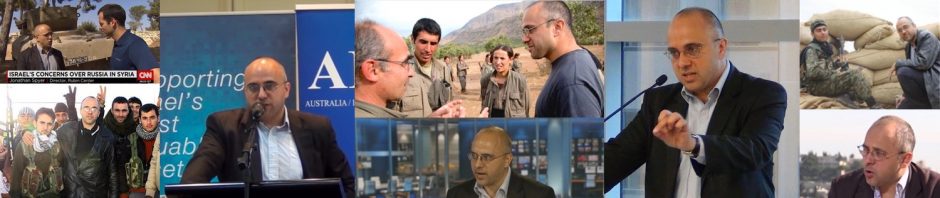
Posted in Interviews | Leave a comment

CiF Watch interview with Jonathan Spyer, author of “The Transforming Fire: The Rise of the Israel-Islamist Conflict”

07/03/2011

CiF Watch interview with Jonathan Spyer, author of “The Transforming Fire: The Rise of the Israel-Islamist Conflict”

AL: I was struck by your passage about how the “mythical Israel” has gained traction beyond Islamist circles. You describe this mythical place as “a place of uninterrupted darkness and horror, in which every human interaction is ugly, crude, racist, brutal.” In our work at CiF Watch, we’ve also noted how such a caricature has taken root among the UK intelligentsia, a dynamic which informs much of the reporting, and commentary, about Israel at the Guardian. Do you have any insights as to how otherwise intelligent and sober minds can so easily accept such a facile and distorted picture of Israeli life – one which is unrecognizable to those who actually live here?

JS: Well, having just returned from a trip to the UK, I think one of the reasons for this is because of the sheer volume of copy and programming hostile to Israel which an average, intelligent consumer of media and TV in the UK would come across and be exposed to – compared to a near absence of anything much proposing an alternative view. In the week I was there, there was ‘The Promise’ – an extremely bizarre but very professionally made saga about the last years of the British Mandate, which managed to depict the 1947-8 period as a sort of attempt by hapless and nice Brits and Arabs to resist the onslaught of crazed Zionist immigrants damaged by the Holocaust. Then there was ‘War child’ about children in Gaza, and also a documentary about settler extremists. I’m not sure if this was an especially busy week! Now, in contrast to this, as a Middle East analyst, in the past I’ve also been struck by the near silence in the British discussion concerning the brutal nature of many regional regimes.

AL: You mention the strength of radical Islam in the UK, and recounted your experiences as a student there in the 90s interacting with adherents to this movement. Why, in your view, has the UK shown to be so much more fertile ground for Islamism, as opposed to, other European countries or the United States?

JS: I don’t know the answer to this, as I’m less familiar with the US situation, but I would counsel against any nation feeling satisfied with its performance in this regard. Off the top of my head, the US produced Anwar al-Awlaki, and Nidal Hassan, so I don’t think this represents a shining success. If one is to adopt a strictly empirical approach, the nation with the most ‘success’ in this regard is France, which has yet to suffer a major Islamist terror attack on its soil committed by home-grown terrorists. As I said, I don’t think anyone should feel smug. But its maybe worth noting that the French system combines an absolute, ruthless lack of tolerance toward foreign Islamist preachers and their activities on french soil (in marked contrast to the UK), with a very sophisticated intelligence community, which has for a long time included lots of people with regional languages and knowledge. I think everyone can see why both these things are good assets to have.

AL: As a new Israeli, I was especially moved by your characterization of Israel’s resiliency, adaptability, and – despite its relative affluence – her capacity, in your view, to understand and respond to the present and future challenges by Islamism (The Muqawama). However, throughout the book, you also understandably expressed concerns about our capacity to resist this threat so, I’d like to know what currents in Israeli political, social, or intellectual life you think could possibly erode this capacity to resist the Islamist threat. For instance, in the late 90s, Yoram Hazony, in his book “The Jewish State“, suggested that post-Zionist thought represented a clear intellectual (existential) threat to the state. Is there a dynamic in the current Israeli political context which particularly worries you?

JS: Yes, I am concerned at the withdrawal from politics of many of Israel’s ‘best and brightest.’ Israel produces excellence in many fields. But it is very noticeable that the young leaders in the most dynamic parts of the private sector tend to shy away from political activity and to some degree from public engagement. I think we need to find a way to change this. Also, I am worried by the state of Israel’s education system, and the performance of Israeli kids today relative to other countries in crucial subjects such as math and English. Israel has been able to thrive because of its edge in the field of knowledge. It’s vital that this edge is not lost. And we can’t afford to have only small islands of world-class excellence in a sea of mediocrity. That isn’t going to cut it, given the nature of the challenges we face.

AL: Before reading your book, I was intrigued by the subtitle: “The Rise of the Israeli-Islamist Conflict”. After finishing it, however, I now see that it’s a much more accurate characterization than the terms typically used, like “Israeli-Arab Conflict” or “Israeli-Palestinian Conflict.” Can you expand a bit on the significance of this subtitle, and why you think its important to frame the conflict in such terms?

JS: The term isn’t mine. Martin Kramer came up with it. And I liked it so much that I decided to annex it (thanks, Martin). But first and foremost, the point is that this term is more accurate, because the main enemy in the axis now facing Israel – Iran – is not an Arab country, so the old terms wont do. Iran has also succeeded in splitting the Palestinian national movement, and arguably one half of that movement (the Ramallah Palestinian leadership) is not aligned against Israel in the current conflict – or at least it is certainly not allied with Iran so there is a clear need for a new term. Also, of course, the new anti-Israel axis is characterized by the fact that it consists almost exclusively of forces bearing allegiance to one or another form of political Islam. So I think the term is an accurate and descriptive one.

AL: Your account of the battle your IDF armored unit was engaged in during the 2nd Lebanon War was quite gripping. I’ve read other accounts by IDF soldiers and officers who described one of the military advantages of the IDF – beyond its weaponry, training, and preparedness – as a culture which encourages improvisation and initiative, and indeed empowers personnel to adapt to new military circumstances and even abandon a plan of battle if the circumstances warrant it. From your experiences, is that a fair characterization of the IDF today?

JS: Flexibility, willingness to improvise, independence of thought – all these characterize the Israeli at his/her best, certainly. At their worst, these can exhibit themselves as failure to engage in proper planning, failure to prepare and over-confidence. So I think that when our army does well, it’s because it manages to turn the Israeli mentality toward the former, rather than the latter. I sincerely hope that recent re-focusing in the military will produce the right results the next time around. I think that from a purely military point of view, certainly from my layman’s eye, the signs emerging from recent campaigns and activities appear mixed.

AL: Regarding the political upheavals in Egypt, and Yusuf al-Qaradawi’s return to the country, how would you assess the chances of the Muslim Brotherhood gaining political power there? And, in the context of Egypt’s previous role (under Mubarak) as part of the anti-Iranian block of Arab states, are you concerned that, even if the MB doesn’t take power, they may break out of this alliance, and move closer to Iran and Syria?

JS: I think there is a very high chance that the Muslim Brotherhood will play a major role in Egyptian politics in the future. This does not mean that the movement will ‘seize power’ or will emerge as the sole ruler of Egypt. Rather, it will probably perform well in elections and emerge as one of the lay power brokers in the country. This could well have the effect of moving the country away from its past role as a lynchpin of the western strategic architecture in the Middle East. It doesn’t mean that Egypt will align with Iran and Syria. For economic reasons the country will have much motivation to remain aligned with the US. But it does mean that a more volatile and uncertain picture could emerge.

AL: Finally, are there any other writing projects you’re planning for the future?

JS: Well I am currently planning some articles on the Syrian opposition, where I have some interesting friends and contacts. I’d also like to write a book on the reasons for the relative success enjoyed by the Iranian (or IRGC) political-military model in certain areas of the Mid-East in the last years – specifically in Lebanon, among the Palestinians and in Iraq. This success has taken place despite Iran’s economic backwardness and the not especially sophisticated nature of their model. So this is something which it is worth looking at. Of course, there are those who are saying that the current unrest in the Arab world will put paid to that success. I’m not convinced. We’ll see.

Posted in Interviews | Leave a comment